


How Advanced Manufacturing Is Shaping the Biopharma Plastic Market
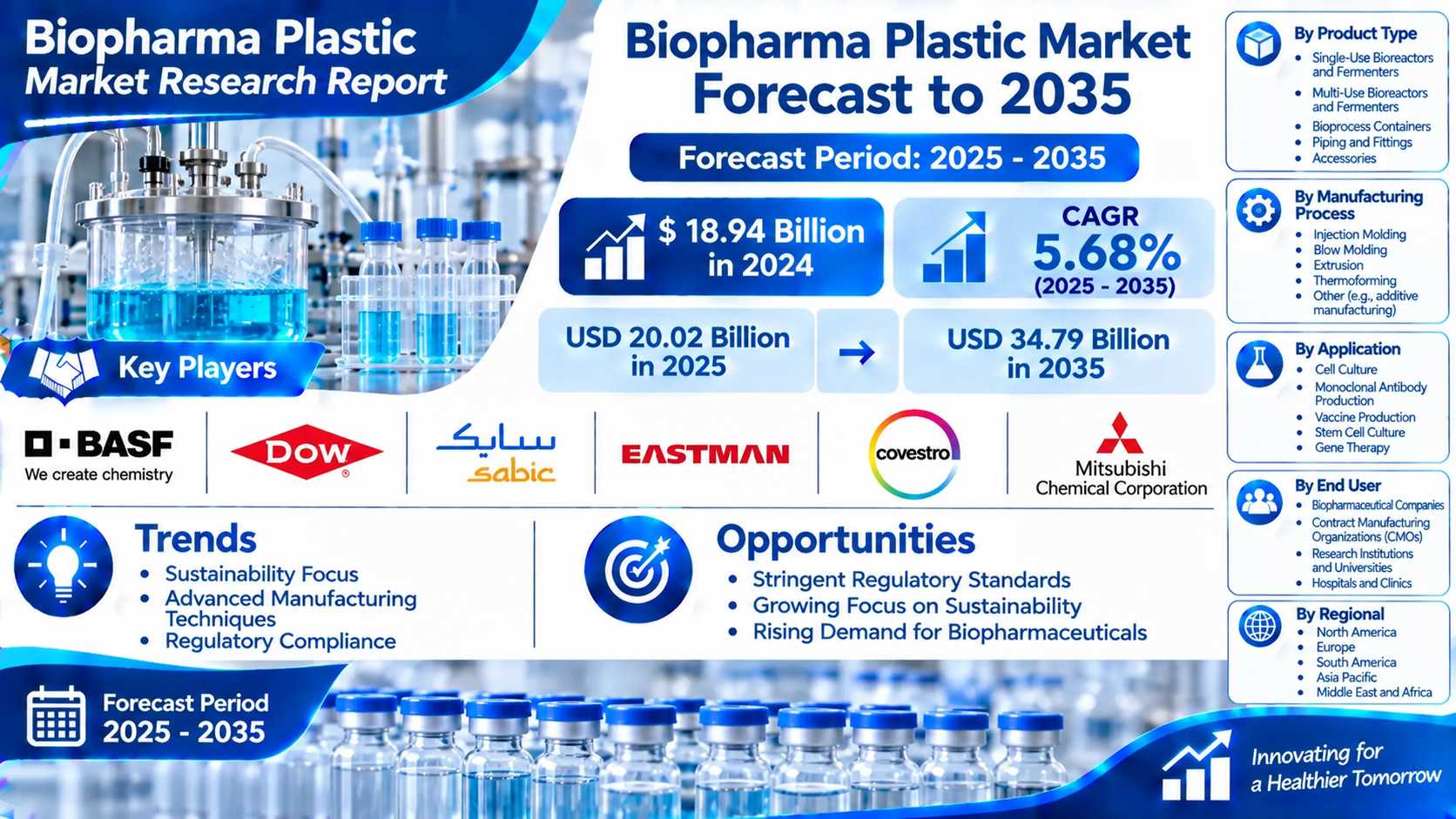
According to Market Research Future® (MRFR), the Biopharma Plastic Market is expected to expand from USD 20.02 billion in 2025 to USD 34.79 billion by 2035, reflecting a CAGR of 5.68% over the 2025–2035 forecast period. The market recorded a value of USD 18.94 billion in 2024. Its scope spans plastic products used in biopharmaceutical manufacturing and research, from bioreactors and bioprocess containers to piping, fittings, and accessories. Demand associated with cell culture, vaccine production, monoclonal antibody production, stem cell culture, and gene therapy contributes to the industry's broad application base.
The Role of Plastics in Biopharmaceutical Production
Biopharmaceutical manufacturing and research depend on a range of equipment and components to support production activities. Plastic products form part of this supply landscape, with the market covering equipment and materials used in different bioprocessing applications. Its product categories include single-use bioreactors and fermenters, multi-use bioreactors and fermenters, bioprocess containers, piping and fittings, and accessories.
This product diversity connects the market with several stages of biopharmaceutical activity. The industry serves commercial manufacturers as well as contract manufacturing organizations, research institutions, universities, hospitals, and clinics. As a result, market demand is influenced by both production requirements and the needs of research and healthcare-related users.
The financial outlook points to continued market expansion. The 2024 valuation of USD 18.94 billion is followed by a projected USD 20.02 billion in 2025. The market is forecast to reach USD 34.79 billion in 2035, supported by a CAGR of 5.68% during the ten-year forecast period.
Product Categories and Equipment Demand
Single-use bioreactors and fermenters and multi-use bioreactors and fermenters are two principal product categories. Their inclusion reflects the different equipment systems represented in the biopharma plastic market. Bioprocess containers form another category, while piping and fittings contribute to the range of components included in the market assessment.
Accessories complete the product segmentation. This broad classification shows that the market is not limited to bioreactor equipment alone. It also includes containers and supporting components used across bioprocessing activities.
For suppliers, the variety of products creates a need to address different customer requirements. Biopharmaceutical companies and contract manufacturing organizations may require products suited to their respective production activities, while research institutions and other end users contribute additional demand. Product portfolios and manufacturing capabilities therefore remain important factors in serving the market.
Manufacturing Processes and Production Capabilities
Five manufacturing categories are identified: injection molding, blow molding, extrusion, thermoforming, and other processes, including additive manufacturing. These methods represent the production technologies covered in the market.
The presence of multiple manufacturing processes reflects the range of products supplied to the biopharmaceutical sector. Injection molding, blow molding, and extrusion are listed alongside thermoforming, while additive manufacturing is included within the other-process category.
Advanced manufacturing techniques are identified as a key trend in the industry. Developments in manufacturing processes can influence how suppliers respond to product specifications and production requirements. This area is also relevant to the market's competitive environment, as manufacturers seek to serve different product categories and applications.
Applications Across Research and Therapeutic Production
The market's applications include cell culture, monoclonal antibody production, vaccine production, stem cell culture, and gene therapy. These areas represent a broad range of biopharmaceutical activities and create demand for products used in different production and research settings.
Cell culture and stem cell culture are included as separate application categories. Monoclonal antibody production and vaccine production represent further areas of activity, while gene therapy adds another application to the market's scope. This range demonstrates the industry's connection with multiple areas of biopharmaceutical development and production.
The diversity of applications also affects the needs of customers. Suppliers must serve different activities and account for the requirements associated with the products and processes involved. The market's growth outlook is therefore linked to the breadth of biopharmaceutical applications covered by its segmentation.
End Users and Industry Demand
Biopharmaceutical companies are one of the principal end-user groups. Contract manufacturing organizations (CMOs) represent another category, highlighting the role of specialized manufacturing providers within the market.
Research institutions and universities form an additional customer group. Their inclusion reflects demand associated with research and academic activities. Hospitals and clinics complete the end-user segmentation, extending the market's scope into healthcare settings.
These four categories provide a broad view of the organizations covered by the market. Their requirements can differ according to their activities, making the ability to serve a varied customer base important for manufacturers and suppliers.
Sustainability and Regulatory Considerations
Sustainability focus is a major trend shaping the biopharma plastic industry. It is also identified as a market opportunity, indicating that environmental considerations have relevance for both current industry activity and future development. Suppliers and manufacturers may need to consider sustainability as part of their product and operational strategies.
Regulatory compliance is another key trend. The market serves biopharmaceutical production and research activities, where regulatory requirements are an important part of the operating environment. Stringent regulatory standards are also identified as an opportunity, reinforcing the importance of compliance-related considerations for companies supplying this sector.
Advanced manufacturing techniques complete the main trend list. Together, sustainability, technology, and compliance create a set of considerations that influence product development, manufacturing, and market participation.
Competitive Landscape and Regional Coverage
The key players identified in the market are BASF SE, Dow Inc., SABIC, Eastman Chemical Company, Covestro AG, and Mitsubishi Chemical Corporation. These companies are part of the competitive landscape serving the biopharma plastic industry. Their market participation is set within an environment where product range, manufacturing capabilities, and the ability to address customer requirements are relevant.
Regionally, the market covers North America, Europe, South America, Asia Pacific, and the Middle East and Africa. These regions represent the geographic scope of the market assessment and provide a framework for examining demand across different biopharmaceutical and research environments.
Outlook Through 2035
The biopharma plastic market is projected to grow to USD 34.79 billion by 2035, compared with USD 20.02 billion in 2025. Its CAGR of 5.68% reflects the expected expansion over the forecast period. Demand across biopharmaceutical companies, contract manufacturing organizations, research institutions, universities, hospitals, and clinics supports the market's broad customer base.
Looking forward, sustainability focus, advanced manufacturing techniques, and regulatory compliance are expected to remain important industry themes. Opportunities associated with stringent regulatory standards and rising demand for biopharmaceuticals may shape supplier strategies. The combination of varied product categories and applications positions the market for continued development through 2035.

 English
 Arabic
 French
 Spanish
 Portuguese
 Deutsch
 Turkish
 Dutch
 Italiano
 Russian
 Romaian
 Greek