


Diving Tourism Gains Momentum with Growing Interest in Marine Adventures and Sustainable Travel
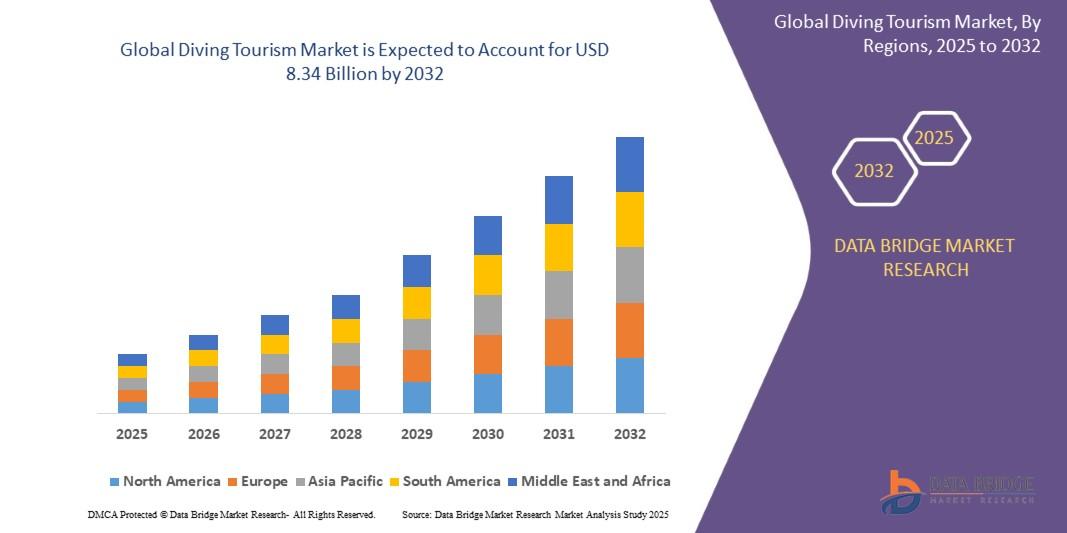
According to the latest report published by Data Bridge Market Research, the Diving Tourism Market
Global diving tourism market size was valued at USD 4.03 billion in 2024 and is projected to reach USD 8.34 billion by 2032, with a CAGR of 9.50% during the forecast period of 2025 to 2032.
The supreme Diving Tourism Market research report has been built by skilful and experienced team players who work hard to achieve an absolute growth and success in the business. This market report puts forth precise and accurate market research information that takes business into the right direction. In today’s economical market place, businesses take a lot of efforts to seek better solutions in terms of product trends, future products, marketing strategy, future events, actions or behaviours. The report contains a number of market drivers and restraints which are obtained from SWOT analysis and all the CAGR projections for the historic year 2018, base year 2019, and forecast period.
Stay informed with our latest keyword market research covering strategies, innovations, and forecasts. Download full report: https://www.databridgemarketresearch.com/reports/global-diving-tourism-market
Diving Tourism Market Segmentation and Market Companies
Segments
- Based on type, the diving tourism market can be segmented into recreational diving and technical diving. Recreational diving, which includes activities such as scuba diving and snorkeling, accounts for a larger share of the market due to its popularity among tourists seeking leisure activities during vacations. On the other hand, technical diving, which involves more complex and advanced diving techniques, caters to a niche segment of experienced divers looking for more challenging underwater experiences.
- Geographically, the diving tourism market is segmented into regions such as North America, Europe, Asia-Pacific, Latin America, and Middle East & Africa. North America and Europe are key markets for diving tourism due to their abundance of coastal areas, well-developed infrastructure, and established diving destinations. Asia-Pacific is also witnessing significant growth in diving tourism, driven by countries like Thailand, Indonesia, and Australia offering diverse marine ecosystems and attractive dive sites.
- By age group, the diving tourism market can be segmented into millennials, Generation X, and baby boomers. Millennials are emerging as a significant consumer group in the diving tourism market, drawn to adventurous and experiential travel activities. Generation X and baby boomers, with more disposable income and a higher likelihood of engaging in luxury travel experiences, also contribute to the growth of the diving tourism market.
Market Players
- Some of the key market players in the global diving tourism market include PADI (Professional Association of Diving Instructors), NAUI (National Association of Underwater Instructors), SDI (Scuba Diving International), TUI Group, Mares, and Aqua Lung. These companies offer a wide range of products and services catering to the needs of both recreational and technical divers, including diver training, equipment sales, dive travel packages, and certification programs. Collaborations with dive resorts, liveaboard operators, and local diving communities are key strategies employed by market players to enhance their presence in the diving tourism industry.
- In addition to established players, there is a growing number of smaller dive operators, eco-tourism companies, and online platforms entering the diving tourism market, offering unique diving experiences, sustainability-focused initiatives, and personalized services to attract divers seeking off-the-beaten-path destinations and responsible travel options.
Diving tourism is a segment of the overall travel industry that has been experiencing steady growth and evolution in recent years. One emerging trend in the diving tourism market is the increasing demand for sustainable and responsible diving experiences. With growing awareness of environmental issues such as coral reef degradation, marine pollution, and climate change, divers are looking for operators and destinations that prioritize eco-friendly practices and conservation efforts. This shift towards eco-tourism is influencing the marketing strategies of diving tourism companies, with a greater emphasis on promoting environmentally conscious diving trips and initiatives.
Another trend shaping the diving tourism market is the rise of technology in enhancing the diving experience. Advances in underwater photography and videography equipment have made it easier for divers to capture and share their underwater adventures, contributing to the popularity of diving as a recreational activity. Moreover, the integration of technology in dive computers, underwater drones, and virtual reality diving simulations is enabling divers to have more immersive and interactive experiences, attracting a tech-savvy audience seeking innovative ways to explore the underwater world.
Furthermore, the diversification of dive destinations and experiences is playing a significant role in expanding the diving tourism market. In addition to traditional diving hotspots like the Caribbean and the Red Sea, emerging destinations in Southeast Asia, the Pacific Islands, and Africa are gaining traction among divers looking for new and unexplored underwater wonders. Liveaboard diving trips, where divers stay on a boat and explore multiple dive sites in remote areas, are also growing in popularity, offering a blend of adventure, convenience, and camaraderie for diving enthusiasts.
The COVID-19 pandemic has had a significant impact on the diving tourism market, leading to disruptions in travel plans, temporary closures of dive centers, and a shift towards domestic diving trips. However, as travel restrictions ease and vaccination rates increase, there is a pent-up demand for international dive travel, especially among experienced divers eager to revisit their favorite dive sites and explore new destinations. Diving tourism operators are adapting to the post-pandemic landscape by implementing health and safety protocols, flexible booking policies, and digital marketing strategies to attract and reassure divers about the safety of their travel experiences.
Overall, the diving tourism market is poised for continued growth and innovation, driven by evolving consumer preferences, technological advancements, sustainability initiatives, and the resilience of the travel industry in adapting to external challenges. As more people seek unique and fulfilling travel experiences that connect them with nature and diverse cultures, diving tourism is well-positioned to meet the demand for adventurous and memorable underwater adventures.The diving tourism market is a dynamic and evolving industry that is influenced by various factors and trends shaping its growth and development. One key aspect of the market is the segmentation based on different criteria such as type, geography, and age group. By dividing the market into recreational diving and technical diving segments, industry players can tailor their products and services to meet the specific needs and preferences of different customer groups. Recreational diving appeals to a broader audience seeking leisure activities, while technical diving targets experienced divers looking for more challenging underwater experiences. Geographically, key regions such as North America, Europe, and Asia-Pacific play a crucial role in driving the growth of diving tourism, offering diverse marine ecosystems and attractive dive sites to cater to the increasing demand for underwater adventures. Moreover, different age groups, including millennials, Generation X, and baby boomers, contribute to the market's expansion with their varied interests in adventurous travel experiences.
Market players in the diving tourism industry, ranging from established organizations like PADI and TUI Group to smaller operators and eco-tourism companies, play a significant role in shaping the market landscape. These companies offer a wide range of products and services, including diver training, equipment sales, and certification programs, to cater to the diverse needs of the diving community. Collaboration with dive resorts, liveaboard operators, and local diving communities is a critical strategy employed by market players to enhance their presence and reach in the competitive diving tourism market. Additionally, the emergence of smaller dive operators and online platforms underscores the growing trend towards personalized diving experiences, sustainability-focused initiatives, and off-the-beaten-path destinations, providing divers with unique and responsible travel options.
In light of emerging trends, the diving tourism market is experiencing a shift towards sustainable and responsible diving practices, driven by increasing environmental awareness among divers. Operators and destinations that prioritize eco-friendly initiatives and conservation efforts are gaining popularity, reflecting a growing demand for environmentally conscious diving experiences. Moreover, technological advancements are enhancing the diving experience by enabling divers to capture and share their underwater adventures more easily, while also providing immersive and interactive experiences through dive computers, underwater drones, and virtual reality simulations. The diversification of dive destinations and experiences, including the rise of liveaboard diving trips in remote areas, is further expanding the market's offerings and attracting a broader audience of diving enthusiasts seeking new and unexplored underwater wonders.
Despite the challenges brought about by the COVID-19 pandemic, the diving tourism market is expected to rebound as travel restrictions ease and vaccination rates increase. With pent-up demand for international dive travel, diving tourism operators are adapting to the post-pandemic landscape by implementing health and safety protocols, flexible booking policies, and digital marketing strategies to ensure the safety and confidence of divers in their travel experiences. Overall, the future outlook for the diving tourism market remains positive, driven by evolving consumer preferences, technological innovations, sustainability initiatives, and the resilience of the travel industry in meeting the demand for unique and fulfilling underwater adventures.
Frequently Asked Questions About This Report
What are the ethical considerations in the Diving Tourism Market?
Which technology has the highest ROI in the Diving Tourism Market?
What is the impact of Synthetic Biology on the Diving Tourism Market?
What is the margin structure across the Diving Tourism Market value chain?
Which region is the most price-sensitive in the Diving Tourism Market industry?
How is Talent Risk (shortage of workers) affecting Diving Tourism Market growth?
What is the impact of Predictive Analytics on Diving Tourism Market inventory?
How are tiered supplier networks managed in the Diving Tourism Market industry?
How is Dynamic Pricing AI being used in the Diving Tourism Market?
Which region is expected to lose market share by 2033?
What is the market share of Europe in the global Diving Tourism Market industry?
What is the impact of antitrust laws on the Diving Tourism Market?
Browse More Reports:
Global Biological Safety Testing Products and Services Market
Global Can Packaging Market
Global Electronic Lab Notebook (ELN) Market
Global Electronic Security Market
Global Frozen Sauces Market
Global Gout Therapeutics Market
Global Hand Geometry Vehicle Access Market
Global Healthcare Transportation Service Market
Global Lead Acid Market
Global Liquid Nitrogen Fertilizer Market
Global Low-Temperature Co-Fired Ceramic (LTCC) and High-Temperature Co-Fired Ceramic (HTCC) Market
Global Probiotic Yogurts Market
Global Rosemary Oil Market
Global Selective Estrogen Receptor Degraders (SERD) Therapeutics Market
Global Soybean Processing Market

 English
 Arabic
 French
 Spanish
 Portuguese
 Turkish
 Dutch
 Italiano
 Russian
 Romaian
 Portuguese (Brazil)
 Greek