


Techawks Cybersecurity is the dedicated cybersecurity community of Techawks, bringing together ethical hackers, security researchers, SOC analysts, students, IT professionals, and technology enthusiasts passionate about protecting the digital world.
Explore ethical hacking, penetration testing, cloud security, AI-powered cybersecurity, digital forensics, threat intelligence, bug bounty programs, security certifications, career guidance, and the latest cyber threats. Learn from experts, share knowledge, participate in discussions, and grow with a global community focused on digital security and innovation.
Explore ethical hacking, penetration testing, cloud security, AI-powered cybersecurity, digital forensics, threat intelligence, bug bounty programs, security certifications, career guidance, and the latest cyber threats. Learn from experts, share knowledge, participate in discussions, and grow with a global community focused on digital security and innovation.
-
PBID: 0230001500000008
-
1 Leute mögen auch
-
59 Beiträge
-
59 Fotos
-
0 Videos
-
Bewertungen
-
Science and Technology
Suche

 English
 Arabic
 French
 Spanish
 Portuguese
 Turkish
 Dutch
Dutch
 Italiano
 Russian
 Romaian
 Portuguese (Brazil)
 Greek
Greek
Neueste Updates
-
The MFA Fallacy: Why Adversary-in-the-Middle (AiTM) Attacks Bypass 2FA Without Guessing a Single Code
Across security operations and everyday engineering, a dangerous sense of false safety remains:
❌ The Myth: "As long as an account has MFA enabled—whether via SMS, an authenticator app, or push approvals—credentials cannot be phished."
✅ The Reality: Standard MFA protects against static credential replay, but it offers zero native defense against Adversary-in-the-Middle (AiTM) proxy phishing and session token theft.
How AiTM Phishing Bypasses MFA in Real Time:
The Reverse Proxy Interception: Instead of serving a static fake page, toolkits (such as Evilginx) sit transparently between the victim and the legitimate authentication server.
Real Authentication Execution: The victim enters their username, password, and real one-time code (OTP). The proxy immediately forwards these inputs to the real service, which validates them and completes authentication.
Session Cookie Exfiltration: Upon successful login, the legitimate platform issues an HTTP session/bearer cookie back to the client. The AiTM proxy intercepts this token, stores it, and sends the user to a benign landing page.
Instant Session Hijacking: The attacker imports the stolen session token directly into their browser. Because the service sees a valid, authenticated session cookie, no password or MFA prompt is ever triggered, giving the attacker immediate access to your inbox, cloud consoles, or internal infrastructure.
Defensive Architecture: How to Protect Sessions
Enforce FIDO2 / Passkeys (WebAuthn): Hardware security keys (e.g., YubiKeys) and platform passkeys use origin-bound cryptographic handshakes. The browser automatically checks the domain name; if the URL points to a proxy rather than the genuine origin, the key simply refuses to sign the authentication challenge.
Cryptographic Token Binding (DPoP): Implement Demonstrating Proof-of-Possession (DPoP) or mTLS token binding for APIs and cloud sessions. This binds the bearer token to a specific client private key, ensuring a stolen cookie is useless on an attacker's machine.
Continuous Conditional Access: Shift evaluation from point-in-time logins to continuous session monitoring. Configure Identity Providers (IdPs) to instantly revoke active sessions when device health, IP subnet, or behavioral risk profiles abruptly drift mid-session.
The takeaway: Authentication isn't a one-time transaction at the door—it's an ongoing state. If your authentication tokens aren't cryptographically bound to the physical hardware, your MFA is only as secure as the cookie in your browser.
Discussion Question
Has your organization made the jump to phishing-resistant WebAuthn/FIDO2 hardware tokens, or are you still relying on time-based one-time passwords (TOTP) and push notifications?
CTA (Join Cybersecurity & Ethical Hacking)
Join the Cybersecurity & Ethical Hacking community to dissect real-world adversary tradecraft, master defensive threat hunting, and elevate your enterprise security architecture.The MFA Fallacy: Why Adversary-in-the-Middle (AiTM) Attacks Bypass 2FA Without Guessing a Single Code Across security operations and everyday engineering, a dangerous sense of false safety remains: ❌ The Myth: "As long as an account has MFA enabled—whether via SMS, an authenticator app, or push approvals—credentials cannot be phished." ✅ The Reality: Standard MFA protects against static credential replay, but it offers zero native defense against Adversary-in-the-Middle (AiTM) proxy phishing and session token theft. How AiTM Phishing Bypasses MFA in Real Time: The Reverse Proxy Interception: Instead of serving a static fake page, toolkits (such as Evilginx) sit transparently between the victim and the legitimate authentication server. Real Authentication Execution: The victim enters their username, password, and real one-time code (OTP). The proxy immediately forwards these inputs to the real service, which validates them and completes authentication. Session Cookie Exfiltration: Upon successful login, the legitimate platform issues an HTTP session/bearer cookie back to the client. The AiTM proxy intercepts this token, stores it, and sends the user to a benign landing page. Instant Session Hijacking: The attacker imports the stolen session token directly into their browser. Because the service sees a valid, authenticated session cookie, no password or MFA prompt is ever triggered, giving the attacker immediate access to your inbox, cloud consoles, or internal infrastructure. Defensive Architecture: How to Protect Sessions Enforce FIDO2 / Passkeys (WebAuthn): Hardware security keys (e.g., YubiKeys) and platform passkeys use origin-bound cryptographic handshakes. The browser automatically checks the domain name; if the URL points to a proxy rather than the genuine origin, the key simply refuses to sign the authentication challenge. Cryptographic Token Binding (DPoP): Implement Demonstrating Proof-of-Possession (DPoP) or mTLS token binding for APIs and cloud sessions. This binds the bearer token to a specific client private key, ensuring a stolen cookie is useless on an attacker's machine. Continuous Conditional Access: Shift evaluation from point-in-time logins to continuous session monitoring. Configure Identity Providers (IdPs) to instantly revoke active sessions when device health, IP subnet, or behavioral risk profiles abruptly drift mid-session. The takeaway: Authentication isn't a one-time transaction at the door—it's an ongoing state. If your authentication tokens aren't cryptographically bound to the physical hardware, your MFA is only as secure as the cookie in your browser. Discussion Question Has your organization made the jump to phishing-resistant WebAuthn/FIDO2 hardware tokens, or are you still relying on time-based one-time passwords (TOTP) and push notifications? CTA (Join Cybersecurity & Ethical Hacking) Join the Cybersecurity & Ethical Hacking community to dissect real-world adversary tradecraft, master defensive threat hunting, and elevate your enterprise security architecture.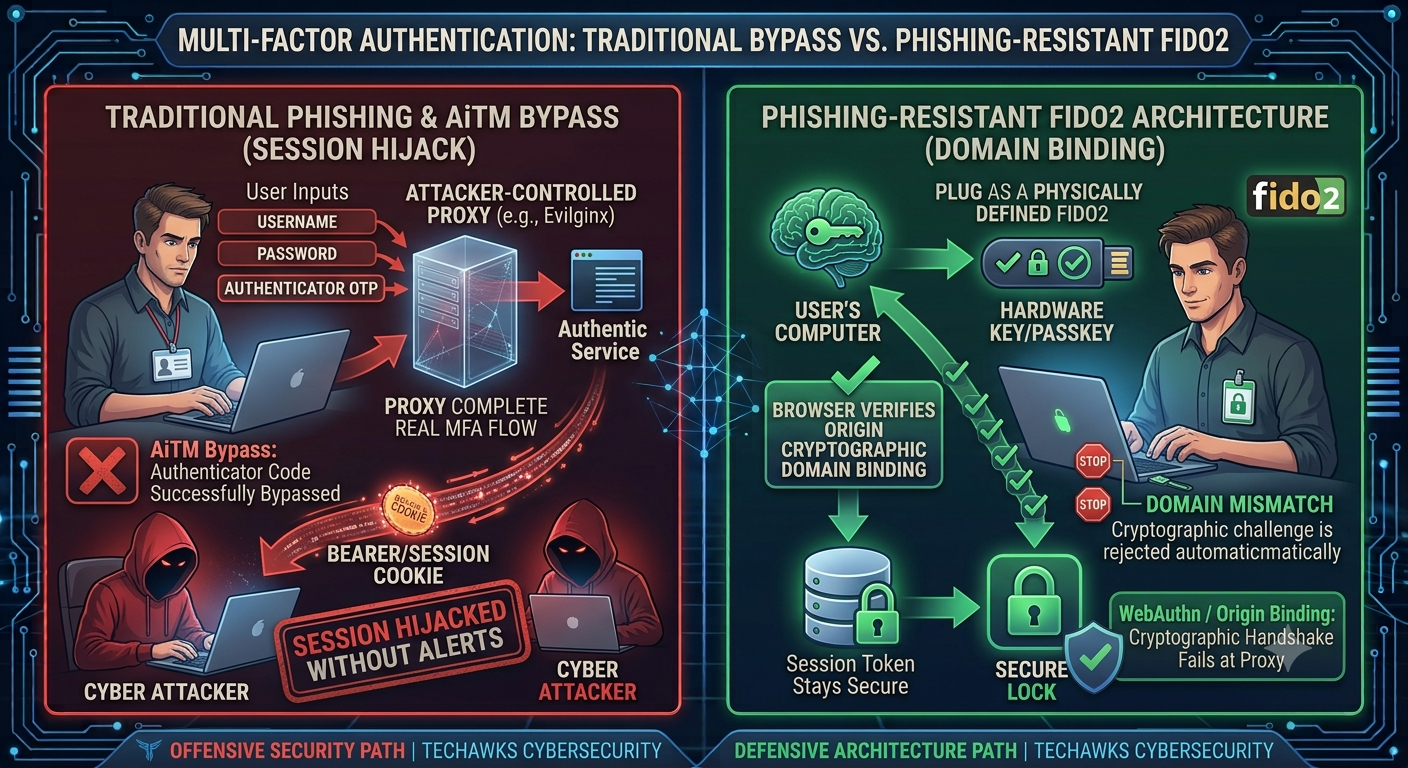 0 Kommentare 0 Geteilt 133 Ansichten 0 Bewertungen
 -
MFA Isn’t Broken, But Your Session Tokens Are: The Rise of Adversary-in-the-Middle Attacks
Most entry-level security learners spend months mastering brute-force mechanics, password cracking, and phishing filters. Meanwhile, real-world breaches have largely abandoned password guessing: attackers don't break credentials anymore—they hijack authenticated sessions.
In an Adversary-in-the-Middle (AiTM) campaign, the threat actor deploys reverse-proxy infrastructure (such as Evilginx or Modlishka) between the target and the legitimate identity provider (IdP).
Here is why standard multi-factor authentication fails against this vector:
The victim enters their username and password on the reverse proxy, which passes them straight to the real login page.
The real IdP prompts for an MFA code or push notification.
The victim completes the MFA prompt.
The IdP issues a valid session cookie / OAuth refresh token.
The proxy intercepts and captures that session token before forwarding it to the user.
Once the attacker holds that token, the authentication process is over. They inject the session cookie into their own browser and inherit the user's active session without needing the password, the phone, or the hardware token ever again.
The Defensive Shift: Fast-Track to FIDO2 / Passkeys and Token Binding
To build resilient defensive architecture against AiTM, security teams must move beyond push- and SMS-based multi-factor protocols:
Enforce FIDO2 / WebAuthn (Passkeys): Traditional TOTP codes and push prompts don't validate the origin URL. FIDO2 protocols bind authentication cryptographically to the exact domain name in the browser address bar. If a user is on a phishing proxy domain, the cryptographic handshake fails automatically.
Continuous Access Evaluation (CAE): Traditional tokens remain valid for hours regardless of network shifts. Implement IdP policies that continuously evaluate context—instantly revoking token validity if IP geolocation, device compliance, or user risk scores abruptly deviate mid-session.
Device-Bound Session Credentials (DBSC): Adopt emerging token-binding standards that tie session keys to the client machine's TPM (Trusted Platform Module), ensuring intercepted cookies cannot be replayed on an attacker’s machine.
Authentication isn't a one-time gate at the front door; it must be an ongoing, cryptographically verified session.
Discussion Question
Has your team transitioned to phishing-resistant FIDO2/WebAuthn credentials yet, or are you still relying on push-based notifications and TOTP codes across your perimeter?
CTA
Master red team offensive tactics, fortify cloud defenses, and become a threat-hunting authority. Join Cybersecurity & Ethical Hacking at Techawks Cybersecurity.MFA Isn’t Broken, But Your Session Tokens Are: The Rise of Adversary-in-the-Middle Attacks Most entry-level security learners spend months mastering brute-force mechanics, password cracking, and phishing filters. Meanwhile, real-world breaches have largely abandoned password guessing: attackers don't break credentials anymore—they hijack authenticated sessions. In an Adversary-in-the-Middle (AiTM) campaign, the threat actor deploys reverse-proxy infrastructure (such as Evilginx or Modlishka) between the target and the legitimate identity provider (IdP). Here is why standard multi-factor authentication fails against this vector: The victim enters their username and password on the reverse proxy, which passes them straight to the real login page. The real IdP prompts for an MFA code or push notification. The victim completes the MFA prompt. The IdP issues a valid session cookie / OAuth refresh token. The proxy intercepts and captures that session token before forwarding it to the user. Once the attacker holds that token, the authentication process is over. They inject the session cookie into their own browser and inherit the user's active session without needing the password, the phone, or the hardware token ever again. The Defensive Shift: Fast-Track to FIDO2 / Passkeys and Token Binding To build resilient defensive architecture against AiTM, security teams must move beyond push- and SMS-based multi-factor protocols: Enforce FIDO2 / WebAuthn (Passkeys): Traditional TOTP codes and push prompts don't validate the origin URL. FIDO2 protocols bind authentication cryptographically to the exact domain name in the browser address bar. If a user is on a phishing proxy domain, the cryptographic handshake fails automatically. Continuous Access Evaluation (CAE): Traditional tokens remain valid for hours regardless of network shifts. Implement IdP policies that continuously evaluate context—instantly revoking token validity if IP geolocation, device compliance, or user risk scores abruptly deviate mid-session. Device-Bound Session Credentials (DBSC): Adopt emerging token-binding standards that tie session keys to the client machine's TPM (Trusted Platform Module), ensuring intercepted cookies cannot be replayed on an attacker’s machine. Authentication isn't a one-time gate at the front door; it must be an ongoing, cryptographically verified session. Discussion Question Has your team transitioned to phishing-resistant FIDO2/WebAuthn credentials yet, or are you still relying on push-based notifications and TOTP codes across your perimeter? CTA Master red team offensive tactics, fortify cloud defenses, and become a threat-hunting authority. Join Cybersecurity & Ethical Hacking at Techawks Cybersecurity.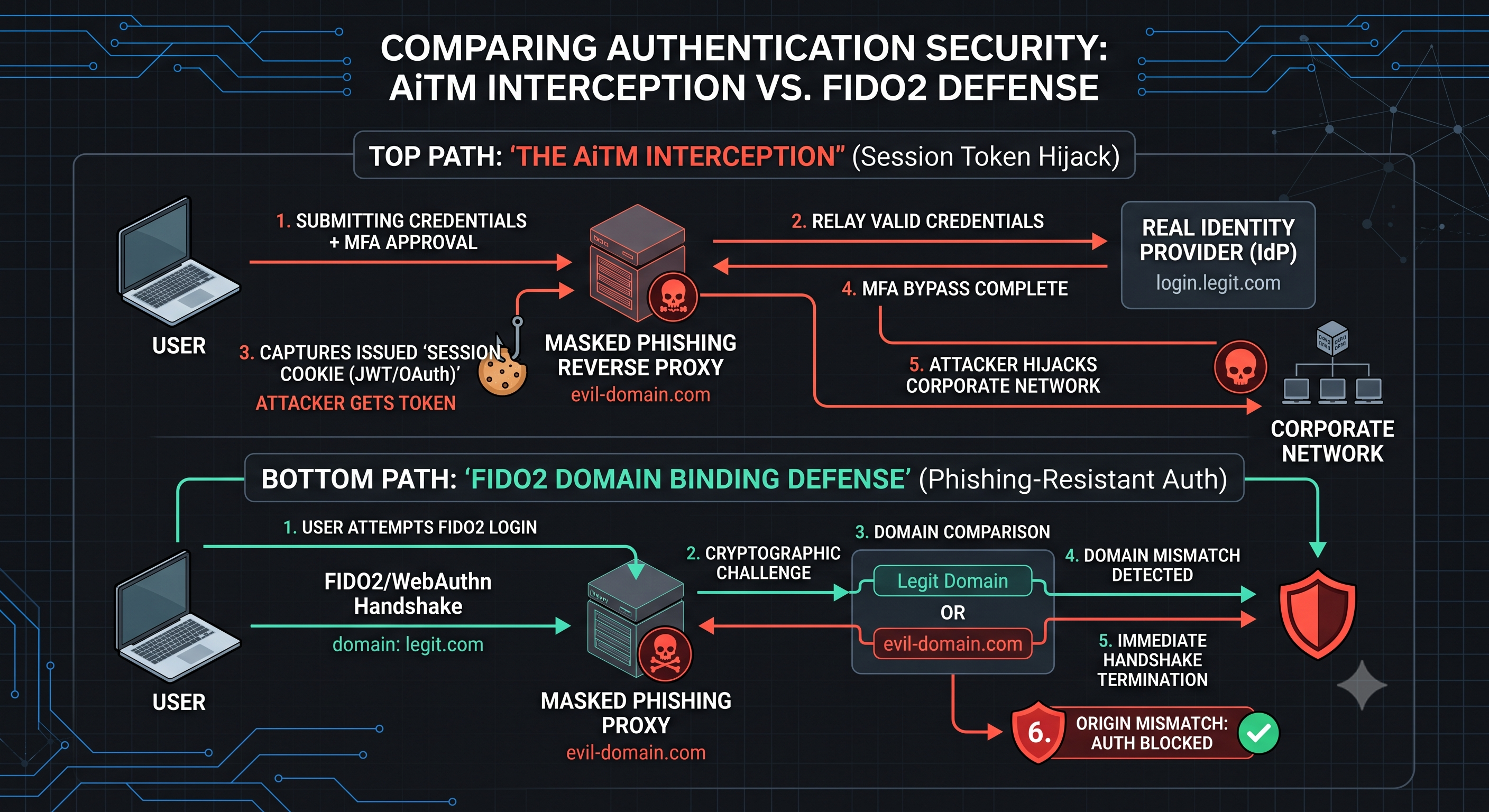 0 Kommentare 0 Geteilt 128 Ansichten 0 Bewertungen
 -
MFA Won't Save You: The Dangerous Blind Spot of OAuth Device Code Phishing
Cybersecurity learners spend months mastering credential stuffing, brute force, and traditional AiTM (Adversary-in-the-Middle) proxy setups. Meanwhile, modern threat actors have industrialized an identity vector that bypasses multi-factor authentication entirely without requiring a fake login page: OAuth Device Authorization Grant abuse (Device Code Phishing).
Originally designed for input-constrained devices (like smart TVs or CLI developer tools), the device authorization flow works by generating a short alphanumeric code on a secondary device, prompting the user to visit an authentic identity provider URL (e.g., [microsoft.com/devicelogin](https://microsoft.com/devicelogin)), and entering the code to grant authorization.
Here is why this vector shatters classical perimeter thinking:
The Victim Uses Real Infrastructure: The target signs into the authentic identity provider domain over a valid SSL certificate. There are no suspicious typo-squatted URLs or reverse-proxy certificates to trigger browser warnings.
Passkeys and MFA Are Rendered Irrelevant: Because the victim authenticates legitimately on their own trusted device, they successfully complete whatever MFA challenge is presented (FIDO2 keys, biometric passkeys, or authenticator apps). The session and refresh tokens, however, are immediately issued to the attacker’s client ID.
Privilege Inheritance: Once the attacker receives the primary refresh token (PRT) or OAuth access token, they can replay it through command-line utilities to harvest data, register backdoor credentials, or pivot across connected enterprise SaaS platforms.
How to Defend and Hunt for It:
Enforce Strict Conditional Access on Device Code Flows: Block the device code authentication flow globally across your identity tenant unless a specific user group or machine explicitly requires it for headless CLI environments.
Bind Tokens via Continuous Access Evaluation (CAE): Implement continuous session verification and client certificate binding (DPoP - Demonstrating Proof-of-Possession) so tokens stolen from an authentication exchange cannot be replayed from an unauthorized IP, ASN, or unrecognized device posture.
Audit Identity Provider Logs: Flag unexpected interactive device code authorizations originating from unmanaged IP ranges or non-standard user agents.
Authentication is only the front door. If your security model assumes a valid token always belongs to the user who requested it, your perimeter is already compromised.
Discussion Question
Has your security lab or enterprise SOC disabled the OAuth Device Authorization Grant, or is it still an open, unmonitored default in your identity tenant?
CTA (Join Cybersecurity & Ethical Hacking)
Ready to look beyond textbook attack vectors and master defensive architecture against real-world identity exploits?
👉 Join the Techawks Cybersecurity & Ethical Hacking Community to analyze emerging threat vectors, dissect offensive labs, and sharpen your defensive edge:MFA Won't Save You: The Dangerous Blind Spot of OAuth Device Code Phishing Cybersecurity learners spend months mastering credential stuffing, brute force, and traditional AiTM (Adversary-in-the-Middle) proxy setups. Meanwhile, modern threat actors have industrialized an identity vector that bypasses multi-factor authentication entirely without requiring a fake login page: OAuth Device Authorization Grant abuse (Device Code Phishing). Originally designed for input-constrained devices (like smart TVs or CLI developer tools), the device authorization flow works by generating a short alphanumeric code on a secondary device, prompting the user to visit an authentic identity provider URL (e.g., [microsoft.com/devicelogin](https://microsoft.com/devicelogin)), and entering the code to grant authorization. Here is why this vector shatters classical perimeter thinking: The Victim Uses Real Infrastructure: The target signs into the authentic identity provider domain over a valid SSL certificate. There are no suspicious typo-squatted URLs or reverse-proxy certificates to trigger browser warnings. Passkeys and MFA Are Rendered Irrelevant: Because the victim authenticates legitimately on their own trusted device, they successfully complete whatever MFA challenge is presented (FIDO2 keys, biometric passkeys, or authenticator apps). The session and refresh tokens, however, are immediately issued to the attacker’s client ID. Privilege Inheritance: Once the attacker receives the primary refresh token (PRT) or OAuth access token, they can replay it through command-line utilities to harvest data, register backdoor credentials, or pivot across connected enterprise SaaS platforms. How to Defend and Hunt for It: Enforce Strict Conditional Access on Device Code Flows: Block the device code authentication flow globally across your identity tenant unless a specific user group or machine explicitly requires it for headless CLI environments. Bind Tokens via Continuous Access Evaluation (CAE): Implement continuous session verification and client certificate binding (DPoP - Demonstrating Proof-of-Possession) so tokens stolen from an authentication exchange cannot be replayed from an unauthorized IP, ASN, or unrecognized device posture. Audit Identity Provider Logs: Flag unexpected interactive device code authorizations originating from unmanaged IP ranges or non-standard user agents. Authentication is only the front door. If your security model assumes a valid token always belongs to the user who requested it, your perimeter is already compromised. Discussion Question Has your security lab or enterprise SOC disabled the OAuth Device Authorization Grant, or is it still an open, unmonitored default in your identity tenant? CTA (Join Cybersecurity & Ethical Hacking) Ready to look beyond textbook attack vectors and master defensive architecture against real-world identity exploits? 👉 Join the Techawks Cybersecurity & Ethical Hacking Community to analyze emerging threat vectors, dissect offensive labs, and sharpen your defensive edge: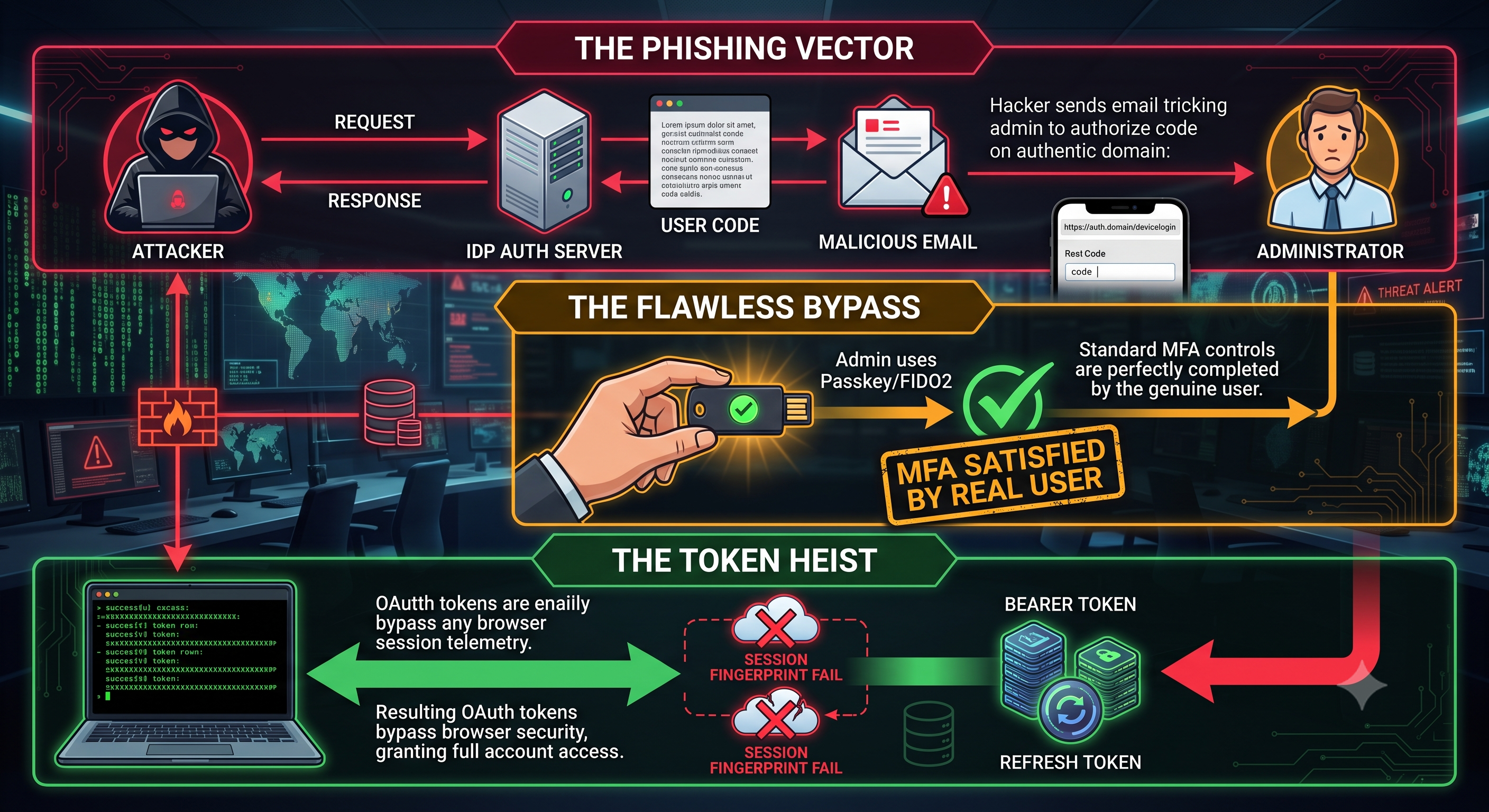 0 Kommentare 0 Geteilt 178 Ansichten 0 Bewertungen
 -
Beyond the Perimeter: The 4-Step Zero-Trust Identity Hardening Checklist for Modern Security Teams
As cyber threats evolve into multi-extortion ecosystems and identity-based attacks dominate initial access vectors, traditional perimeter defense is no longer sufficient. Organizations must shift from "trust but verify" to continuous, identity-first verification across every layer of their architecture.
To secure your environment against credential stuffing, session hijacking, and unauthorized machine access, use this actionable zero-trust hardening checklist:
Enforce Adaptive Multi-Factor Authentication (MFA): Move beyond basic text-message codes. Implement context-aware, risk-based adaptive MFA and phishing-resistant passkeys that evaluate device posture and location before granting access.
Audit and Scope Non-Human Identities: AI agents, service accounts, and API tokens now outnumber human users in many enterprises. Enforce strict least-privilege access and continuous monitoring for all machine identities.
Implement Continuous Risk Scoring & Session Verification: Do not trust a session just because authentication succeeded once. Continuously monitor user behavior anomalies and trigger step-up verification if risk parameters shift mid-session.
Isolate with Micro-Segmentation: Limit lateral movement by breaking flat corporate networks down into micro-segments, ensuring that a single compromised credential cannot grant an attacker free reign across your entire infrastructure.
Discussion Question: What is your biggest challenge when implementing Zero-Trust architecture—managing legacy applications that don't support modern identity protocols, or controlling the explosion of non-human and AI agent identities? Drop your thoughts below!
CTA (Join Cybersecurity & Ethical Hacking): Ready to master modern defense and ethical hacking strategies? Join Cybersecurity & Ethical Hacking to access real-world lab walkthroughs, threat intelligence breakdowns, and specialized security career resources.Beyond the Perimeter: The 4-Step Zero-Trust Identity Hardening Checklist for Modern Security Teams As cyber threats evolve into multi-extortion ecosystems and identity-based attacks dominate initial access vectors, traditional perimeter defense is no longer sufficient. Organizations must shift from "trust but verify" to continuous, identity-first verification across every layer of their architecture. To secure your environment against credential stuffing, session hijacking, and unauthorized machine access, use this actionable zero-trust hardening checklist: Enforce Adaptive Multi-Factor Authentication (MFA): Move beyond basic text-message codes. Implement context-aware, risk-based adaptive MFA and phishing-resistant passkeys that evaluate device posture and location before granting access. Audit and Scope Non-Human Identities: AI agents, service accounts, and API tokens now outnumber human users in many enterprises. Enforce strict least-privilege access and continuous monitoring for all machine identities. Implement Continuous Risk Scoring & Session Verification: Do not trust a session just because authentication succeeded once. Continuously monitor user behavior anomalies and trigger step-up verification if risk parameters shift mid-session. Isolate with Micro-Segmentation: Limit lateral movement by breaking flat corporate networks down into micro-segments, ensuring that a single compromised credential cannot grant an attacker free reign across your entire infrastructure. Discussion Question: What is your biggest challenge when implementing Zero-Trust architecture—managing legacy applications that don't support modern identity protocols, or controlling the explosion of non-human and AI agent identities? Drop your thoughts below! CTA (Join Cybersecurity & Ethical Hacking): Ready to master modern defense and ethical hacking strategies? Join Cybersecurity & Ethical Hacking to access real-world lab walkthroughs, threat intelligence breakdowns, and specialized security career resources.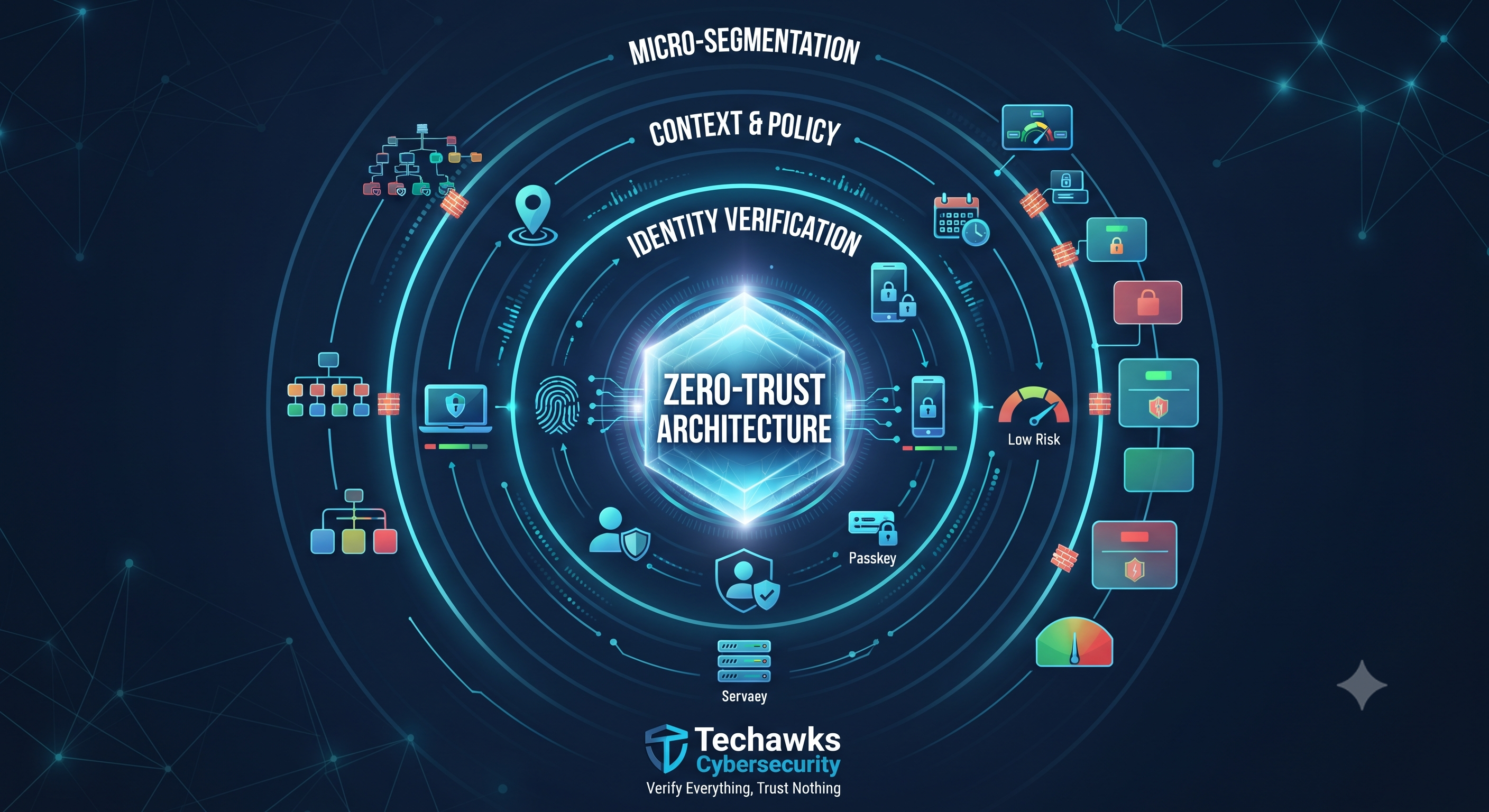 0 Kommentare 0 Geteilt 119 Ansichten 0 Bewertungen
 -
The Identity Perimeter: Why Network Firewalls Can’t Protect Against Session Token Theft
For years, security teams treated multi-factor authentication (MFA) as the ultimate wall. Push notifications, hardware keys, and OTPs stopped brute-force credential stuffing in its tracks.
However, attackers have shifted their attack vectors from obtaining passwords to acquiring the post-authentication credential: Session Tokens.
Through adversary-in-the-middle (AiTM) phishing proxies and infostealer malware, attackers bypass MFA entirely. Once an authenticated session token is extracted from memory or persistent browser storage, the attacker replay-injects it into their own browser. To your identity provider (IdP), that attacker isn't an intruder—they are an authenticated employee.
How to Defend the Post-Auth Boundary:
Enforce Token Binding (DPoP):
Transition from bearer tokens to cryptographic proof-of-possession schemes like Demonstrating Proof-of-Possession (DPoP) at the application layer. DPoP binds access and refresh tokens to a private key held by the client, rendering stolen tokens useless on third-party machines.
Implement Continuous Access Evaluation (CAE):
Static token expiration intervals (e.g., 8-hour or 24-hour lifetimes) give adversaries massive attack windows. Use CAE protocols that dynamically revoke session tokens the instant telemetry signals change (e.g., sudden IP/ASN subnet shift, abnormal device health status, or user role change).
Restructure Secret and Cookie Hygiene:
Ensure all authentication cookies use HttpOnly, Secure, and SameSite=Strict attributes to block client-side JavaScript execution (XSS exfiltration). For native applications and developer tools, eliminate persistent plain-text API credentials on local disk by utilizing OS-level secure enclaves and keyrings.
MFA proves who you are at the front door. Token security and continuous evaluation verify that you are still the one walking the halls.
Discussion Question
For security engineers and analysts: How is your team tackling session hijacking—are you enforcing strict short-lived tokens with CAE, mandating device-bound cryptographic keys, or relying on anomaly detection rules? Share your implementation hurdles below.
CTA
Ready to understand modern attack surfaces and master defensive engineering?
👉 Join the Techawks Cybersecurity & Ethical Hacking Community to dissect threat vectors, participate in capture-the-flag challenges, and learn from security practitioners.The Identity Perimeter: Why Network Firewalls Can’t Protect Against Session Token Theft For years, security teams treated multi-factor authentication (MFA) as the ultimate wall. Push notifications, hardware keys, and OTPs stopped brute-force credential stuffing in its tracks. However, attackers have shifted their attack vectors from obtaining passwords to acquiring the post-authentication credential: Session Tokens. Through adversary-in-the-middle (AiTM) phishing proxies and infostealer malware, attackers bypass MFA entirely. Once an authenticated session token is extracted from memory or persistent browser storage, the attacker replay-injects it into their own browser. To your identity provider (IdP), that attacker isn't an intruder—they are an authenticated employee. How to Defend the Post-Auth Boundary: Enforce Token Binding (DPoP): Transition from bearer tokens to cryptographic proof-of-possession schemes like Demonstrating Proof-of-Possession (DPoP) at the application layer. DPoP binds access and refresh tokens to a private key held by the client, rendering stolen tokens useless on third-party machines. Implement Continuous Access Evaluation (CAE): Static token expiration intervals (e.g., 8-hour or 24-hour lifetimes) give adversaries massive attack windows. Use CAE protocols that dynamically revoke session tokens the instant telemetry signals change (e.g., sudden IP/ASN subnet shift, abnormal device health status, or user role change). Restructure Secret and Cookie Hygiene: Ensure all authentication cookies use HttpOnly, Secure, and SameSite=Strict attributes to block client-side JavaScript execution (XSS exfiltration). For native applications and developer tools, eliminate persistent plain-text API credentials on local disk by utilizing OS-level secure enclaves and keyrings. MFA proves who you are at the front door. Token security and continuous evaluation verify that you are still the one walking the halls. Discussion Question For security engineers and analysts: How is your team tackling session hijacking—are you enforcing strict short-lived tokens with CAE, mandating device-bound cryptographic keys, or relying on anomaly detection rules? Share your implementation hurdles below. CTA Ready to understand modern attack surfaces and master defensive engineering? 👉 Join the Techawks Cybersecurity & Ethical Hacking Community to dissect threat vectors, participate in capture-the-flag challenges, and learn from security practitioners. 0 Kommentare 0 Geteilt 1KB Ansichten 0 Bewertungen
 -
MFA Won't Save You: How Token Theft and AiTM Phishing Bypass Traditional Authentication
Most cybersecurity learners focus heavily on credential cracking: brute-forcing hashes, credential stuffing, and credential stuffing defense.
Adversaries have largely abandoned trying to guess or crack passwords. Instead, modern intrusion chains exploit a fundamental design premise of the web: post-authentication trust.
Once a user passes MFA—whether via SMS, an authenticator push, or biometric verification—the application issues a bearer token (such as a session cookie or OAuth access token). From that point forward, the server only checks if the bearer token is valid, not who holds it.
The Attack Vector: Adversary-in-the-Middle (AiTM)
Rather than cloning static login pages, attackers deploy reverse-proxy frameworks (like Evilginx).
The victim visits what looks like a legitimate login portal.
The proxy server transparently relays authentication requests directly to the legitimate service.
The user solves the real MFA challenge.
The legitimate service responds with an authenticated session cookie.
The proxy captures that cookie in transit, bypassing MFA entirely without ever cracking a single key.
How Modern Security Teams Defend the Session:
Transition to FIDO2 / Passkeys (Origin-Bound Authentication): Unlike push notifications or TOTP codes, FIDO2/WebAuthn ties authentication to the browser's cryptographic origin. A phishing proxy running on auth-verify-security.com cannot satisfy the cryptographic challenge intended for the legitimate domain.
Continuous Access Evaluation (CAE) / DPoP: Implement Demonstrating Proof-of-Possession (DPoP) at the application layer. DPoP binds access tokens to a client-generated private key, ensuring stolen bearer tokens cannot be replayed from an unauthorized IP or client.
Device Telemetry and Impossible Travel Rules: Enforce conditional access policies that revoke session validity when a token abruptly changes ASN, TLS fingerprint, or geographic origin mid-session.
Authentication is not a one-time gate at login; it is a continuous posture. If your security model trusts a bearer token indefinitely, you haven't secured the perimeter—you’ve just postponed the breach.
Discussion Question
In your lab or organization, how are you mitigating token theft: enforcing FIDO2 hardware keys, setting strict token lifetimes with DPoP, or relying on identity threat detection (ITDR) telemetry?
CTA
Sharpen your offensive and defensive security fundamentals. Join ethical hackers, SOC analysts, and security researchers inside Cybersecurity & Ethical Hacking to dissect real-world malware, audit threat vectors, and master enterprise defense.MFA Won't Save You: How Token Theft and AiTM Phishing Bypass Traditional Authentication Most cybersecurity learners focus heavily on credential cracking: brute-forcing hashes, credential stuffing, and credential stuffing defense. Adversaries have largely abandoned trying to guess or crack passwords. Instead, modern intrusion chains exploit a fundamental design premise of the web: post-authentication trust. Once a user passes MFA—whether via SMS, an authenticator push, or biometric verification—the application issues a bearer token (such as a session cookie or OAuth access token). From that point forward, the server only checks if the bearer token is valid, not who holds it. The Attack Vector: Adversary-in-the-Middle (AiTM) Rather than cloning static login pages, attackers deploy reverse-proxy frameworks (like Evilginx). The victim visits what looks like a legitimate login portal. The proxy server transparently relays authentication requests directly to the legitimate service. The user solves the real MFA challenge. The legitimate service responds with an authenticated session cookie. The proxy captures that cookie in transit, bypassing MFA entirely without ever cracking a single key. How Modern Security Teams Defend the Session: Transition to FIDO2 / Passkeys (Origin-Bound Authentication): Unlike push notifications or TOTP codes, FIDO2/WebAuthn ties authentication to the browser's cryptographic origin. A phishing proxy running on auth-verify-security.com cannot satisfy the cryptographic challenge intended for the legitimate domain. Continuous Access Evaluation (CAE) / DPoP: Implement Demonstrating Proof-of-Possession (DPoP) at the application layer. DPoP binds access tokens to a client-generated private key, ensuring stolen bearer tokens cannot be replayed from an unauthorized IP or client. Device Telemetry and Impossible Travel Rules: Enforce conditional access policies that revoke session validity when a token abruptly changes ASN, TLS fingerprint, or geographic origin mid-session. Authentication is not a one-time gate at login; it is a continuous posture. If your security model trusts a bearer token indefinitely, you haven't secured the perimeter—you’ve just postponed the breach. Discussion Question In your lab or organization, how are you mitigating token theft: enforcing FIDO2 hardware keys, setting strict token lifetimes with DPoP, or relying on identity threat detection (ITDR) telemetry? CTA Sharpen your offensive and defensive security fundamentals. Join ethical hackers, SOC analysts, and security researchers inside Cybersecurity & Ethical Hacking to dissect real-world malware, audit threat vectors, and master enterprise defense. 0 Kommentare 0 Geteilt 239 Ansichten 0 Bewertungen
 -
Session Token Theft: Why Your Phishing-Resistant MFA Still Lets Attackers In
Most security training teaches that Multi-Factor Authentication is the final boss of identity defense. But MFA only protects the front door during initial authentication.
Once a user successfully authenticates, the identity provider or server issues an HTTP session cookie, OAuth bearer token, or JSON Web Token (JWT). From that second forward, the application relies on that token to verify authorization on every request.
If an attacker intercepts or extracts that active token, they do not need to solve an MFA challenge. They replay the token and inherit the session with identical privileges.
How Modern Session Hijacking Works:
Adversary-in-the-Middle (AiTM) Proxies: Attackers deploy reverse proxies (tools like Evilginx). When a target logs in, the proxy relays credentials to the legitimate service and captures the generated session cookie directly out of the HTTP response header.
Infostealer Malware: Trojanized software or drive-by downloads execute on the developer's or employee's endpoint, exfiltrating the SQLite cookie database and local storage from browser directories (e.g., Chrome/Edge user profiles) where active tokens reside in plaintext.
Token Replay Execution: The threat actor imports the extracted cookie string into their own browser session or API client. Because the session is already authenticated, the server accepts the request without triggering anomaly gates.
Three Engineering Defenses to Implement Today:
Enforce Token Binding (DPoP - Demonstrating Proof-of-Possession): Standard bearer tokens are usable by whoever holds them. Migrating to RFC 9449 (DPoP) binds access tokens to a private cryptographic key generated in the client runtime. Even if the bearer token is exfiltrated, it cannot be used without the client-side private key.
Aggressive Session Lifetimes & Continuous Access Evaluation (CAE): Long-lived 30-day session cookies are an unacceptable risk for privileged accounts. Reduce admin session life to short windows (2–4 hours) and configure protocols like CAE to revoke tokens immediately upon critical network or device posture changes.
Elevate Cookie Flags: Ensure all session cookies explicitly mandate Secure, HttpOnly (to prevent extraction via client-side Cross-Site Scripting), and strict SameSite=Lax or Strict to mitigate cross-site request forgery.
In modern security, identity verification isn't a point-in-time handshake—it must be an ongoing, continuous cryptographic contract.
Discussion Question
Is your team exploring cryptographic token binding (like DPoP) or Continuous Access Evaluation (CAE), or are your cloud applications still running on standard bearer tokens and static cookie lifespans?
CTA (Join Cybersecurity & Ethical Hacking)
Ready to move past surface-level checklists and master modern attack vectors, offensive security, and identity hardening? Join the Cybersecurity & Ethical Hacking community to break down real-world attack flows and defense blueprints.Session Token Theft: Why Your Phishing-Resistant MFA Still Lets Attackers In Most security training teaches that Multi-Factor Authentication is the final boss of identity defense. But MFA only protects the front door during initial authentication. Once a user successfully authenticates, the identity provider or server issues an HTTP session cookie, OAuth bearer token, or JSON Web Token (JWT). From that second forward, the application relies on that token to verify authorization on every request. If an attacker intercepts or extracts that active token, they do not need to solve an MFA challenge. They replay the token and inherit the session with identical privileges. How Modern Session Hijacking Works: Adversary-in-the-Middle (AiTM) Proxies: Attackers deploy reverse proxies (tools like Evilginx). When a target logs in, the proxy relays credentials to the legitimate service and captures the generated session cookie directly out of the HTTP response header. Infostealer Malware: Trojanized software or drive-by downloads execute on the developer's or employee's endpoint, exfiltrating the SQLite cookie database and local storage from browser directories (e.g., Chrome/Edge user profiles) where active tokens reside in plaintext. Token Replay Execution: The threat actor imports the extracted cookie string into their own browser session or API client. Because the session is already authenticated, the server accepts the request without triggering anomaly gates. Three Engineering Defenses to Implement Today: Enforce Token Binding (DPoP - Demonstrating Proof-of-Possession): Standard bearer tokens are usable by whoever holds them. Migrating to RFC 9449 (DPoP) binds access tokens to a private cryptographic key generated in the client runtime. Even if the bearer token is exfiltrated, it cannot be used without the client-side private key. Aggressive Session Lifetimes & Continuous Access Evaluation (CAE): Long-lived 30-day session cookies are an unacceptable risk for privileged accounts. Reduce admin session life to short windows (2–4 hours) and configure protocols like CAE to revoke tokens immediately upon critical network or device posture changes. Elevate Cookie Flags: Ensure all session cookies explicitly mandate Secure, HttpOnly (to prevent extraction via client-side Cross-Site Scripting), and strict SameSite=Lax or Strict to mitigate cross-site request forgery. In modern security, identity verification isn't a point-in-time handshake—it must be an ongoing, continuous cryptographic contract. Discussion Question Is your team exploring cryptographic token binding (like DPoP) or Continuous Access Evaluation (CAE), or are your cloud applications still running on standard bearer tokens and static cookie lifespans? CTA (Join Cybersecurity & Ethical Hacking) Ready to move past surface-level checklists and master modern attack vectors, offensive security, and identity hardening? Join the Cybersecurity & Ethical Hacking community to break down real-world attack flows and defense blueprints. 0 Kommentare 0 Geteilt 166 Ansichten 0 Bewertungen
 -
The 970+ CVE Avalanche: Why "Vulnerability Flooding" Is Breaking Traditional SecOps (And How to Prioritize)
Hook
When Patch Tuesday drops nearly 1,000 CVEs in a single day, standard patch management isn't just difficult—it is mathematically broken. If your team is still triaging purely by raw CVSS scores, you are chasing paper while attackers slip past.
Main Post
We have officially entered the era of AI-accelerated vulnerability discovery.
Software vendors and automated dynamic-testing agents are indexing legacy codebases at unprecedented scale, uncovering hundreds of memory and link-resolution defects per month. But this introduces a dangerous defender's dilemma: alert fatigue masking real-world weaponization.
Out of hundreds of patched vulnerabilities, only a tiny fraction are reachable, weaponizable without authentication, and actively exploited in the wild.
When zero-days like ALPC (Advanced Local Procedure Call) heap overflows (e.g., CVE-2026-85880) hit alongside wormable network-level bugs, junior analysts waste hours checking low-risk endpoints instead of isolating privilege-escalation vectors.
The Modern Triage Matrix: Moving from CVSS to EPSS + KEV
1. Distinguish "Theoretical Severity" from "Exploit Probability"
CVSS (Common Vulnerability Scoring System): Tells you how bad a bug is if someone pops it. A CVSS 9.8 in an unreachable internal utility is far less urgent than a CVSS 7.8 zero-day actively exploited to escape sandboxes.
EPSS (Exploit Prediction Scoring System): Measures the statistical likelihood that a vulnerability will be weaponized in the wild within 30 days. Prioritize high-EPSS candidates over paper CVSS scores.
2. The 3-Filter Triage Hierarchy
Before pushing patches that could break production workloads, run every high-volume CVE release through three filters:
In-The-Wild Status (CISA KEV / Vendor Zero-Days): Immediate patch cycle (within 24–48 hours) for known exploited vulnerabilities (e.g., sandbox escapes, update-stack link bypasses).
Network Reachability & Unauthenticated Pre-Auth: Is the vulnerable service (e.g., DNS, RPC, TFTP) exposed to untrusted segments without requiring valid credentials?
Execution Context: Does exploiting the bug grant local user or elevated NT AUTHORITY\SYSTEM privileges?
3. Compensating Controls Beat Panic Patching
Can't reboot critical servers right away?
Block vulnerable RPC/ALPC interfaces across internal subnets.
Restrict AppContainer execution boundaries on untrusted user software.
Enable network micro-segmentation to neutralize wormable propagation paths before binaries are compiled and distributed.
The Security Takeaway: The volume of CVEs will only expand. Top-tier defenders aren't patch-printers; they are threat-modelers who filter out noise to eliminate actual adversary leverage.
Discussion Question
When a massive patch release drops, how does your security team decide what gets patched immediately vs. scheduled for standard maintenance—CVSS score, reachability, or known active exploitation?
CTA
Join Cybersecurity & Ethical Hacking
Master threat hunting, active triage workflows, and offensive/defensive tradecraft alongside ethical hackers and SOC analysts worldwide. Join the Techawks Cybersecurity community today: [Link]The 970+ CVE Avalanche: Why "Vulnerability Flooding" Is Breaking Traditional SecOps (And How to Prioritize) Hook When Patch Tuesday drops nearly 1,000 CVEs in a single day, standard patch management isn't just difficult—it is mathematically broken. If your team is still triaging purely by raw CVSS scores, you are chasing paper while attackers slip past. Main Post We have officially entered the era of AI-accelerated vulnerability discovery. Software vendors and automated dynamic-testing agents are indexing legacy codebases at unprecedented scale, uncovering hundreds of memory and link-resolution defects per month. But this introduces a dangerous defender's dilemma: alert fatigue masking real-world weaponization. Out of hundreds of patched vulnerabilities, only a tiny fraction are reachable, weaponizable without authentication, and actively exploited in the wild. When zero-days like ALPC (Advanced Local Procedure Call) heap overflows (e.g., CVE-2026-85880) hit alongside wormable network-level bugs, junior analysts waste hours checking low-risk endpoints instead of isolating privilege-escalation vectors. The Modern Triage Matrix: Moving from CVSS to EPSS + KEV 1. Distinguish "Theoretical Severity" from "Exploit Probability" CVSS (Common Vulnerability Scoring System): Tells you how bad a bug is if someone pops it. A CVSS 9.8 in an unreachable internal utility is far less urgent than a CVSS 7.8 zero-day actively exploited to escape sandboxes. EPSS (Exploit Prediction Scoring System): Measures the statistical likelihood that a vulnerability will be weaponized in the wild within 30 days. Prioritize high-EPSS candidates over paper CVSS scores. 2. The 3-Filter Triage Hierarchy Before pushing patches that could break production workloads, run every high-volume CVE release through three filters: In-The-Wild Status (CISA KEV / Vendor Zero-Days): Immediate patch cycle (within 24–48 hours) for known exploited vulnerabilities (e.g., sandbox escapes, update-stack link bypasses). Network Reachability & Unauthenticated Pre-Auth: Is the vulnerable service (e.g., DNS, RPC, TFTP) exposed to untrusted segments without requiring valid credentials? Execution Context: Does exploiting the bug grant local user or elevated NT AUTHORITY\SYSTEM privileges? 3. Compensating Controls Beat Panic Patching Can't reboot critical servers right away? Block vulnerable RPC/ALPC interfaces across internal subnets. Restrict AppContainer execution boundaries on untrusted user software. Enable network micro-segmentation to neutralize wormable propagation paths before binaries are compiled and distributed. The Security Takeaway: The volume of CVEs will only expand. Top-tier defenders aren't patch-printers; they are threat-modelers who filter out noise to eliminate actual adversary leverage. Discussion Question When a massive patch release drops, how does your security team decide what gets patched immediately vs. scheduled for standard maintenance—CVSS score, reachability, or known active exploitation? CTA Join Cybersecurity & Ethical Hacking Master threat hunting, active triage workflows, and offensive/defensive tradecraft alongside ethical hackers and SOC analysts worldwide. Join the Techawks Cybersecurity community today: [Link] 0 Kommentare 0 Geteilt 173 Ansichten 0 Bewertungen
 -
Malware-Free Intrusions: How Modern Attackers Bypass EDR Without Dropping a Single File
The biggest misconception among cybersecurity students and junior defenders is that an intrusion always starts with malware. In real-world enterprise breaches, attackers rarely burn a zero-day executable when they can simply abuse legitimate administrative identity.
Adversaries increasingly favor Malware-Light, Identity-Driven Attacks using living-off-the-land techniques (LotL). Rather than planting suspicious files that trigger Endpoint Detection and Response (EDR) heuristics, threat actors steal valid session tokens, abuse OAuth grants, or leverage native administrative utilities (PowerShell, WMI, cloud CLI tools).
To an endpoint antivirus, an engineer querying an AWS bucket looks identical to an attacker exfiltrating sensitive data with stolen session credentials.
Here is how modern defenders detect and stop identity-centric intrusions:
Session Hijacking Over Credential Re-entry: Attackers don't bother cracking complex passwords or triggering MFA fatigue; they extract active session cookies and OAuth access tokens straight from browser memory or unmanaged dev machines. Combat this by binding session tokens to device posture using Continuous Access Evaluation (CAE) and token-binding protocols.
Behavioral Baselining Over File Signatures: Because no .exe is executed, signature matching is useless. Detections must rely on User and Entity Behavior Analytics (UEBA)—flagging anomalies like a developer service account accessing production datastores at 3 AM from an uncharacteristic IP or user-agent.
Privilege Scoping (Least Privilege at Runtime): Long-lived static admin credentials must be replaced with Just-In-Time (JIT) access. If an attacker compromises a credential that expires in 15 minutes and carries tightly bounded scopes, their ability to pivot laterally is neutralized.
The perimeter didn't disappear—it migrated entirely to Identity. Defending the endpoint starts with defending the credential.
Discussion Question
POLL: In your security lab or organization, which attack vector do you find hardest to detect and defend against?
Stolen session tokens / Cookie theft bypassing MFA
Living-off-the-Land (native CLI / WMI execution)
Third-party SaaS OAuth integrations & API token leaks
AI-generated targeted phishing / Social engineering
Vote below and share the detection rule or lab project you're using to tackle it!
CTA
Want to master ethical hacking, defensive security architectures, and enterprise threat hunting?
👉 Join Cybersecurity & Ethical Hacking [link in bio/comments] to practice hands-on labs, analyze real breach post-mortems, and level up with fellow security researchers.Malware-Free Intrusions: How Modern Attackers Bypass EDR Without Dropping a Single File The biggest misconception among cybersecurity students and junior defenders is that an intrusion always starts with malware. In real-world enterprise breaches, attackers rarely burn a zero-day executable when they can simply abuse legitimate administrative identity. Adversaries increasingly favor Malware-Light, Identity-Driven Attacks using living-off-the-land techniques (LotL). Rather than planting suspicious files that trigger Endpoint Detection and Response (EDR) heuristics, threat actors steal valid session tokens, abuse OAuth grants, or leverage native administrative utilities (PowerShell, WMI, cloud CLI tools). To an endpoint antivirus, an engineer querying an AWS bucket looks identical to an attacker exfiltrating sensitive data with stolen session credentials. Here is how modern defenders detect and stop identity-centric intrusions: Session Hijacking Over Credential Re-entry: Attackers don't bother cracking complex passwords or triggering MFA fatigue; they extract active session cookies and OAuth access tokens straight from browser memory or unmanaged dev machines. Combat this by binding session tokens to device posture using Continuous Access Evaluation (CAE) and token-binding protocols. Behavioral Baselining Over File Signatures: Because no .exe is executed, signature matching is useless. Detections must rely on User and Entity Behavior Analytics (UEBA)—flagging anomalies like a developer service account accessing production datastores at 3 AM from an uncharacteristic IP or user-agent. Privilege Scoping (Least Privilege at Runtime): Long-lived static admin credentials must be replaced with Just-In-Time (JIT) access. If an attacker compromises a credential that expires in 15 minutes and carries tightly bounded scopes, their ability to pivot laterally is neutralized. The perimeter didn't disappear—it migrated entirely to Identity. Defending the endpoint starts with defending the credential. Discussion Question POLL: In your security lab or organization, which attack vector do you find hardest to detect and defend against? Stolen session tokens / Cookie theft bypassing MFA Living-off-the-Land (native CLI / WMI execution) Third-party SaaS OAuth integrations & API token leaks AI-generated targeted phishing / Social engineering Vote below and share the detection rule or lab project you're using to tackle it! CTA Want to master ethical hacking, defensive security architectures, and enterprise threat hunting? 👉 Join Cybersecurity & Ethical Hacking [link in bio/comments] to practice hands-on labs, analyze real breach post-mortems, and level up with fellow security researchers. 0 Kommentare 0 Geteilt 145 Ansichten 0 Bewertungen
 -
The "Domain Admin" Trap: Why Modern Security Engineering Is Moving from Static Roles to Ephemeral Identity Proofs
Over the past week, threat intelligence reports surrounding critical enterprise bypasses—including active exploitation of build pipeline token generation (CVE-2026-82329) and ongoing identity fabric escalation—reiterated a fundamental reality: Attackers do not break encryption; they abuse legitimate identity pathways.
Across modern cloud-native environments and hybrid Active Directory structures, perimeter firewalls are trivial compared to identity misconfigurations. When service accounts, CI/CD runners, and autonomous AI agents mint administrative tokens or manipulate certificate templates, an attacker doesn't need zero-day exploit payloads—they simply authenticate.
For aspiring security analysts and ethical hackers, understanding identity architecture is now the single highest-leverage career skill.
Here is how to elevate your learning beyond standard penetration testing and build real authority in Identity Threat Detection and Response (ITDR):
Audit Non-Human Identities (NHIs): In enterprise environments, non-human identities (APIs, workload agents, automated pipelines) outnumber human employees by more than 10 to 1. Learn how long-lived API tokens and over-permissioned service accounts create invisible lateral paths. Build home labs that replace static credentials with short-lived, ephemeral secrets via Workload Identity Federation.
Master Certificate Authority & Trust Boundaries: Dive into Active Directory Certificate Services (AD CS) and public key infrastructure. Understand how request attributes and enrollment delegation can be manipulated to impersonate domain controllers or bypass authentication controls.
Shift from Vulnerability Scanning to Permission Auditing: Running an automated vulnerability scanner only tells you what packages are outdated. High-value defenders map graph relationships: Who can modify this Service Principal Name (SPN)? What role can generate administrative tokens? Tools like BloodHound and telemetry hunting in Windows Event Logs (IDs 4886–4888) carry far more weight in SOC and offensive security interviews.
Organizations don't just need people who can run an exploit script; they need engineers who understand how trust is brokered, validated, and revoked.
Discussion Question
When assessing access control in your personal lab or cloud environments, what strategy do you use to detect inactive, over-permissioned non-human service accounts before they become a lateral pivot?
CTA
Ready to transition from basic script-kiddie tools to professional identity defense and offensive architecture? Join Cybersecurity & Ethical Hacking to dissect real-world enterprise vectors and build production-grade security skills.The "Domain Admin" Trap: Why Modern Security Engineering Is Moving from Static Roles to Ephemeral Identity Proofs Over the past week, threat intelligence reports surrounding critical enterprise bypasses—including active exploitation of build pipeline token generation (CVE-2026-82329) and ongoing identity fabric escalation—reiterated a fundamental reality: Attackers do not break encryption; they abuse legitimate identity pathways. Across modern cloud-native environments and hybrid Active Directory structures, perimeter firewalls are trivial compared to identity misconfigurations. When service accounts, CI/CD runners, and autonomous AI agents mint administrative tokens or manipulate certificate templates, an attacker doesn't need zero-day exploit payloads—they simply authenticate. For aspiring security analysts and ethical hackers, understanding identity architecture is now the single highest-leverage career skill. Here is how to elevate your learning beyond standard penetration testing and build real authority in Identity Threat Detection and Response (ITDR): Audit Non-Human Identities (NHIs): In enterprise environments, non-human identities (APIs, workload agents, automated pipelines) outnumber human employees by more than 10 to 1. Learn how long-lived API tokens and over-permissioned service accounts create invisible lateral paths. Build home labs that replace static credentials with short-lived, ephemeral secrets via Workload Identity Federation. Master Certificate Authority & Trust Boundaries: Dive into Active Directory Certificate Services (AD CS) and public key infrastructure. Understand how request attributes and enrollment delegation can be manipulated to impersonate domain controllers or bypass authentication controls. Shift from Vulnerability Scanning to Permission Auditing: Running an automated vulnerability scanner only tells you what packages are outdated. High-value defenders map graph relationships: Who can modify this Service Principal Name (SPN)? What role can generate administrative tokens? Tools like BloodHound and telemetry hunting in Windows Event Logs (IDs 4886–4888) carry far more weight in SOC and offensive security interviews. Organizations don't just need people who can run an exploit script; they need engineers who understand how trust is brokered, validated, and revoked. Discussion Question When assessing access control in your personal lab or cloud environments, what strategy do you use to detect inactive, over-permissioned non-human service accounts before they become a lateral pivot? CTA Ready to transition from basic script-kiddie tools to professional identity defense and offensive architecture? Join Cybersecurity & Ethical Hacking to dissect real-world enterprise vectors and build production-grade security skills. 0 Kommentare 0 Geteilt 160 Ansichten 0 Bewertungen
 -
The Zero-Trust Audit Challenge: Why Assuming Breach Will Transform Your Security Posture
Most teams treat security as a boundary problem: set up firewalls, enforce VPN access, and assume that every packet, device, and service operating inside the internal subnet is trustworthy.
In real-world compromises, this implicit trust is exactly what turns a single compromised workstation into a full domain takeover. Once an adversary gains an initial foothold, flat networks allow them to scan internal subnets, dump memory credentials, and pivot across lateral routes completely unnoticed.
To build an architecture that survives a breach, stop assuming your internal network is safe and take the 72-Hour Zero-Trust Hardening Challenge:
Eliminate Implicit Lateral Trust
Segment your network down to the workload level. If an internal microservice or application tier doesn't need to communicate with another, explicitly deny traffic at the firewall or service mesh layer. Enforce mutual TLS (mTLS) for all internal service-to-service communications so every request is authenticated and encrypted, regardless of where it originates.
Conduct the "Assume Breach" Credential Sweep
Assume an attacker has local admin access to an average developer machine right now. Ask:
Are there static cloud keys or private SSH tokens saved in plaintext configs or bash histories?
Do standard user accounts have read access to internal network shares or unsegmented staging databases?
Scrub static secrets and replace them with short-lived, dynamically generated credentials delivered via a centralized secrets vault.
Enforce Micro-Perimeters and Least Privilege Access
Audit your Active Directory or IAM role hierarchies. Strip wildcard permissions (*) from service accounts and enforce time-bound, role-based access control (RBAC). Require re-authentication or step-up verification when accounts attempt high-risk actions, even from trusted corporate devices.
Defensive security isn't about hoping the perimeter never fails. It’s about building a system where a single compromised node gives the attacker nothing else to compromise.
Key Takeaways
Internal subnets should be treated with the same zero-trust posture as the public internet.
Flat networks enable effortless lateral movement; micro-segmentation contains the blast radius.
Replace long-lived static secrets with short-lived, rotated credentials to neutralize token exfiltration.
Enforce least privilege strictly across service accounts and human operators alike.
CTA
Ready to move past perimeter defense and master modern adversarial tradecraft? Join the Cybersecurity & Ethical Hacking community to dissect attack vectors, run architectural audits, and level up your defensive game with practitioners worldwide.The Zero-Trust Audit Challenge: Why Assuming Breach Will Transform Your Security Posture Most teams treat security as a boundary problem: set up firewalls, enforce VPN access, and assume that every packet, device, and service operating inside the internal subnet is trustworthy. In real-world compromises, this implicit trust is exactly what turns a single compromised workstation into a full domain takeover. Once an adversary gains an initial foothold, flat networks allow them to scan internal subnets, dump memory credentials, and pivot across lateral routes completely unnoticed. To build an architecture that survives a breach, stop assuming your internal network is safe and take the 72-Hour Zero-Trust Hardening Challenge: Eliminate Implicit Lateral Trust Segment your network down to the workload level. If an internal microservice or application tier doesn't need to communicate with another, explicitly deny traffic at the firewall or service mesh layer. Enforce mutual TLS (mTLS) for all internal service-to-service communications so every request is authenticated and encrypted, regardless of where it originates. Conduct the "Assume Breach" Credential Sweep Assume an attacker has local admin access to an average developer machine right now. Ask: Are there static cloud keys or private SSH tokens saved in plaintext configs or bash histories? Do standard user accounts have read access to internal network shares or unsegmented staging databases? Scrub static secrets and replace them with short-lived, dynamically generated credentials delivered via a centralized secrets vault. Enforce Micro-Perimeters and Least Privilege Access Audit your Active Directory or IAM role hierarchies. Strip wildcard permissions (*) from service accounts and enforce time-bound, role-based access control (RBAC). Require re-authentication or step-up verification when accounts attempt high-risk actions, even from trusted corporate devices. Defensive security isn't about hoping the perimeter never fails. It’s about building a system where a single compromised node gives the attacker nothing else to compromise. Key Takeaways Internal subnets should be treated with the same zero-trust posture as the public internet. Flat networks enable effortless lateral movement; micro-segmentation contains the blast radius. Replace long-lived static secrets with short-lived, rotated credentials to neutralize token exfiltration. Enforce least privilege strictly across service accounts and human operators alike. CTA Ready to move past perimeter defense and master modern adversarial tradecraft? Join the Cybersecurity & Ethical Hacking community to dissect attack vectors, run architectural audits, and level up your defensive game with practitioners worldwide.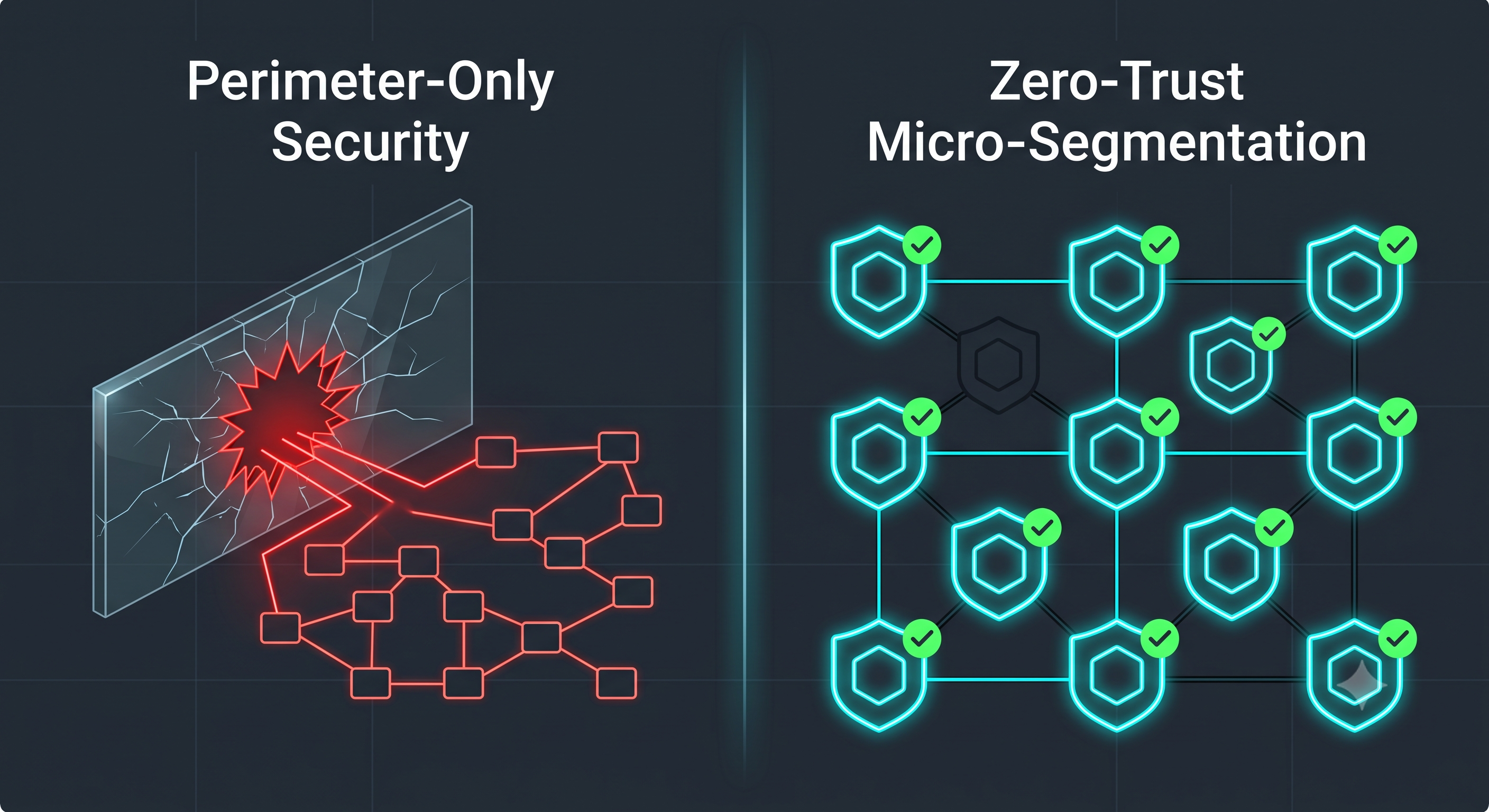 0 Kommentare 0 Geteilt 156 Ansichten 0 Bewertungen
 -
The MFA Bulletproof Fallacy: Why Attackers Don't Crack Your Password, They Steal Your Session
As organizations enforce stricter MFA policies and adopt passwordless authentication, the traditional credential-stuffing playbook has changed. Modern adversaries rarely waste time attempting to guess passwords or trigger MFA push-fatigue storms.
Instead, they target the post-authentication state.
Myth: Multi-Factor Authentication (MFA) guarantees that an unauthorized user cannot access an authenticated cloud or enterprise account.
Fact: MFA only protects the initial point of authentication. Once a user successfully passes MFA, the application generates a bearer session token (or session cookie). If an attacker exfiltrates this token via infostealer malware or Adversary-in-the-Middle (AiTM) reverse proxies, they replay the session in their own browser—bypassing password prompts and MFA triggers entirely.
Why this matters for cybersecurity defenders:
In identity-first attacks, the adversary does not look like an intruder; they look like an authenticated, legitimate user. Automated security alerts for "impossible travel" or failed logins remain silent because the active session was already authenticated by the real employee.
How to defend the post-authentication boundary:
Implement Continuous Access Evaluation (CAE / CAEP)
Stop trusting static session tokens with 24-hour expiration windows. Deploy continuous evaluation protocols that revoke tokens in near-real-time if the user’s IP subnet, device compliance posture, or location changes abruptly mid-session.
Enforce Token and Session Binding
Transition to hardware-bound tokens using Demonstrating Proof-of-Possession (DPoP) or device-bound session credentials. If a stolen session cookie is replayed from a browser or machine without the corresponding private cryptographic key, the server rejects the request.
Transition to Phishing-Resistant MFA (FIDO2 / Passkeys)
SMS codes, one-time passwords (OTP), and push notifications are susceptible to AiTM proxy interception. FIDO2/WebAuthn hardware keys cryptographically bind authentication to the legitimate server domain, stopping proxy phishing before a token can be minted.
Modern identity defense isn't just about verifying who signs in. It is about continuously validating that the identity holding the active session is still the person you authenticated.
Discussion Question
Does your team currently monitor and restrict post-authentication token lifespans, or does your access policy rely entirely on point-in-time login challenges?
CTA
Ready to build resilient defensive architectures and stay ahead of modern adversary tradecraft? Join the Cybersecurity & Ethical Hacking community to break down real attack vectors, analyze threat intelligence, and level up with security practitioners worldwide.The MFA Bulletproof Fallacy: Why Attackers Don't Crack Your Password, They Steal Your Session As organizations enforce stricter MFA policies and adopt passwordless authentication, the traditional credential-stuffing playbook has changed. Modern adversaries rarely waste time attempting to guess passwords or trigger MFA push-fatigue storms. Instead, they target the post-authentication state. Myth: Multi-Factor Authentication (MFA) guarantees that an unauthorized user cannot access an authenticated cloud or enterprise account. Fact: MFA only protects the initial point of authentication. Once a user successfully passes MFA, the application generates a bearer session token (or session cookie). If an attacker exfiltrates this token via infostealer malware or Adversary-in-the-Middle (AiTM) reverse proxies, they replay the session in their own browser—bypassing password prompts and MFA triggers entirely. Why this matters for cybersecurity defenders: In identity-first attacks, the adversary does not look like an intruder; they look like an authenticated, legitimate user. Automated security alerts for "impossible travel" or failed logins remain silent because the active session was already authenticated by the real employee. How to defend the post-authentication boundary: Implement Continuous Access Evaluation (CAE / CAEP) Stop trusting static session tokens with 24-hour expiration windows. Deploy continuous evaluation protocols that revoke tokens in near-real-time if the user’s IP subnet, device compliance posture, or location changes abruptly mid-session. Enforce Token and Session Binding Transition to hardware-bound tokens using Demonstrating Proof-of-Possession (DPoP) or device-bound session credentials. If a stolen session cookie is replayed from a browser or machine without the corresponding private cryptographic key, the server rejects the request. Transition to Phishing-Resistant MFA (FIDO2 / Passkeys) SMS codes, one-time passwords (OTP), and push notifications are susceptible to AiTM proxy interception. FIDO2/WebAuthn hardware keys cryptographically bind authentication to the legitimate server domain, stopping proxy phishing before a token can be minted. Modern identity defense isn't just about verifying who signs in. It is about continuously validating that the identity holding the active session is still the person you authenticated. Discussion Question Does your team currently monitor and restrict post-authentication token lifespans, or does your access policy rely entirely on point-in-time login challenges? CTA Ready to build resilient defensive architectures and stay ahead of modern adversary tradecraft? Join the Cybersecurity & Ethical Hacking community to break down real attack vectors, analyze threat intelligence, and level up with security practitioners worldwide.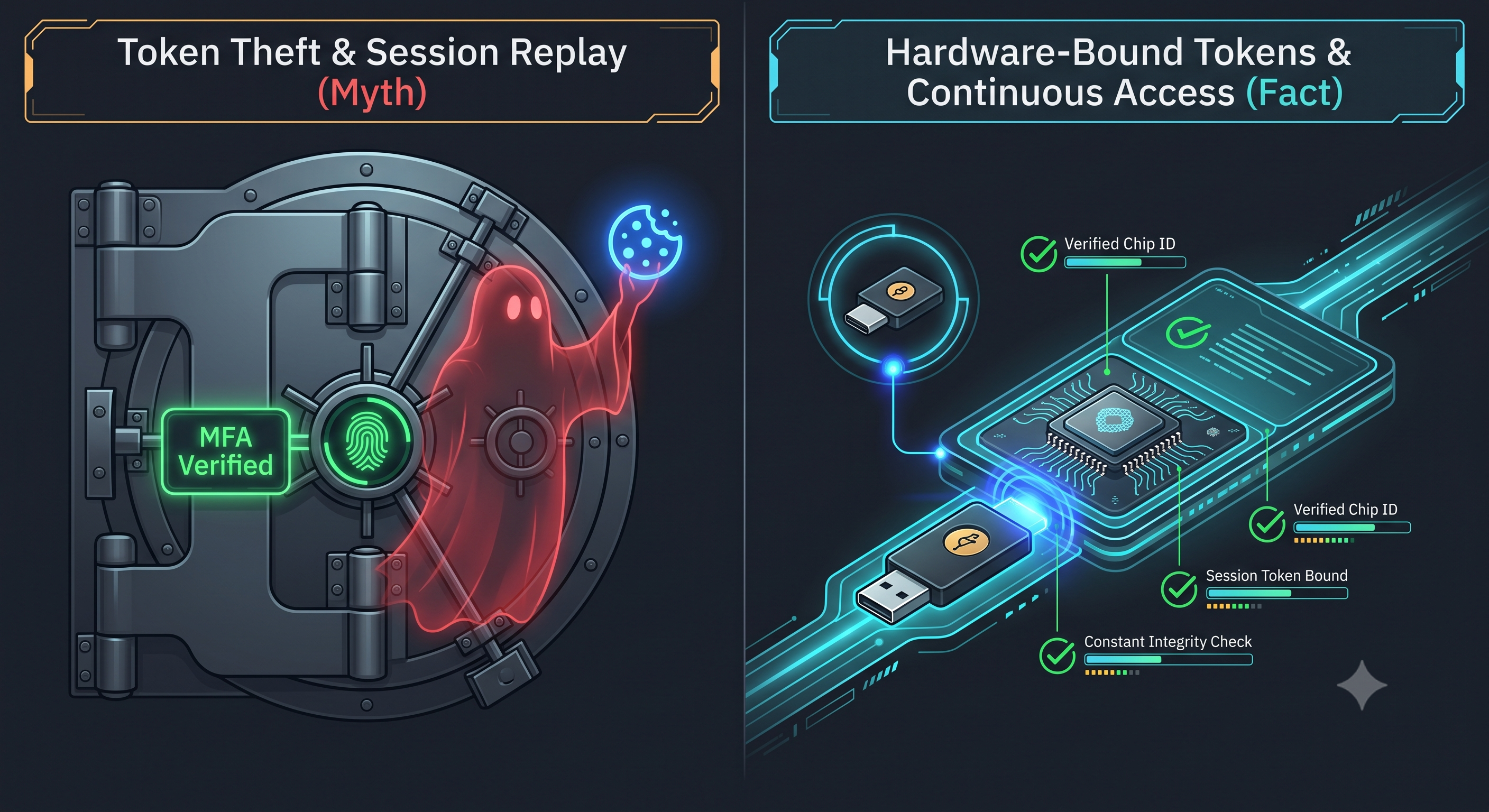 0 Kommentare 0 Geteilt 146 Ansichten 0 Bewertungen
Mehr Storys