


Ditching the Sidecar Tax: How eBPF and Ambient Mesh Are Rewriting Kubernetes Networking
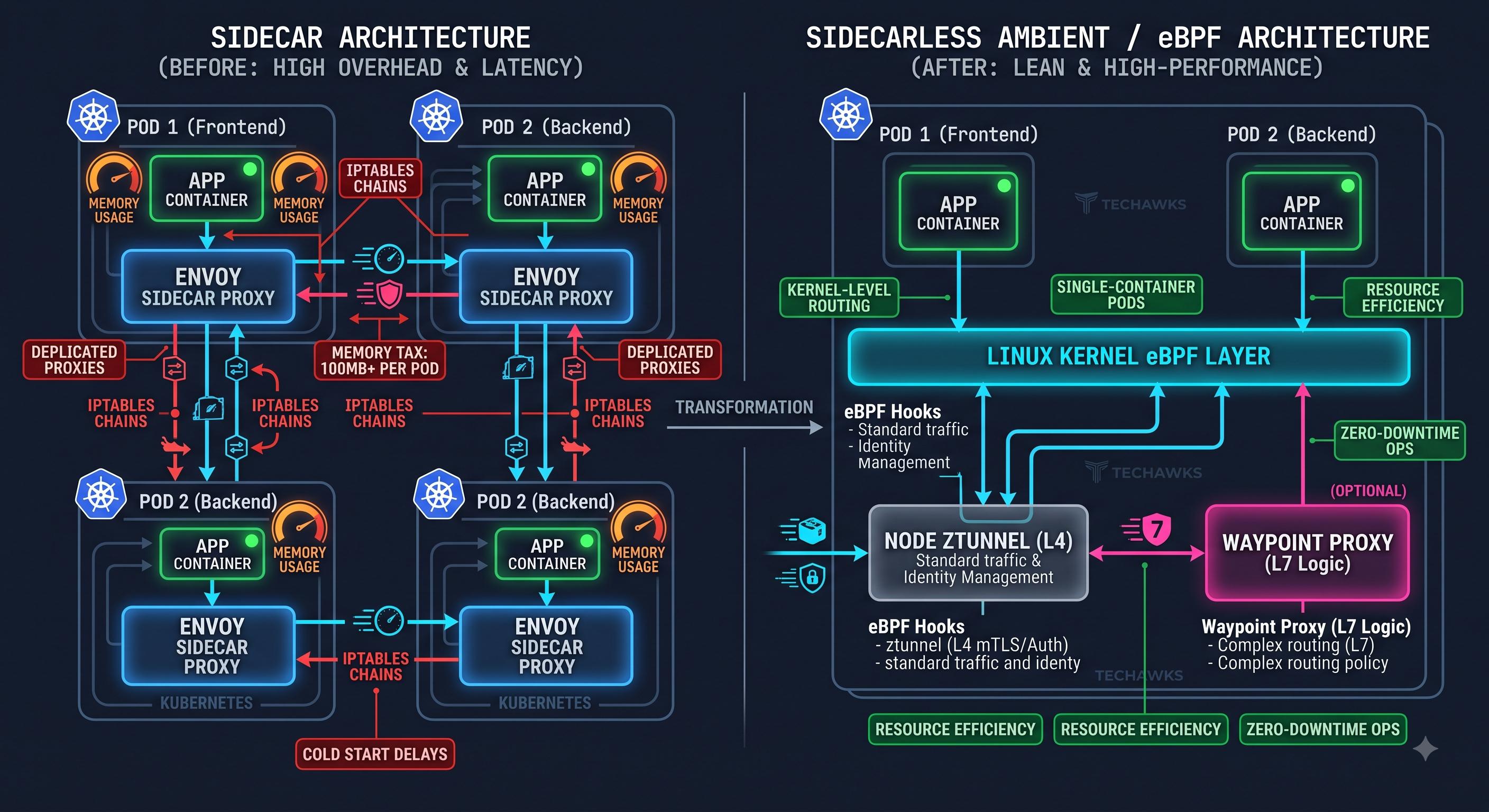
For years, the standard way to enforce mutual TLS (mTLS), observability, and traffic policies in Kubernetes was injecting an Envoy proxy sidecar container next to every single application container.
At scale, this creates severe friction:
Resource bloat: 50MB to 100MB+ of dedicated RAM per pod just for the proxy.
Operational drag: Updating mesh configurations or proxy versions requires restarting application pods.
Troubleshooting nightmare: Dual-container lifecycle races during pod startup and shutdown.
The cloud-native ecosystem is transitioning to a Sidecarless Data Plane powered by eBPF (Extended Berkeley Packet Filter) and Ambient Mesh architectures (e.g., Cilium Service Mesh and Istio Ambient Mode):
┌──────────────────────────────────┐
│ Application Pod (Zero Sidecars / Single Container) │
└───────────────────────────┬──────┘
│ (Socket / Syscall)
▼
┌──────────────────────────────────┐
│ Linux Kernel Layer (eBPF Socket / TC Routing) │
│ ├─ Bypasses iptables rule traversal │
│ └─ Zero-instrumentation L4 mTLS & Identity Tagging │
└───────────────────────────┬──────┘
│
┌────────────────────┴───────────────┐
│ (L4 Transport) │ (L7 Complex Routing)
▼ ▼
┌──────────────────────┐ ┌─────┐
│ Node Shared ztunnel │ │ Waypoint Proxy │
│ (L4 mutual TLS only) │ │ (Dedicated L7 Envoy) │
└──────────────────────┘ └─────┘
3 Key Architectural Shifts for Cloud Engineers:
Kernel-Level Packet Interception via eBPF:
Instead of looping packets through multiple veth pairs and traversing massive, slow iptables chains, eBPF attaches directly to socket layers (sock_ops) and Traffic Control (TC) hooks inside the Linux kernel, routing traffic straight across memory buffers with minimum latency.
Decoupling Layer 4 Security from Layer 7 Processing:
In traditional sidecars, a full HTTP/gRPC parsing proxy is loaded even if you only need encrypted mTLS. In sidecarless architectures, a lightweight node-level daemon (like Istio's Rust-based ztunnel) handles L4 encryption transparently. High-overhead Layer 7 proxies (Waypoint Proxies) are deployed only for services that explicitly require path-based routing or header mutation.
Zero-Downtime Mesh Operations:
Workloads join the mesh with a single namespace label. Upgrades to the proxy or CNI layer happen on the node or gateway without restarting application workloads or breaking long-lived connections.
Platform Engineering Rule:
Don't penalize your microservices with proxy bloat for features they never use. Route Layer 4 at the kernel level, and reserve Layer 7 proxies only where application logic demands them.
Discussion Question
Is your team running a traditional sidecar-injected service mesh, exploring eBPF-native CNIs (like Cilium), or evaluating Ambient Mesh? What has been your biggest obstacle in migrating away from the sidecar model in production?
CTA (Join Cloud, DevOps & Open Source)
Want to dive into real-world Kubernetes performance optimization, platform engineering architectures, and eBPF tooling with practicing cloud architects?
☁️ Join the Techawks Cloud, DevOps & Open Source Community — check out the link in our bio/comments to access our hands-on infrastructure labs, CKA/CKS workshops, and live architecture reviews!
For years, the standard way to enforce mutual TLS (mTLS), observability, and traffic policies in Kubernetes was injecting an Envoy proxy sidecar container next to every single application container.
At scale, this creates severe friction:
Resource bloat: 50MB to 100MB+ of dedicated RAM per pod just for the proxy.
Operational drag: Updating mesh configurations or proxy versions requires restarting application pods.
Troubleshooting nightmare: Dual-container lifecycle races during pod startup and shutdown.
The cloud-native ecosystem is transitioning to a Sidecarless Data Plane powered by eBPF (Extended Berkeley Packet Filter) and Ambient Mesh architectures (e.g., Cilium Service Mesh and Istio Ambient Mode):
┌──────────────────────────────────┐
│ Application Pod (Zero Sidecars / Single Container) │
└───────────────────────────┬──────┘
│ (Socket / Syscall)
▼
┌──────────────────────────────────┐
│ Linux Kernel Layer (eBPF Socket / TC Routing) │
│ ├─ Bypasses iptables rule traversal │
│ └─ Zero-instrumentation L4 mTLS & Identity Tagging │
└───────────────────────────┬──────┘
│
┌────────────────────┴───────────────┐
│ (L4 Transport) │ (L7 Complex Routing)
▼ ▼
┌──────────────────────┐ ┌─────┐
│ Node Shared ztunnel │ │ Waypoint Proxy │
│ (L4 mutual TLS only) │ │ (Dedicated L7 Envoy) │
└──────────────────────┘ └─────┘
3 Key Architectural Shifts for Cloud Engineers:
Kernel-Level Packet Interception via eBPF:
Instead of looping packets through multiple veth pairs and traversing massive, slow iptables chains, eBPF attaches directly to socket layers (sock_ops) and Traffic Control (TC) hooks inside the Linux kernel, routing traffic straight across memory buffers with minimum latency.
Decoupling Layer 4 Security from Layer 7 Processing:
In traditional sidecars, a full HTTP/gRPC parsing proxy is loaded even if you only need encrypted mTLS. In sidecarless architectures, a lightweight node-level daemon (like Istio's Rust-based ztunnel) handles L4 encryption transparently. High-overhead Layer 7 proxies (Waypoint Proxies) are deployed only for services that explicitly require path-based routing or header mutation.
Zero-Downtime Mesh Operations:
Workloads join the mesh with a single namespace label. Upgrades to the proxy or CNI layer happen on the node or gateway without restarting application workloads or breaking long-lived connections.
Platform Engineering Rule:
Don't penalize your microservices with proxy bloat for features they never use. Route Layer 4 at the kernel level, and reserve Layer 7 proxies only where application logic demands them.
Discussion Question
Is your team running a traditional sidecar-injected service mesh, exploring eBPF-native CNIs (like Cilium), or evaluating Ambient Mesh? What has been your biggest obstacle in migrating away from the sidecar model in production?
CTA (Join Cloud, DevOps & Open Source)
Want to dive into real-world Kubernetes performance optimization, platform engineering architectures, and eBPF tooling with practicing cloud architects?
☁️ Join the Techawks Cloud, DevOps & Open Source Community — check out the link in our bio/comments to access our hands-on infrastructure labs, CKA/CKS workshops, and live architecture reviews!
Ditching the Sidecar Tax: How eBPF and Ambient Mesh Are Rewriting Kubernetes Networking
For years, the standard way to enforce mutual TLS (mTLS), observability, and traffic policies in Kubernetes was injecting an Envoy proxy sidecar container next to every single application container.
At scale, this creates severe friction:
Resource bloat: 50MB to 100MB+ of dedicated RAM per pod just for the proxy.
Operational drag: Updating mesh configurations or proxy versions requires restarting application pods.
Troubleshooting nightmare: Dual-container lifecycle races during pod startup and shutdown.
The cloud-native ecosystem is transitioning to a Sidecarless Data Plane powered by eBPF (Extended Berkeley Packet Filter) and Ambient Mesh architectures (e.g., Cilium Service Mesh and Istio Ambient Mode):
┌──────────────────────────────────┐
│ Application Pod (Zero Sidecars / Single Container) │
└───────────────────────────┬──────┘
│ (Socket / Syscall)
▼
┌──────────────────────────────────┐
│ Linux Kernel Layer (eBPF Socket / TC Routing) │
│ ├─ Bypasses iptables rule traversal │
│ └─ Zero-instrumentation L4 mTLS & Identity Tagging │
└───────────────────────────┬──────┘
│
┌────────────────────┴───────────────┐
│ (L4 Transport) │ (L7 Complex Routing)
▼ ▼
┌──────────────────────┐ ┌─────┐
│ Node Shared ztunnel │ │ Waypoint Proxy │
│ (L4 mutual TLS only) │ │ (Dedicated L7 Envoy) │
└──────────────────────┘ └─────┘
3 Key Architectural Shifts for Cloud Engineers:
Kernel-Level Packet Interception via eBPF:
Instead of looping packets through multiple veth pairs and traversing massive, slow iptables chains, eBPF attaches directly to socket layers (sock_ops) and Traffic Control (TC) hooks inside the Linux kernel, routing traffic straight across memory buffers with minimum latency.
Decoupling Layer 4 Security from Layer 7 Processing:
In traditional sidecars, a full HTTP/gRPC parsing proxy is loaded even if you only need encrypted mTLS. In sidecarless architectures, a lightweight node-level daemon (like Istio's Rust-based ztunnel) handles L4 encryption transparently. High-overhead Layer 7 proxies (Waypoint Proxies) are deployed only for services that explicitly require path-based routing or header mutation.
Zero-Downtime Mesh Operations:
Workloads join the mesh with a single namespace label. Upgrades to the proxy or CNI layer happen on the node or gateway without restarting application workloads or breaking long-lived connections.
Platform Engineering Rule:
Don't penalize your microservices with proxy bloat for features they never use. Route Layer 4 at the kernel level, and reserve Layer 7 proxies only where application logic demands them.
Discussion Question
Is your team running a traditional sidecar-injected service mesh, exploring eBPF-native CNIs (like Cilium), or evaluating Ambient Mesh? What has been your biggest obstacle in migrating away from the sidecar model in production?
CTA (Join Cloud, DevOps & Open Source)
Want to dive into real-world Kubernetes performance optimization, platform engineering architectures, and eBPF tooling with practicing cloud architects?
☁️ Join the Techawks Cloud, DevOps & Open Source Community — check out the link in our bio/comments to access our hands-on infrastructure labs, CKA/CKS workshops, and live architecture reviews!

 English
 Arabic
 French
 Spanish
 Deutsch
 Turkish
 Dutch
Dutch
 Italiano
 Russian
 Romaian
 Portuguese (Brazil)
 Greek
Greek