


Bootstrapping vs. Venture Capital: How to Choose the Right Capital Strategy for Your Startup
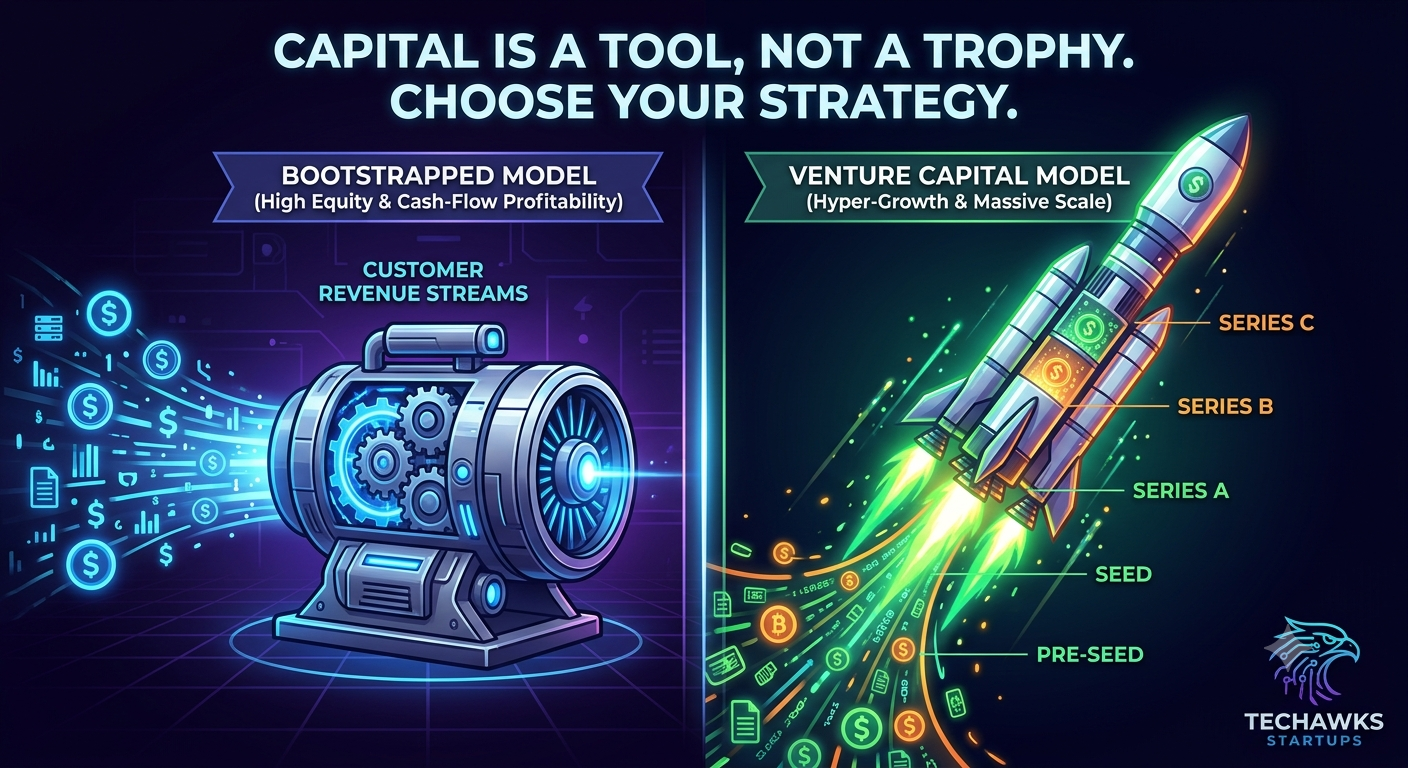
Venture capital is not a badge of honor—it is a specific financial tool designed for high-risk, hyper-growth business models. Choosing between bootstrapping and raising VC fundamentally shapes your company's ownership, growth pace, and ultimate exit options.
Before signing a term sheet or committing to a pitch deck circuit, run your startup idea through these three strategic filters:
1. Market Size & Addressable Velocity
Venture Capital Fit: Your total addressable market (TAM) is in the billions, and winner-take-most network dynamics demand rapid customer acquisition before competitors lock in market share.
Bootstrapping Fit: Your market is specialized or niche, allowing for profitable cash-flow operations without requiring multi-million-dollar land-grab marketing budgets.
2. Unit Economics and Margin Structure
Venture Capital Fit: High upfront engineering and R&D costs require heavy capital injection before reaching operational breakeven (e.g., deep tech, hardware, complex enterprise software).
Bootstrapping Fit: High gross margins and short sales cycles allow customer revenue to directly fund product development, hiring, and day-to-day operations from month one.
3. Founder Alignment and Exit Realities
Venture Capital Fit: You are comfortable trading equity and control for aggressive growth, targeting a large-scale M&A or IPO exit within a 7- to 10-year window.
Bootstrapping Fit: You value long-term equity control, profit distribution, operational flexibility, and building a sustainable business on your own timeline.
Actionable Advice for Early-Stage Founders
Treat fundraising as an deliberate architectural choice, not a default milestone. Build your Minimum Viable Product (MVP) using lean, bootstrapped principles first. Proving customer demand and unit economics with real revenue gives you maximum leverage—whether you choose to remain self-funded or pitch investors from a position of strength.
Key Takeaways
VC is a Speed Engine: Raising capital is about accelerating speed-to-market in massive, winner-take-all sectors—not validating whether an idea works.
Bootstrapping Retains Control: Self-funding aligns growth with real profitability, keeping founders in full command of company direction and equity.
Prove Leverage First: Focus on achieving cash-flow efficiency and customer acquisition before deciding on capital strategy.
CTA
Did you bootstrap your startup or choose the venture capital route? Join Startup Founders & Entrepreneurs to debate funding models, benchmark financial metrics, and trade strategies with fellow founders.
Venture capital is not a badge of honor—it is a specific financial tool designed for high-risk, hyper-growth business models. Choosing between bootstrapping and raising VC fundamentally shapes your company's ownership, growth pace, and ultimate exit options.
Before signing a term sheet or committing to a pitch deck circuit, run your startup idea through these three strategic filters:
1. Market Size & Addressable Velocity
Venture Capital Fit: Your total addressable market (TAM) is in the billions, and winner-take-most network dynamics demand rapid customer acquisition before competitors lock in market share.
Bootstrapping Fit: Your market is specialized or niche, allowing for profitable cash-flow operations without requiring multi-million-dollar land-grab marketing budgets.
2. Unit Economics and Margin Structure
Venture Capital Fit: High upfront engineering and R&D costs require heavy capital injection before reaching operational breakeven (e.g., deep tech, hardware, complex enterprise software).
Bootstrapping Fit: High gross margins and short sales cycles allow customer revenue to directly fund product development, hiring, and day-to-day operations from month one.
3. Founder Alignment and Exit Realities
Venture Capital Fit: You are comfortable trading equity and control for aggressive growth, targeting a large-scale M&A or IPO exit within a 7- to 10-year window.
Bootstrapping Fit: You value long-term equity control, profit distribution, operational flexibility, and building a sustainable business on your own timeline.
Actionable Advice for Early-Stage Founders
Treat fundraising as an deliberate architectural choice, not a default milestone. Build your Minimum Viable Product (MVP) using lean, bootstrapped principles first. Proving customer demand and unit economics with real revenue gives you maximum leverage—whether you choose to remain self-funded or pitch investors from a position of strength.
Key Takeaways
VC is a Speed Engine: Raising capital is about accelerating speed-to-market in massive, winner-take-all sectors—not validating whether an idea works.
Bootstrapping Retains Control: Self-funding aligns growth with real profitability, keeping founders in full command of company direction and equity.
Prove Leverage First: Focus on achieving cash-flow efficiency and customer acquisition before deciding on capital strategy.
CTA
Did you bootstrap your startup or choose the venture capital route? Join Startup Founders & Entrepreneurs to debate funding models, benchmark financial metrics, and trade strategies with fellow founders.
Bootstrapping vs. Venture Capital: How to Choose the Right Capital Strategy for Your Startup
Venture capital is not a badge of honor—it is a specific financial tool designed for high-risk, hyper-growth business models. Choosing between bootstrapping and raising VC fundamentally shapes your company's ownership, growth pace, and ultimate exit options.
Before signing a term sheet or committing to a pitch deck circuit, run your startup idea through these three strategic filters:
1. Market Size & Addressable Velocity
Venture Capital Fit: Your total addressable market (TAM) is in the billions, and winner-take-most network dynamics demand rapid customer acquisition before competitors lock in market share.
Bootstrapping Fit: Your market is specialized or niche, allowing for profitable cash-flow operations without requiring multi-million-dollar land-grab marketing budgets.
2. Unit Economics and Margin Structure
Venture Capital Fit: High upfront engineering and R&D costs require heavy capital injection before reaching operational breakeven (e.g., deep tech, hardware, complex enterprise software).
Bootstrapping Fit: High gross margins and short sales cycles allow customer revenue to directly fund product development, hiring, and day-to-day operations from month one.
3. Founder Alignment and Exit Realities
Venture Capital Fit: You are comfortable trading equity and control for aggressive growth, targeting a large-scale M&A or IPO exit within a 7- to 10-year window.
Bootstrapping Fit: You value long-term equity control, profit distribution, operational flexibility, and building a sustainable business on your own timeline.
Actionable Advice for Early-Stage Founders
Treat fundraising as an deliberate architectural choice, not a default milestone. Build your Minimum Viable Product (MVP) using lean, bootstrapped principles first. Proving customer demand and unit economics with real revenue gives you maximum leverage—whether you choose to remain self-funded or pitch investors from a position of strength.
Key Takeaways
VC is a Speed Engine: Raising capital is about accelerating speed-to-market in massive, winner-take-all sectors—not validating whether an idea works.
Bootstrapping Retains Control: Self-funding aligns growth with real profitability, keeping founders in full command of company direction and equity.
Prove Leverage First: Focus on achieving cash-flow efficiency and customer acquisition before deciding on capital strategy.
CTA
Did you bootstrap your startup or choose the venture capital route? Join Startup Founders & Entrepreneurs to debate funding models, benchmark financial metrics, and trade strategies with fellow founders.

 English
 Arabic
 French
 Spanish
 Portuguese
 Deutsch
 Turkish
 Italiano
 Russian
 Romaian
 Portuguese (Brazil)
 Greek
Greek