


Tool Review: DuckDB + Apache Iceberg & The Death of the "Spark-for-Everything" Reflex
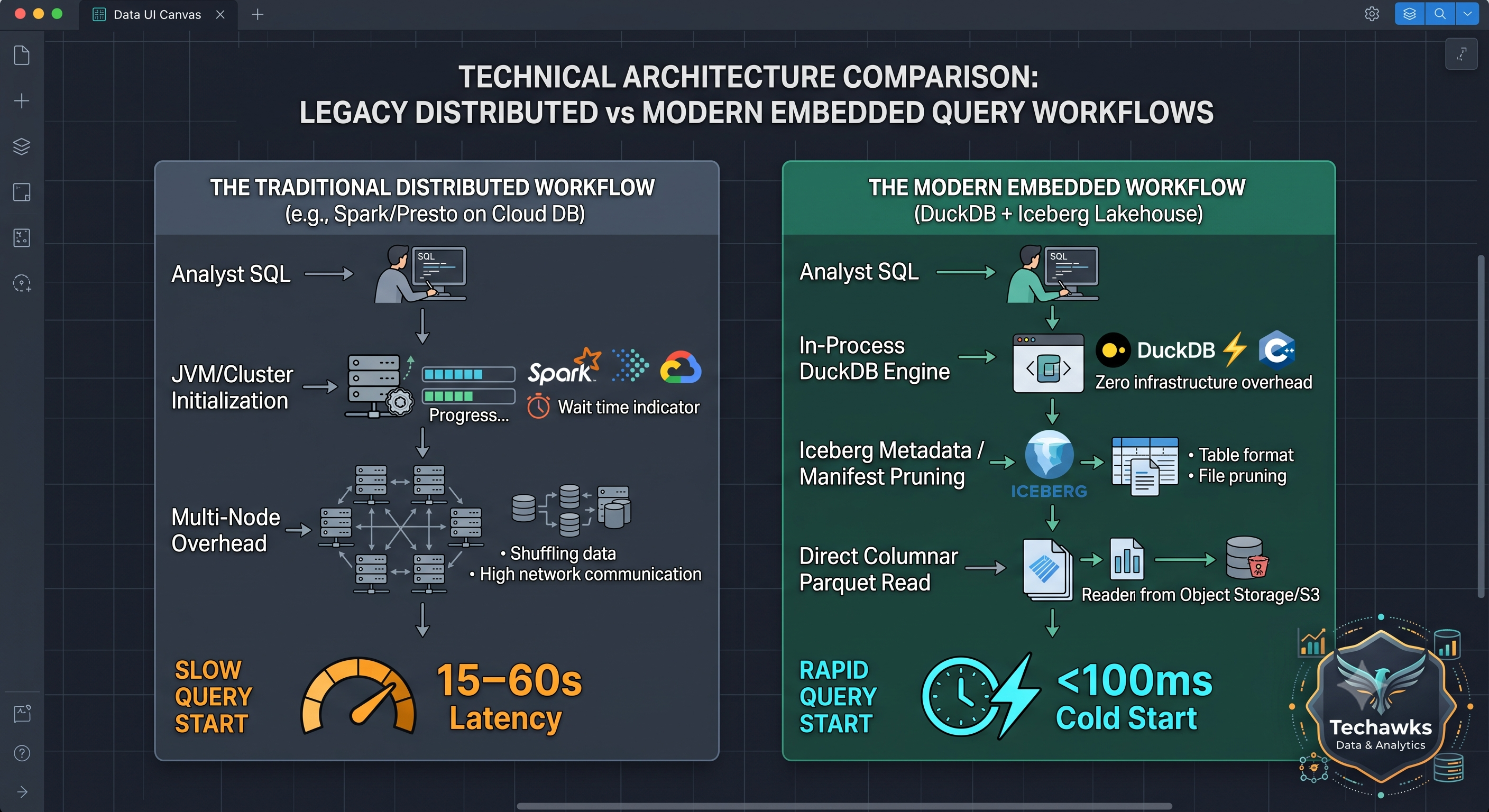
For years, querying Apache Iceberg tables required heavy JVM-based compute engines—such as Apache Spark, Trino, or managed warehouse warehouses. If a data analyst or engineer simply wanted to inspect snapshots, debug null anomalies, or profile an ad-hoc partition, the friction of JVM initialization and cluster spin-up slowed down iteration cycles.
DuckDB's native Iceberg extension changes this paradigm by reading Iceberg metadata hierarchies directly from local disk or S3-compatible cloud storage, executing vectorized SQL queries in-process in milliseconds.
-- 1. Install & load the Iceberg extension
INSTALL iceberg;
LOAD iceberg;
-- 2. Query an Iceberg snapshot directly from object storage with metadata pruning
SELECT
customer_region,
COUNT(order_id) AS total_orders,
ROUND(SUM(net_amount), 2) AS total_revenue
FROM iceberg_scan('s3://prod-lakehouse/data/orders_table')
WHERE order_date >= DATE '2026-08-01'
GROUP BY customer_region;
Why This Tool Matters for Data Teams
File- and Row-Group Pruning: DuckDB parses the Iceberg manifest list and manifest files before touching the underlying Parquet files. It skips entire files and non-matching row groups, streaming only the necessary columnar byte vectors into memory.
Zero JVM / Zero Cluster Overhead: Runs as an embedded, in-process engine within Python, notebooks, or CLI runtimes—eliminating executor scheduling overhead for single-machine workloads (<100GB to 1TB)
Time Travel & Snapshot Auditing: Enables instant time travel via snapshot_id or timestamp parameters, making table auditing and regression debugging effortless without duplicating dataset copies.
3 Practical Rules for Analytics Workflows
Use DuckDB for Exploratory Analysis & CI/CD: Validate data pipeline outputs, schema contracts, and ingestion jobs locally using DuckDB before triggering distributed transformation pipelines.
Push Predicates Early: Structure your queries with explicit partition and column filters so DuckDB can push predicates down directly into the Iceberg manifest reader.
Know the Scaling Boundary: Use DuckDB for single-node ad-hoc analytics and pipeline validation; delegate multi-terabyte shuffle-heavy ETL to distributed engines like Spark or Trino.
Discussion Question
Are you currently running lightweight queries over your open table formats using embedded engines like DuckDB, or is your organization still routing all lakehouse queries through distributed clusters?
CTA
Join Data Science & Analytics in the Techawks Data & Analytics community to exchange production lakehouse patterns, SQL optimization techniques, and modern open-source data architectures.
For years, querying Apache Iceberg tables required heavy JVM-based compute engines—such as Apache Spark, Trino, or managed warehouse warehouses. If a data analyst or engineer simply wanted to inspect snapshots, debug null anomalies, or profile an ad-hoc partition, the friction of JVM initialization and cluster spin-up slowed down iteration cycles.
DuckDB's native Iceberg extension changes this paradigm by reading Iceberg metadata hierarchies directly from local disk or S3-compatible cloud storage, executing vectorized SQL queries in-process in milliseconds.
-- 1. Install & load the Iceberg extension
INSTALL iceberg;
LOAD iceberg;
-- 2. Query an Iceberg snapshot directly from object storage with metadata pruning
SELECT
customer_region,
COUNT(order_id) AS total_orders,
ROUND(SUM(net_amount), 2) AS total_revenue
FROM iceberg_scan('s3://prod-lakehouse/data/orders_table')
WHERE order_date >= DATE '2026-08-01'
GROUP BY customer_region;
Why This Tool Matters for Data Teams
File- and Row-Group Pruning: DuckDB parses the Iceberg manifest list and manifest files before touching the underlying Parquet files. It skips entire files and non-matching row groups, streaming only the necessary columnar byte vectors into memory.
Zero JVM / Zero Cluster Overhead: Runs as an embedded, in-process engine within Python, notebooks, or CLI runtimes—eliminating executor scheduling overhead for single-machine workloads (<100GB to 1TB)
Time Travel & Snapshot Auditing: Enables instant time travel via snapshot_id or timestamp parameters, making table auditing and regression debugging effortless without duplicating dataset copies.
3 Practical Rules for Analytics Workflows
Use DuckDB for Exploratory Analysis & CI/CD: Validate data pipeline outputs, schema contracts, and ingestion jobs locally using DuckDB before triggering distributed transformation pipelines.
Push Predicates Early: Structure your queries with explicit partition and column filters so DuckDB can push predicates down directly into the Iceberg manifest reader.
Know the Scaling Boundary: Use DuckDB for single-node ad-hoc analytics and pipeline validation; delegate multi-terabyte shuffle-heavy ETL to distributed engines like Spark or Trino.
Discussion Question
Are you currently running lightweight queries over your open table formats using embedded engines like DuckDB, or is your organization still routing all lakehouse queries through distributed clusters?
CTA
Join Data Science & Analytics in the Techawks Data & Analytics community to exchange production lakehouse patterns, SQL optimization techniques, and modern open-source data architectures.
Tool Review: DuckDB + Apache Iceberg & The Death of the "Spark-for-Everything" Reflex
For years, querying Apache Iceberg tables required heavy JVM-based compute engines—such as Apache Spark, Trino, or managed warehouse warehouses. If a data analyst or engineer simply wanted to inspect snapshots, debug null anomalies, or profile an ad-hoc partition, the friction of JVM initialization and cluster spin-up slowed down iteration cycles.
DuckDB's native Iceberg extension changes this paradigm by reading Iceberg metadata hierarchies directly from local disk or S3-compatible cloud storage, executing vectorized SQL queries in-process in milliseconds.
-- 1. Install & load the Iceberg extension
INSTALL iceberg;
LOAD iceberg;
-- 2. Query an Iceberg snapshot directly from object storage with metadata pruning
SELECT
customer_region,
COUNT(order_id) AS total_orders,
ROUND(SUM(net_amount), 2) AS total_revenue
FROM iceberg_scan('s3://prod-lakehouse/data/orders_table')
WHERE order_date >= DATE '2026-08-01'
GROUP BY customer_region;
Why This Tool Matters for Data Teams
File- and Row-Group Pruning: DuckDB parses the Iceberg manifest list and manifest files before touching the underlying Parquet files. It skips entire files and non-matching row groups, streaming only the necessary columnar byte vectors into memory.
Zero JVM / Zero Cluster Overhead: Runs as an embedded, in-process engine within Python, notebooks, or CLI runtimes—eliminating executor scheduling overhead for single-machine workloads (<100GB to 1TB)
Time Travel & Snapshot Auditing: Enables instant time travel via snapshot_id or timestamp parameters, making table auditing and regression debugging effortless without duplicating dataset copies.
3 Practical Rules for Analytics Workflows
Use DuckDB for Exploratory Analysis & CI/CD: Validate data pipeline outputs, schema contracts, and ingestion jobs locally using DuckDB before triggering distributed transformation pipelines.
Push Predicates Early: Structure your queries with explicit partition and column filters so DuckDB can push predicates down directly into the Iceberg manifest reader.
Know the Scaling Boundary: Use DuckDB for single-node ad-hoc analytics and pipeline validation; delegate multi-terabyte shuffle-heavy ETL to distributed engines like Spark or Trino.
Discussion Question
Are you currently running lightweight queries over your open table formats using embedded engines like DuckDB, or is your organization still routing all lakehouse queries through distributed clusters?
CTA
Join Data Science & Analytics in the Techawks Data & Analytics community to exchange production lakehouse patterns, SQL optimization techniques, and modern open-source data architectures.

 English
 Arabic
 French
 Spanish
 Portuguese
 Deutsch
 Turkish
 Dutch
Dutch
 Italiano
 Russian
 Romaian
 Portuguese (Brazil)