


Degree vs. Projects: What Actually Lands Your First Tech Role?
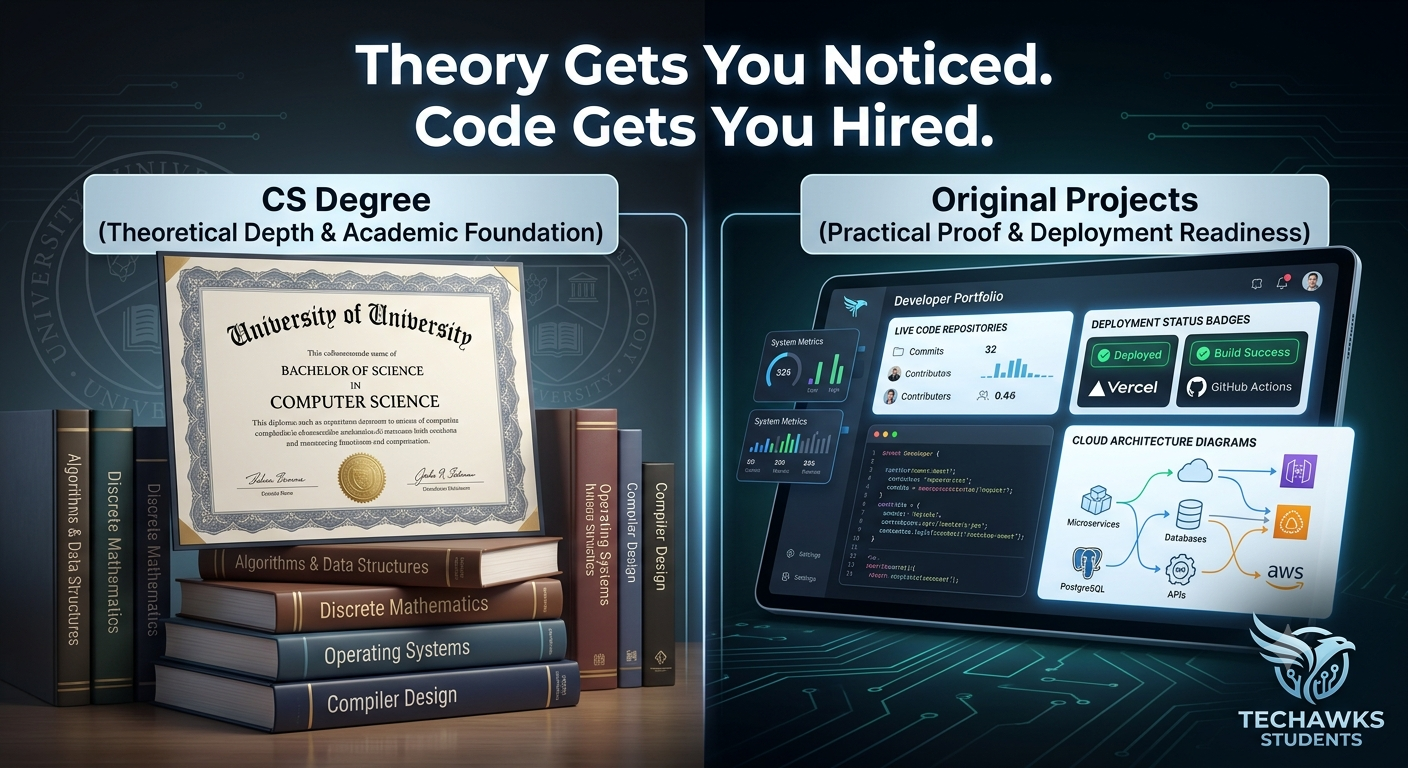
The debate between prioritizing formal academic coursework versus spending time building personal projects is a constant source of anxiety for tech students. To maximize your employability before graduation, you need to understand how recruiters and engineering leads evaluate both assets.
Here is how degree credentials and real-world projects actually compare when launching your tech career:
1. The Computer Science Degree: The Foundation & Filtering Mechanism
A CS degree provides deep, structured exposure to underlying engineering concepts like operating systems, computer architecture, networking, and discrete mathematics.
Where It Helps: Passing automated applicant tracking systems (ATS), meeting baseline requirements for large enterprise companies, and providing long-term conceptual depth for complex system engineering.
Where It Falls Short: Academic curricula often lag behind modern industry toolchains, meaning a CS degree alone rarely proves you can ship production code using current frameworks, CI/CD pipelines, or cloud services.
2. Portfolio Projects: Proof of Execution & Practical Value
Building original, deployed applications demonstrates immediate capability to hiring managers.
Where It Helps: Differentiating your resume from thousands of applicants, proving you can write clean, maintainable code, and providing concrete talking points for technical interviews.
Where It Falls Short: Copying basic tutorial projects (like simple to-do list apps) offers zero competitive advantage. Projects must solve real problems, feature deployment pipelines, and demonstrate code quality.
Actionable Advice for Balancing Both
Don't choose one at the expense of the other—use them synergistically:
Target the Intersection: Use class assignments as opportunities to build non-trivial, deployed projects instead of doing the bare minimum to pass.
Focus on Depth Over Quantity: Two polished, fully deployed applications with working live demos, architecture diagrams, and comprehensive READMEs matter significantly more than ten incomplete tutorial repositories.
Highlight Problem-Solving: Frame your portfolio projects around trade-offs you made (e.g., database choices, state management strategies) rather than just listing tech stack keywords.
Key Takeaways
Degrees Get You Screened, Projects Get You Hired: A degree validates your theoretical foundation, but real-world projects prove you can deliver value on day one.
Quality Over Quantity: Recruiters evaluate candidate portfolios based on depth, documentation, and live deployments—not raw repo counts.
Combine Theory with Modern Tools: Use your academic understanding of algorithms and systems to build well-architected applications with modern frameworks.
CTA
How are you balancing class assignments with personal side projects this semester? Join Students in Tech to share your project repositories, get feedback on your portfolio, and engage in technical discussions with fellow students and senior developers.
The debate between prioritizing formal academic coursework versus spending time building personal projects is a constant source of anxiety for tech students. To maximize your employability before graduation, you need to understand how recruiters and engineering leads evaluate both assets.
Here is how degree credentials and real-world projects actually compare when launching your tech career:
1. The Computer Science Degree: The Foundation & Filtering Mechanism
A CS degree provides deep, structured exposure to underlying engineering concepts like operating systems, computer architecture, networking, and discrete mathematics.
Where It Helps: Passing automated applicant tracking systems (ATS), meeting baseline requirements for large enterprise companies, and providing long-term conceptual depth for complex system engineering.
Where It Falls Short: Academic curricula often lag behind modern industry toolchains, meaning a CS degree alone rarely proves you can ship production code using current frameworks, CI/CD pipelines, or cloud services.
2. Portfolio Projects: Proof of Execution & Practical Value
Building original, deployed applications demonstrates immediate capability to hiring managers.
Where It Helps: Differentiating your resume from thousands of applicants, proving you can write clean, maintainable code, and providing concrete talking points for technical interviews.
Where It Falls Short: Copying basic tutorial projects (like simple to-do list apps) offers zero competitive advantage. Projects must solve real problems, feature deployment pipelines, and demonstrate code quality.
Actionable Advice for Balancing Both
Don't choose one at the expense of the other—use them synergistically:
Target the Intersection: Use class assignments as opportunities to build non-trivial, deployed projects instead of doing the bare minimum to pass.
Focus on Depth Over Quantity: Two polished, fully deployed applications with working live demos, architecture diagrams, and comprehensive READMEs matter significantly more than ten incomplete tutorial repositories.
Highlight Problem-Solving: Frame your portfolio projects around trade-offs you made (e.g., database choices, state management strategies) rather than just listing tech stack keywords.
Key Takeaways
Degrees Get You Screened, Projects Get You Hired: A degree validates your theoretical foundation, but real-world projects prove you can deliver value on day one.
Quality Over Quantity: Recruiters evaluate candidate portfolios based on depth, documentation, and live deployments—not raw repo counts.
Combine Theory with Modern Tools: Use your academic understanding of algorithms and systems to build well-architected applications with modern frameworks.
CTA
How are you balancing class assignments with personal side projects this semester? Join Students in Tech to share your project repositories, get feedback on your portfolio, and engage in technical discussions with fellow students and senior developers.
Degree vs. Projects: What Actually Lands Your First Tech Role?
The debate between prioritizing formal academic coursework versus spending time building personal projects is a constant source of anxiety for tech students. To maximize your employability before graduation, you need to understand how recruiters and engineering leads evaluate both assets.
Here is how degree credentials and real-world projects actually compare when launching your tech career:
1. The Computer Science Degree: The Foundation & Filtering Mechanism
A CS degree provides deep, structured exposure to underlying engineering concepts like operating systems, computer architecture, networking, and discrete mathematics.
Where It Helps: Passing automated applicant tracking systems (ATS), meeting baseline requirements for large enterprise companies, and providing long-term conceptual depth for complex system engineering.
Where It Falls Short: Academic curricula often lag behind modern industry toolchains, meaning a CS degree alone rarely proves you can ship production code using current frameworks, CI/CD pipelines, or cloud services.
2. Portfolio Projects: Proof of Execution & Practical Value
Building original, deployed applications demonstrates immediate capability to hiring managers.
Where It Helps: Differentiating your resume from thousands of applicants, proving you can write clean, maintainable code, and providing concrete talking points for technical interviews.
Where It Falls Short: Copying basic tutorial projects (like simple to-do list apps) offers zero competitive advantage. Projects must solve real problems, feature deployment pipelines, and demonstrate code quality.
Actionable Advice for Balancing Both
Don't choose one at the expense of the other—use them synergistically:
Target the Intersection: Use class assignments as opportunities to build non-trivial, deployed projects instead of doing the bare minimum to pass.
Focus on Depth Over Quantity: Two polished, fully deployed applications with working live demos, architecture diagrams, and comprehensive READMEs matter significantly more than ten incomplete tutorial repositories.
Highlight Problem-Solving: Frame your portfolio projects around trade-offs you made (e.g., database choices, state management strategies) rather than just listing tech stack keywords.
Key Takeaways
Degrees Get You Screened, Projects Get You Hired: A degree validates your theoretical foundation, but real-world projects prove you can deliver value on day one.
Quality Over Quantity: Recruiters evaluate candidate portfolios based on depth, documentation, and live deployments—not raw repo counts.
Combine Theory with Modern Tools: Use your academic understanding of algorithms and systems to build well-architected applications with modern frameworks.
CTA
How are you balancing class assignments with personal side projects this semester? Join Students in Tech to share your project repositories, get feedback on your portfolio, and engage in technical discussions with fellow students and senior developers.

 English
 Arabic
 French
 Spanish
 Portuguese
 Deutsch
 Turkish
 Dutch
Dutch
 Russian
 Romaian
 Portuguese (Brazil)
 Greek
Greek