


How to Build a High-Impact Developer Portfolio Project from Scratch: A Step-by-Step Guide
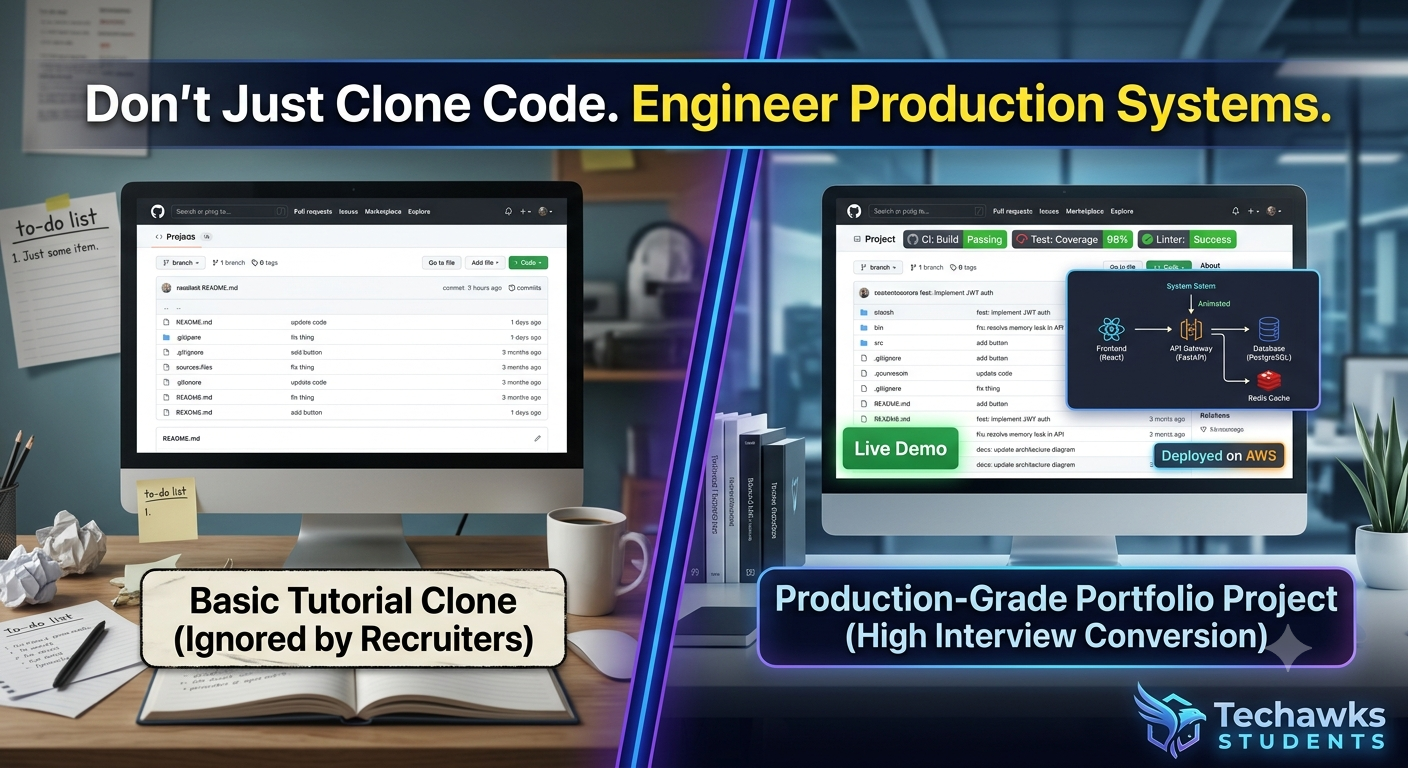
Building a portfolio project that actually lands job interviews requires treating your side project like a production software system. Instead of following a step-by-step video tutorial, build an original application using industry-standard engineering practices.
Follow this 5-step tutorial to transform your next coding idea into a hiring-manager-grade portfolio asset:
Step 1: Solve a Real Problem with a Defined Scope
Avoid generic clone tutorials. Identify a niche workflow problem you or a local organization experience:
Scope It Tight: Limit your core MVP (Minimum Viable Product) to 2–3 core user workflows (e.g., user authentication, data processing, and a visual dashboard).
Define Key Requirements: Document your API endpoints, database models, and application flow before writing a single line of code.
Step 2: Establish a Professional Git Workflow
Hiring managers inspect your GitHub repository commit history to evaluate your daily coding habits.
Write Meaningful Commits: Avoid fixed stuff or update. Use conventional commit messaging (e.g., feat: add JWT authentication endpoint or fix: resolve race condition in queue).
Use Feature Branches: Create pull requests for new features rather than committing directly to the main branch.
Step 3: Integrate Automated Testing and CI/CD
Building code that works on your local machine isn't enough—prove your app is reliable in automated environments.
Write Unit and Integration Tests: Aim for test coverage on critical business logic using frameworks like Jest, PyTest, or JUnit.
Set Up Continuous Integration (CI): Configure GitHub Actions or GitLab CI to run test suites and linter checks automatically on every pull request.
Step 4: Deploy to Production & Instrument Monitoring
A repository without a live demo link significantly reduces engagement from recruiters.
Deploy to Cloud Hosting: Host your frontend and backend on cloud platforms like Vercel, Render, AWS, or GCP with custom environment variables.
Add Health Checks & Logging: Implement structured error logging and basic uptime monitoring to ensure your application remains operational.
Step 5: Write an Executive-Level README
Your README is the documentation homepage for your project. Structure it with clear, professional sections:
Live Demo Link & Screenshots/GIFs: Show the working application immediately at the top.
Architecture Diagram: Include a visual diagram mapping frontend, backend API, database, and third-party services.
Engineering Trade-offs: Briefly document why you chose specific databases, state management tools, or frameworks over alternatives.
Local Setup Instructions: Provide single-command setup steps (docker-compose up or npm install && npm start).
Key Takeaways
Ditch Tutorial Clones: Build original applications that solve specific problems to stand out from generic applicant pools.
Prioritize Engineering Practices: Implement CI/CD pipelines, unit testing, and proper Git branch workflows to prove deployment readiness.
Document Trade-offs: A clear README with architecture diagrams and trade-off explanations demonstrates senior-level critical thinking.
CTA
What portfolio project are you building this semester? Join Students in Tech to get code reviews on your pull requests, collaborate on open-source projects, and get feedback on your portfolio READMEs from experienced engineers.
Building a portfolio project that actually lands job interviews requires treating your side project like a production software system. Instead of following a step-by-step video tutorial, build an original application using industry-standard engineering practices.
Follow this 5-step tutorial to transform your next coding idea into a hiring-manager-grade portfolio asset:
Step 1: Solve a Real Problem with a Defined Scope
Avoid generic clone tutorials. Identify a niche workflow problem you or a local organization experience:
Scope It Tight: Limit your core MVP (Minimum Viable Product) to 2–3 core user workflows (e.g., user authentication, data processing, and a visual dashboard).
Define Key Requirements: Document your API endpoints, database models, and application flow before writing a single line of code.
Step 2: Establish a Professional Git Workflow
Hiring managers inspect your GitHub repository commit history to evaluate your daily coding habits.
Write Meaningful Commits: Avoid fixed stuff or update. Use conventional commit messaging (e.g., feat: add JWT authentication endpoint or fix: resolve race condition in queue).
Use Feature Branches: Create pull requests for new features rather than committing directly to the main branch.
Step 3: Integrate Automated Testing and CI/CD
Building code that works on your local machine isn't enough—prove your app is reliable in automated environments.
Write Unit and Integration Tests: Aim for test coverage on critical business logic using frameworks like Jest, PyTest, or JUnit.
Set Up Continuous Integration (CI): Configure GitHub Actions or GitLab CI to run test suites and linter checks automatically on every pull request.
Step 4: Deploy to Production & Instrument Monitoring
A repository without a live demo link significantly reduces engagement from recruiters.
Deploy to Cloud Hosting: Host your frontend and backend on cloud platforms like Vercel, Render, AWS, or GCP with custom environment variables.
Add Health Checks & Logging: Implement structured error logging and basic uptime monitoring to ensure your application remains operational.
Step 5: Write an Executive-Level README
Your README is the documentation homepage for your project. Structure it with clear, professional sections:
Live Demo Link & Screenshots/GIFs: Show the working application immediately at the top.
Architecture Diagram: Include a visual diagram mapping frontend, backend API, database, and third-party services.
Engineering Trade-offs: Briefly document why you chose specific databases, state management tools, or frameworks over alternatives.
Local Setup Instructions: Provide single-command setup steps (docker-compose up or npm install && npm start).
Key Takeaways
Ditch Tutorial Clones: Build original applications that solve specific problems to stand out from generic applicant pools.
Prioritize Engineering Practices: Implement CI/CD pipelines, unit testing, and proper Git branch workflows to prove deployment readiness.
Document Trade-offs: A clear README with architecture diagrams and trade-off explanations demonstrates senior-level critical thinking.
CTA
What portfolio project are you building this semester? Join Students in Tech to get code reviews on your pull requests, collaborate on open-source projects, and get feedback on your portfolio READMEs from experienced engineers.
How to Build a High-Impact Developer Portfolio Project from Scratch: A Step-by-Step Guide
Building a portfolio project that actually lands job interviews requires treating your side project like a production software system. Instead of following a step-by-step video tutorial, build an original application using industry-standard engineering practices.
Follow this 5-step tutorial to transform your next coding idea into a hiring-manager-grade portfolio asset:
Step 1: Solve a Real Problem with a Defined Scope
Avoid generic clone tutorials. Identify a niche workflow problem you or a local organization experience:
Scope It Tight: Limit your core MVP (Minimum Viable Product) to 2–3 core user workflows (e.g., user authentication, data processing, and a visual dashboard).
Define Key Requirements: Document your API endpoints, database models, and application flow before writing a single line of code.
Step 2: Establish a Professional Git Workflow
Hiring managers inspect your GitHub repository commit history to evaluate your daily coding habits.
Write Meaningful Commits: Avoid fixed stuff or update. Use conventional commit messaging (e.g., feat: add JWT authentication endpoint or fix: resolve race condition in queue).
Use Feature Branches: Create pull requests for new features rather than committing directly to the main branch.
Step 3: Integrate Automated Testing and CI/CD
Building code that works on your local machine isn't enough—prove your app is reliable in automated environments.
Write Unit and Integration Tests: Aim for test coverage on critical business logic using frameworks like Jest, PyTest, or JUnit.
Set Up Continuous Integration (CI): Configure GitHub Actions or GitLab CI to run test suites and linter checks automatically on every pull request.
Step 4: Deploy to Production & Instrument Monitoring
A repository without a live demo link significantly reduces engagement from recruiters.
Deploy to Cloud Hosting: Host your frontend and backend on cloud platforms like Vercel, Render, AWS, or GCP with custom environment variables.
Add Health Checks & Logging: Implement structured error logging and basic uptime monitoring to ensure your application remains operational.
Step 5: Write an Executive-Level README
Your README is the documentation homepage for your project. Structure it with clear, professional sections:
Live Demo Link & Screenshots/GIFs: Show the working application immediately at the top.
Architecture Diagram: Include a visual diagram mapping frontend, backend API, database, and third-party services.
Engineering Trade-offs: Briefly document why you chose specific databases, state management tools, or frameworks over alternatives.
Local Setup Instructions: Provide single-command setup steps (docker-compose up or npm install && npm start).
Key Takeaways
Ditch Tutorial Clones: Build original applications that solve specific problems to stand out from generic applicant pools.
Prioritize Engineering Practices: Implement CI/CD pipelines, unit testing, and proper Git branch workflows to prove deployment readiness.
Document Trade-offs: A clear README with architecture diagrams and trade-off explanations demonstrates senior-level critical thinking.
CTA
What portfolio project are you building this semester? Join Students in Tech to get code reviews on your pull requests, collaborate on open-source projects, and get feedback on your portfolio READMEs from experienced engineers.

 English
 French
 Spanish
 Portuguese
 Deutsch
 Turkish
 Dutch
Dutch
 Italiano
 Russian
 Romaian
 Portuguese (Brazil)
 Greek
Greek