


The Ultimate Technical Resume Checklist: 10 Actionable Checks to Pass ATS and Land Engineering Interviews
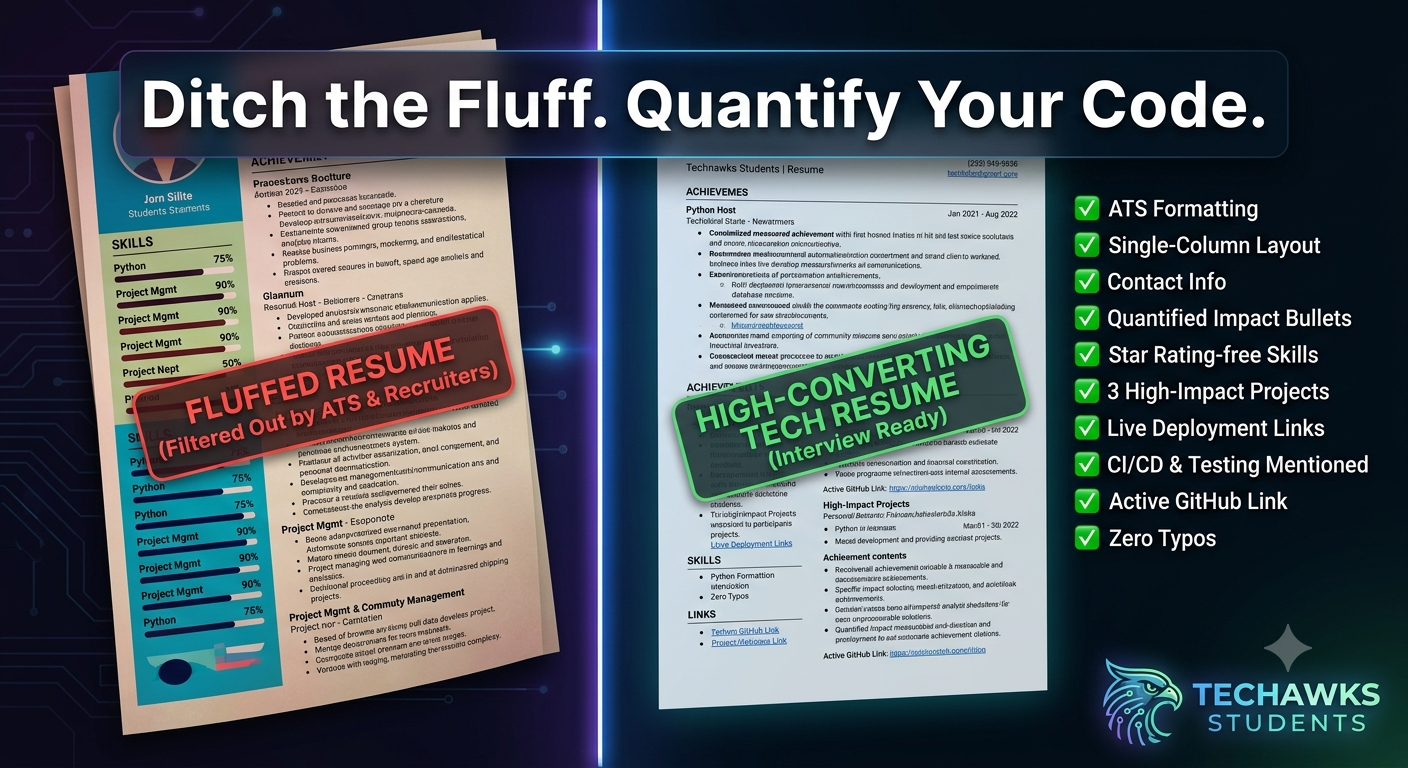
Writing a high-converting technical resume is about removing fluff and highlighting quantifiable impact, relevant stack experience, and deployed code. Whether you're applying to major tech enterprises or fast-growing startups, run your resume through this battle-tested checklist:
Phase 1: Formatting & Structure
1. Clean, Single-Column Layout: Use a single-column, plain-text-friendly layout without tables, graphic progress bars, or profile photos to ensure ATS parsers process your data seamlessly.
2. Strictly One Page: Keep your resume strictly to a single page. Prioritize recent, high-impact technical projects and relevant coursework over unrelated jobs.
3. Active Web & Repository Links: Hyperlink your GitHub profile, LinkedIn, and live project demos at the top under your contact details. Ensure every link is clickable and leads to a live site or active repository.
Phase 2: Technical Skills & Projects
4. Categorized Skills Section: Group your skills clearly (e.g., Languages: Python, TypeScript; Frameworks: React, Node.js; Tools & Databases: Docker, PostgreSQL, AWS). Avoid rating scales or "skill meters."
5. High-Impact Project Titles: Name your personal or open-source projects clearly, accompanied by the primary tech stack used in parentheses (e.g., Distributed Task Queue System — Go, Redis, Docker).
6. The Action-Impact Bullet Formula: Write project bullet points using the Google "XYZ" formula: Accomplished [X], as measured by [Y], by doing [Z]. (e.g., "Reduced API latency by 35% by implementing Redis caching across 5 core endpoints").
Phase 3: Experience & Technical Depth
7. Highlight Industry Toolchains: Include practical engineering tools like Git workflow, CI/CD pipelines, unit testing frameworks, and deployment platforms (e.g., Vercel, AWS, GCP).
8. Relevant Coursework & Achievements: List relevant upper-level computer science electives (e.g., Distributed Systems, Database Management, Operating Systems) rather than entry-level general requirements.
9. Quantified Open-Source & Leadership Contributions: Detail hackathon awards, open-source pull requests, or student tech club leadership roles with specific participant or user counts.
10. Zero Grammar or Syntax Typos: Review code syntax, framework capitalizations (e.g., "JavaScript" instead of "javascript", "PostgreSQL" instead of "postgres"), and grammar before exporting as a standard PDF.
Key Takeaways
Optimize for Parsing First: ATS software and recruiters both favor simple single-column PDF formatting over complex graphic designs.
Quantify Results: Every project bullet point should connect your technical decisions to a measurable output (speed, memory, test coverage, user numbers).
Proof Over Claims: Passive skill lists don't convince hiring managers—showing deployed projects with active links and automated tests does.
CTA
Are you preparing your technical resume for upcoming internship applications or campus hiring drives? Join Students in Tech to get peer resume reviews, trade ATS optimization tips, and benchmark your portfolio with fellow student engineers.
Writing a high-converting technical resume is about removing fluff and highlighting quantifiable impact, relevant stack experience, and deployed code. Whether you're applying to major tech enterprises or fast-growing startups, run your resume through this battle-tested checklist:
Phase 1: Formatting & Structure
1. Clean, Single-Column Layout: Use a single-column, plain-text-friendly layout without tables, graphic progress bars, or profile photos to ensure ATS parsers process your data seamlessly.
2. Strictly One Page: Keep your resume strictly to a single page. Prioritize recent, high-impact technical projects and relevant coursework over unrelated jobs.
3. Active Web & Repository Links: Hyperlink your GitHub profile, LinkedIn, and live project demos at the top under your contact details. Ensure every link is clickable and leads to a live site or active repository.
Phase 2: Technical Skills & Projects
4. Categorized Skills Section: Group your skills clearly (e.g., Languages: Python, TypeScript; Frameworks: React, Node.js; Tools & Databases: Docker, PostgreSQL, AWS). Avoid rating scales or "skill meters."
5. High-Impact Project Titles: Name your personal or open-source projects clearly, accompanied by the primary tech stack used in parentheses (e.g., Distributed Task Queue System — Go, Redis, Docker).
6. The Action-Impact Bullet Formula: Write project bullet points using the Google "XYZ" formula: Accomplished [X], as measured by [Y], by doing [Z]. (e.g., "Reduced API latency by 35% by implementing Redis caching across 5 core endpoints").
Phase 3: Experience & Technical Depth
7. Highlight Industry Toolchains: Include practical engineering tools like Git workflow, CI/CD pipelines, unit testing frameworks, and deployment platforms (e.g., Vercel, AWS, GCP).
8. Relevant Coursework & Achievements: List relevant upper-level computer science electives (e.g., Distributed Systems, Database Management, Operating Systems) rather than entry-level general requirements.
9. Quantified Open-Source & Leadership Contributions: Detail hackathon awards, open-source pull requests, or student tech club leadership roles with specific participant or user counts.
10. Zero Grammar or Syntax Typos: Review code syntax, framework capitalizations (e.g., "JavaScript" instead of "javascript", "PostgreSQL" instead of "postgres"), and grammar before exporting as a standard PDF.
Key Takeaways
Optimize for Parsing First: ATS software and recruiters both favor simple single-column PDF formatting over complex graphic designs.
Quantify Results: Every project bullet point should connect your technical decisions to a measurable output (speed, memory, test coverage, user numbers).
Proof Over Claims: Passive skill lists don't convince hiring managers—showing deployed projects with active links and automated tests does.
CTA
Are you preparing your technical resume for upcoming internship applications or campus hiring drives? Join Students in Tech to get peer resume reviews, trade ATS optimization tips, and benchmark your portfolio with fellow student engineers.
The Ultimate Technical Resume Checklist: 10 Actionable Checks to Pass ATS and Land Engineering Interviews
Writing a high-converting technical resume is about removing fluff and highlighting quantifiable impact, relevant stack experience, and deployed code. Whether you're applying to major tech enterprises or fast-growing startups, run your resume through this battle-tested checklist:
Phase 1: Formatting & Structure
1. Clean, Single-Column Layout: Use a single-column, plain-text-friendly layout without tables, graphic progress bars, or profile photos to ensure ATS parsers process your data seamlessly.
2. Strictly One Page: Keep your resume strictly to a single page. Prioritize recent, high-impact technical projects and relevant coursework over unrelated jobs.
3. Active Web & Repository Links: Hyperlink your GitHub profile, LinkedIn, and live project demos at the top under your contact details. Ensure every link is clickable and leads to a live site or active repository.
Phase 2: Technical Skills & Projects
4. Categorized Skills Section: Group your skills clearly (e.g., Languages: Python, TypeScript; Frameworks: React, Node.js; Tools & Databases: Docker, PostgreSQL, AWS). Avoid rating scales or "skill meters."
5. High-Impact Project Titles: Name your personal or open-source projects clearly, accompanied by the primary tech stack used in parentheses (e.g., Distributed Task Queue System — Go, Redis, Docker).
6. The Action-Impact Bullet Formula: Write project bullet points using the Google "XYZ" formula: Accomplished [X], as measured by [Y], by doing [Z]. (e.g., "Reduced API latency by 35% by implementing Redis caching across 5 core endpoints").
Phase 3: Experience & Technical Depth
7. Highlight Industry Toolchains: Include practical engineering tools like Git workflow, CI/CD pipelines, unit testing frameworks, and deployment platforms (e.g., Vercel, AWS, GCP).
8. Relevant Coursework & Achievements: List relevant upper-level computer science electives (e.g., Distributed Systems, Database Management, Operating Systems) rather than entry-level general requirements.
9. Quantified Open-Source & Leadership Contributions: Detail hackathon awards, open-source pull requests, or student tech club leadership roles with specific participant or user counts.
10. Zero Grammar or Syntax Typos: Review code syntax, framework capitalizations (e.g., "JavaScript" instead of "javascript", "PostgreSQL" instead of "postgres"), and grammar before exporting as a standard PDF.
Key Takeaways
Optimize for Parsing First: ATS software and recruiters both favor simple single-column PDF formatting over complex graphic designs.
Quantify Results: Every project bullet point should connect your technical decisions to a measurable output (speed, memory, test coverage, user numbers).
Proof Over Claims: Passive skill lists don't convince hiring managers—showing deployed projects with active links and automated tests does.
CTA
Are you preparing your technical resume for upcoming internship applications or campus hiring drives? Join Students in Tech to get peer resume reviews, trade ATS optimization tips, and benchmark your portfolio with fellow student engineers.

 English
 Arabic
 French
 Spanish
 Deutsch
 Turkish
 Dutch
Dutch
 Italiano
 Russian
 Romaian
 Portuguese (Brazil)
 Greek
Greek