


Why Memory Bandwidth—Not Flops—Is the Real Bottleneck in AI Inference (And How Speculative Decoding Solves It)
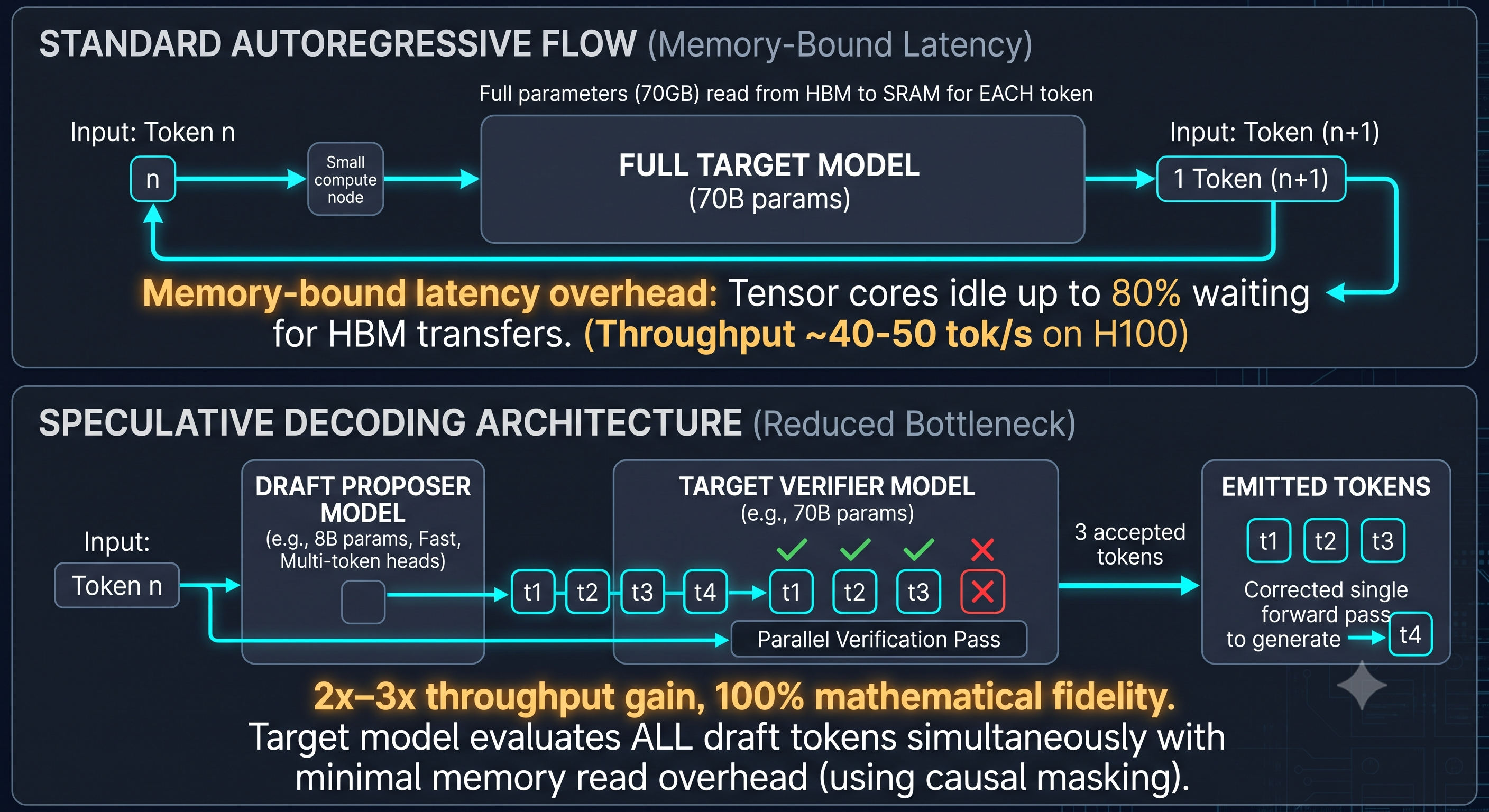
In standard autoregressive generation, generating 1 token requires loading every single parameter of a model from High Bandwidth Memory (HBM) into SRAM/compute units.
For a 70-billion-parameter model in 8-bit precision: 70 GB of weights must travel through the memory bus for every single token generated.
Even on an NVIDIA H100 (3.35 TB/s memory bandwidth), physical memory throughput limits standard single-batch generation speed to ~40–50 tokens/second.
The tensor cores spend most of their clock cycles waiting for memory transfers (memory-bound, Arithmetic Intensity \ll Hardware Capability).
The Solution: Speculative Decoding
Instead of loading 70B parameters sequentially N X N tokens, we decouple drafting from verification:
Lightweight Draft Proposer: A tiny, ultra-fast model (e.g., an 8B model or multi-token speculation head) rapidly drafts a sequence of K candidate tokens. Parallel Verification Forward Pass: The large target model evaluates all K candidate tokens simultaneously in a single forward pass using causal masking.
Lossless Acceptance: Through rejection sampling, the target model accepts matching tokens and corrects the first divergence.
The Engineering Takeaway:
Because transformer forward passes over $K$ tokens can be computed in parallel with minimal extra memory read overhead compared to 1 token, you achieve a 2x–3x latency reduction without losing mathematical accuracy or model quality.
Discussion Question & Poll
What is your primary architectural bottleneck when serving LLMs in production?
📊 A) Time to First Token (TTFT) / Prompt ingestion latency
📊 B) Inter-Token Latency (ITL) / Memory bandwidth bounds
📊 C) GPU VRAM limits / KV-cache capacity
📊 D) Inference operational cost ($ per 1M tokens)
Drop your infrastructure setup and framework choice (vLLM, TensorRT-LLM, TGI, SGLang) in the comments!
Call to Action (CTA)
Ready to master high-performance AI infrastructure, systems engineering, and full-stack software architecture?
👉 Join the Techawks General Community to connect with engineers building the future of distributed systems and scalable technology.
In standard autoregressive generation, generating 1 token requires loading every single parameter of a model from High Bandwidth Memory (HBM) into SRAM/compute units.
For a 70-billion-parameter model in 8-bit precision: 70 GB of weights must travel through the memory bus for every single token generated.
Even on an NVIDIA H100 (3.35 TB/s memory bandwidth), physical memory throughput limits standard single-batch generation speed to ~40–50 tokens/second.
The tensor cores spend most of their clock cycles waiting for memory transfers (memory-bound, Arithmetic Intensity \ll Hardware Capability).
The Solution: Speculative Decoding
Instead of loading 70B parameters sequentially N X N tokens, we decouple drafting from verification:
Lightweight Draft Proposer: A tiny, ultra-fast model (e.g., an 8B model or multi-token speculation head) rapidly drafts a sequence of K candidate tokens. Parallel Verification Forward Pass: The large target model evaluates all K candidate tokens simultaneously in a single forward pass using causal masking.
Lossless Acceptance: Through rejection sampling, the target model accepts matching tokens and corrects the first divergence.
The Engineering Takeaway:
Because transformer forward passes over $K$ tokens can be computed in parallel with minimal extra memory read overhead compared to 1 token, you achieve a 2x–3x latency reduction without losing mathematical accuracy or model quality.
Discussion Question & Poll
What is your primary architectural bottleneck when serving LLMs in production?
📊 A) Time to First Token (TTFT) / Prompt ingestion latency
📊 B) Inter-Token Latency (ITL) / Memory bandwidth bounds
📊 C) GPU VRAM limits / KV-cache capacity
📊 D) Inference operational cost ($ per 1M tokens)
Drop your infrastructure setup and framework choice (vLLM, TensorRT-LLM, TGI, SGLang) in the comments!
Call to Action (CTA)
Ready to master high-performance AI infrastructure, systems engineering, and full-stack software architecture?
👉 Join the Techawks General Community to connect with engineers building the future of distributed systems and scalable technology.
Why Memory Bandwidth—Not Flops—Is the Real Bottleneck in AI Inference (And How Speculative Decoding Solves It)
In standard autoregressive generation, generating 1 token requires loading every single parameter of a model from High Bandwidth Memory (HBM) into SRAM/compute units.
For a 70-billion-parameter model in 8-bit precision: 70 GB of weights must travel through the memory bus for every single token generated.
Even on an NVIDIA H100 (3.35 TB/s memory bandwidth), physical memory throughput limits standard single-batch generation speed to ~40–50 tokens/second.
The tensor cores spend most of their clock cycles waiting for memory transfers (memory-bound, Arithmetic Intensity \ll Hardware Capability).
The Solution: Speculative Decoding
Instead of loading 70B parameters sequentially N X N tokens, we decouple drafting from verification:
Lightweight Draft Proposer: A tiny, ultra-fast model (e.g., an 8B model or multi-token speculation head) rapidly drafts a sequence of K candidate tokens. Parallel Verification Forward Pass: The large target model evaluates all K candidate tokens simultaneously in a single forward pass using causal masking.
Lossless Acceptance: Through rejection sampling, the target model accepts matching tokens and corrects the first divergence.
The Engineering Takeaway:
Because transformer forward passes over $K$ tokens can be computed in parallel with minimal extra memory read overhead compared to 1 token, you achieve a 2x–3x latency reduction without losing mathematical accuracy or model quality.
Discussion Question & Poll
What is your primary architectural bottleneck when serving LLMs in production?
📊 A) Time to First Token (TTFT) / Prompt ingestion latency
📊 B) Inter-Token Latency (ITL) / Memory bandwidth bounds
📊 C) GPU VRAM limits / KV-cache capacity
📊 D) Inference operational cost ($ per 1M tokens)
Drop your infrastructure setup and framework choice (vLLM, TensorRT-LLM, TGI, SGLang) in the comments!
Call to Action (CTA)
Ready to master high-performance AI infrastructure, systems engineering, and full-stack software architecture?
👉 Join the Techawks General Community to connect with engineers building the future of distributed systems and scalable technology.

 English
 Arabic
 French
 Spanish
 Portuguese
 Deutsch
 Turkish
 Dutch
Dutch
 Russian
 Romaian
 Portuguese (Brazil)
 Greek
Greek