


Zero Trust Architecture vs. Perimeter Security: Is the Traditional Network Defense Dead?
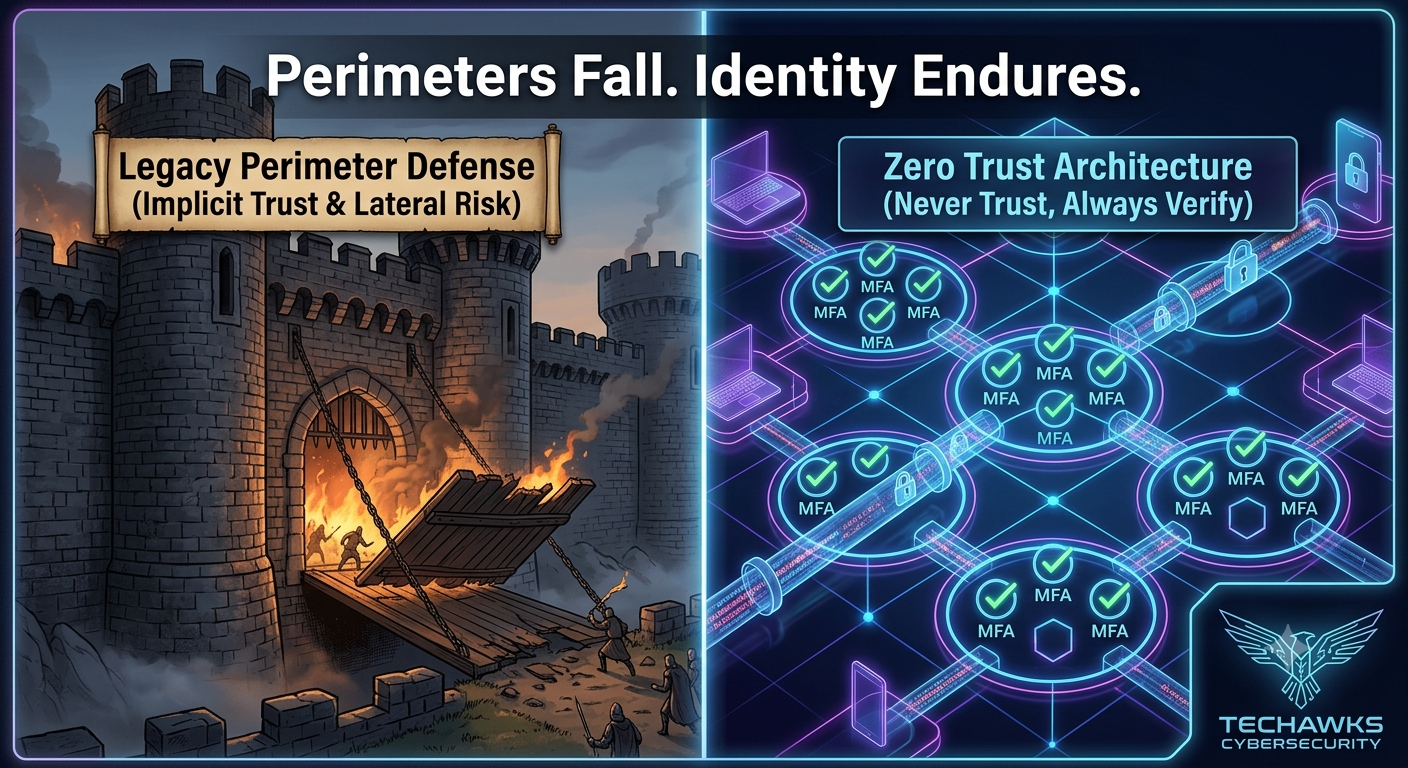
The shift toward Zero Trust Architecture (ZTA) represents a fundamental evolution in how security teams approach network access and identity verification. Rather than assuming internal traffic is inherently safe, Zero Trust operates on a simple mandate: "Never trust, always verify."
To evaluate where cybersecurity strategy is heading, it is crucial to analyze how these two models compare in production environments:
1. Perimeter Security (Castle-and-Moat)
The Core Premise: Focuses heavily on defending the boundary of a network. Once a user or device passes initial authentication (via VPN, firewall, or gateway), they are granted broad access to internal resources.
The Vulnerability: If an attacker compromises a single endpoint or steals internal VPN credentials, they gain lateral movement privileges, allowing them to scan databases, pivot across servers, and exfiltrate sensitive data undetected.
2. Zero Trust Architecture (Micro-Segmentation & Continuous Auth)
The Core Premise: Removes implicit trust based on network location. Every access request—whether originating inside or outside the corporate network—must be authenticated, authorized, and encrypted before access is granted.
Key Mechanisms:
Identity-First Security: Access is granted based on verified identity, device health, and context rather than IP addresses.
Least Privilege Access: Users only receive the minimum permissions necessary to perform their specific role (Role-Based Access Control / ABAC).
Micro-segmentation: Networks are isolated into tiny zones to prevent lateral movement during a breach.
Actionable Advice for Security Learners & Analysts
Moving to Zero Trust doesn't mean firewalls and perimeter tools are useless—it means they can no longer stand alone as your primary defense:
Start with Identity Management: Prioritize learning identity and access management (IAM) platforms, multi-factor authentication (MFA) protocols, and Single Sign-On (SSO) integrations.
Master Micro-Segmentation: Understand how cloud networks (AWS VPCs, Azure VNets) use security groups and network policies to isolate microservices.
Assume Breach: Design network policies under the assumption that an attacker is already inside the network segment.
Key Takeaways
Perimeter Alone Is Insufficient: Internal network location no longer guarantees that a device or user is benign.
Verify Continuously: Zero Trust relies on continuous identity verification, device compliance checks, and least-privilege access rules.
Contain Lateral Movement: Implementing micro-segmentation limits the blast radius if an individual endpoint or account is compromised.
CTA
How is your organization or lab environment balancing traditional firewalls with Zero Trust access controls? Join Cybersecurity & Ethical Hacking to share your architecture diagrams, discuss IAM strategies, and collaborate with fellow security researchers.
The shift toward Zero Trust Architecture (ZTA) represents a fundamental evolution in how security teams approach network access and identity verification. Rather than assuming internal traffic is inherently safe, Zero Trust operates on a simple mandate: "Never trust, always verify."
To evaluate where cybersecurity strategy is heading, it is crucial to analyze how these two models compare in production environments:
1. Perimeter Security (Castle-and-Moat)
The Core Premise: Focuses heavily on defending the boundary of a network. Once a user or device passes initial authentication (via VPN, firewall, or gateway), they are granted broad access to internal resources.
The Vulnerability: If an attacker compromises a single endpoint or steals internal VPN credentials, they gain lateral movement privileges, allowing them to scan databases, pivot across servers, and exfiltrate sensitive data undetected.
2. Zero Trust Architecture (Micro-Segmentation & Continuous Auth)
The Core Premise: Removes implicit trust based on network location. Every access request—whether originating inside or outside the corporate network—must be authenticated, authorized, and encrypted before access is granted.
Key Mechanisms:
Identity-First Security: Access is granted based on verified identity, device health, and context rather than IP addresses.
Least Privilege Access: Users only receive the minimum permissions necessary to perform their specific role (Role-Based Access Control / ABAC).
Micro-segmentation: Networks are isolated into tiny zones to prevent lateral movement during a breach.
Actionable Advice for Security Learners & Analysts
Moving to Zero Trust doesn't mean firewalls and perimeter tools are useless—it means they can no longer stand alone as your primary defense:
Start with Identity Management: Prioritize learning identity and access management (IAM) platforms, multi-factor authentication (MFA) protocols, and Single Sign-On (SSO) integrations.
Master Micro-Segmentation: Understand how cloud networks (AWS VPCs, Azure VNets) use security groups and network policies to isolate microservices.
Assume Breach: Design network policies under the assumption that an attacker is already inside the network segment.
Key Takeaways
Perimeter Alone Is Insufficient: Internal network location no longer guarantees that a device or user is benign.
Verify Continuously: Zero Trust relies on continuous identity verification, device compliance checks, and least-privilege access rules.
Contain Lateral Movement: Implementing micro-segmentation limits the blast radius if an individual endpoint or account is compromised.
CTA
How is your organization or lab environment balancing traditional firewalls with Zero Trust access controls? Join Cybersecurity & Ethical Hacking to share your architecture diagrams, discuss IAM strategies, and collaborate with fellow security researchers.
Zero Trust Architecture vs. Perimeter Security: Is the Traditional Network Defense Dead?
The shift toward Zero Trust Architecture (ZTA) represents a fundamental evolution in how security teams approach network access and identity verification. Rather than assuming internal traffic is inherently safe, Zero Trust operates on a simple mandate: "Never trust, always verify."
To evaluate where cybersecurity strategy is heading, it is crucial to analyze how these two models compare in production environments:
1. Perimeter Security (Castle-and-Moat)
The Core Premise: Focuses heavily on defending the boundary of a network. Once a user or device passes initial authentication (via VPN, firewall, or gateway), they are granted broad access to internal resources.
The Vulnerability: If an attacker compromises a single endpoint or steals internal VPN credentials, they gain lateral movement privileges, allowing them to scan databases, pivot across servers, and exfiltrate sensitive data undetected.
2. Zero Trust Architecture (Micro-Segmentation & Continuous Auth)
The Core Premise: Removes implicit trust based on network location. Every access request—whether originating inside or outside the corporate network—must be authenticated, authorized, and encrypted before access is granted.
Key Mechanisms:
Identity-First Security: Access is granted based on verified identity, device health, and context rather than IP addresses.
Least Privilege Access: Users only receive the minimum permissions necessary to perform their specific role (Role-Based Access Control / ABAC).
Micro-segmentation: Networks are isolated into tiny zones to prevent lateral movement during a breach.
Actionable Advice for Security Learners & Analysts
Moving to Zero Trust doesn't mean firewalls and perimeter tools are useless—it means they can no longer stand alone as your primary defense:
Start with Identity Management: Prioritize learning identity and access management (IAM) platforms, multi-factor authentication (MFA) protocols, and Single Sign-On (SSO) integrations.
Master Micro-Segmentation: Understand how cloud networks (AWS VPCs, Azure VNets) use security groups and network policies to isolate microservices.
Assume Breach: Design network policies under the assumption that an attacker is already inside the network segment.
Key Takeaways
Perimeter Alone Is Insufficient: Internal network location no longer guarantees that a device or user is benign.
Verify Continuously: Zero Trust relies on continuous identity verification, device compliance checks, and least-privilege access rules.
Contain Lateral Movement: Implementing micro-segmentation limits the blast radius if an individual endpoint or account is compromised.
CTA
How is your organization or lab environment balancing traditional firewalls with Zero Trust access controls? Join Cybersecurity & Ethical Hacking to share your architecture diagrams, discuss IAM strategies, and collaborate with fellow security researchers.

 English
 Arabic
 French
 Spanish
 Portuguese
 Deutsch
 Dutch
Dutch
 Italiano
 Russian
 Romaian
 Portuguese (Brazil)
 Greek
Greek