


Why Copy-Pasting AI Code Is Slowing Your Learning Down (And the "Reverse Code Review" Technique)
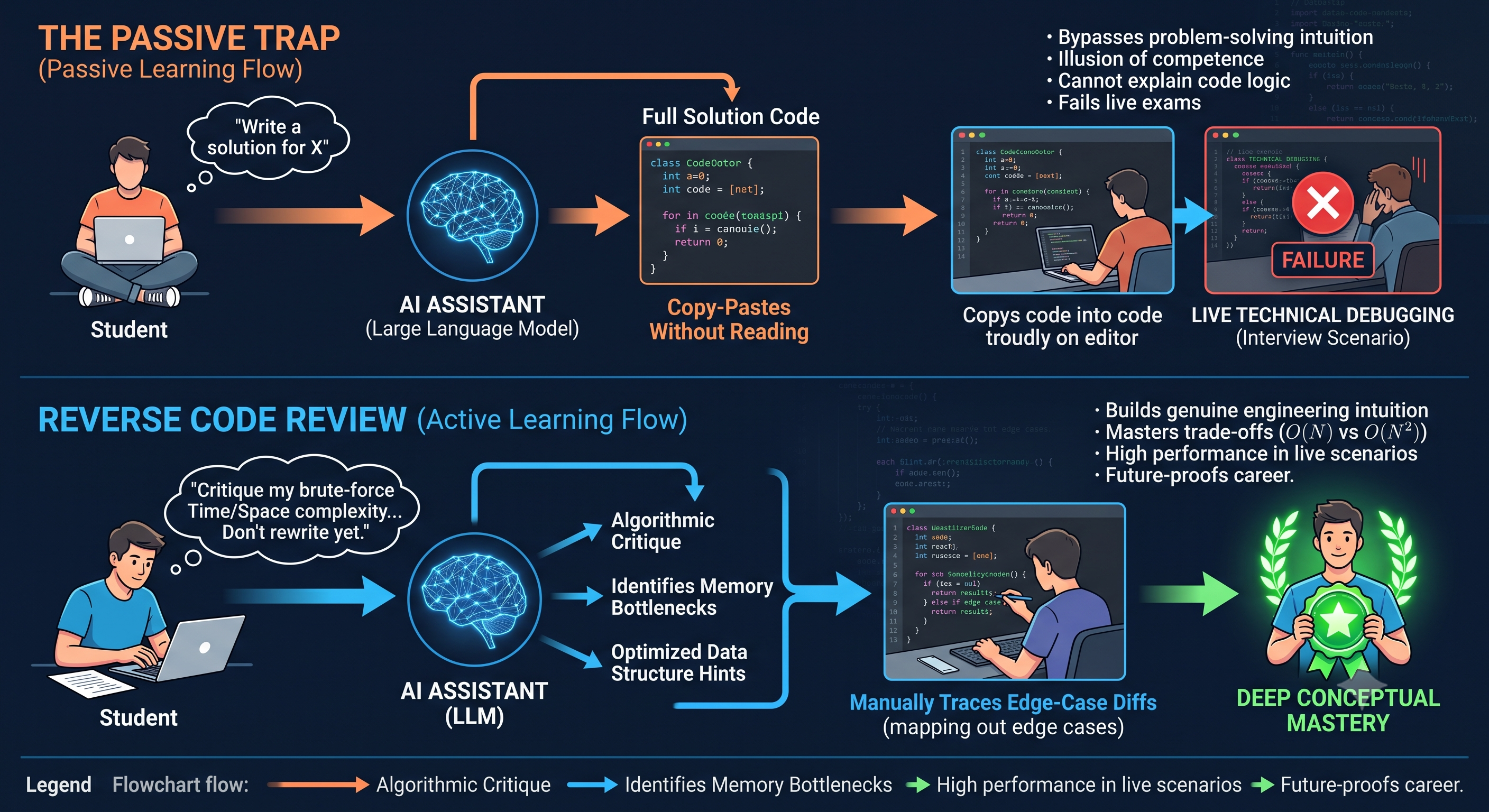
When you let an AI write code for a problem you haven't solved yourself, you experience the Illusion of Competence: reading working code feels easy, but producing it from a blank file remains impossible.
To build genuine engineering intuition while still leveraging modern tools, flip the workflow:
The Reverse Code Review Framework
Write the Naive Implementation First: Solve the problem yourself using basic loops, brute force, or pseudocode—without touching AI.
Prompt for Code Review, Not Code Generation: Instead of prompting "Write a solution for X", prompt:
"Here is my brute-force solution in Python. Do not rewrite it yet. Critique my Time/Space complexity ($O(N)$), identify memory bottlenecks, and hint at which data structure reduces the lookup time."
Trace the Diff by Hand: When the AI suggests an optimized pattern (e.g., swapping a nested loop for a Hash Map or Two-Pointer approach), write down the step-by-step memory state for 3 test inputs before running the code.
The "Explain-Back" Verification: Ask the model to generate 2 hidden edge cases designed to break your updated code. Debug those failures manually.
The Student Takeaway:
Treat AI like a senior engineer conducting a pull request review on your work, not an automated ghostwriter. Your competitive edge as a student isn't typing speed—it's mental models and debugging ability.
Discussion Question & Poll
How do you currently integrate AI tools into your daily coding and study routine?
📊 A) Interactive Tutor (Asking for conceptual explanations & mental models)
📊 B) Code Reviewer & Debugger (Fixing errors & optimizing my own code)
📊 C) Rapid Prototyping (Generating boilerplate & scaffolding)
📊 D) Solution Generator (Writing functions directly from problem prompts)
What is the most effective prompt you use to study complex algorithms? Share it in the comments!
Call to Action (CTA)
Ready to master core computer science fundamentals, build standout projects, and level up alongside ambitious peers?
👉 Join Students in Tech to access peer study groups, live coding challenges, and student developer resources.
When you let an AI write code for a problem you haven't solved yourself, you experience the Illusion of Competence: reading working code feels easy, but producing it from a blank file remains impossible.
To build genuine engineering intuition while still leveraging modern tools, flip the workflow:
The Reverse Code Review Framework
Write the Naive Implementation First: Solve the problem yourself using basic loops, brute force, or pseudocode—without touching AI.
Prompt for Code Review, Not Code Generation: Instead of prompting "Write a solution for X", prompt:
"Here is my brute-force solution in Python. Do not rewrite it yet. Critique my Time/Space complexity ($O(N)$), identify memory bottlenecks, and hint at which data structure reduces the lookup time."
Trace the Diff by Hand: When the AI suggests an optimized pattern (e.g., swapping a nested loop for a Hash Map or Two-Pointer approach), write down the step-by-step memory state for 3 test inputs before running the code.
The "Explain-Back" Verification: Ask the model to generate 2 hidden edge cases designed to break your updated code. Debug those failures manually.
The Student Takeaway:
Treat AI like a senior engineer conducting a pull request review on your work, not an automated ghostwriter. Your competitive edge as a student isn't typing speed—it's mental models and debugging ability.
Discussion Question & Poll
How do you currently integrate AI tools into your daily coding and study routine?
📊 A) Interactive Tutor (Asking for conceptual explanations & mental models)
📊 B) Code Reviewer & Debugger (Fixing errors & optimizing my own code)
📊 C) Rapid Prototyping (Generating boilerplate & scaffolding)
📊 D) Solution Generator (Writing functions directly from problem prompts)
What is the most effective prompt you use to study complex algorithms? Share it in the comments!
Call to Action (CTA)
Ready to master core computer science fundamentals, build standout projects, and level up alongside ambitious peers?
👉 Join Students in Tech to access peer study groups, live coding challenges, and student developer resources.
Why Copy-Pasting AI Code Is Slowing Your Learning Down (And the "Reverse Code Review" Technique)
When you let an AI write code for a problem you haven't solved yourself, you experience the Illusion of Competence: reading working code feels easy, but producing it from a blank file remains impossible.
To build genuine engineering intuition while still leveraging modern tools, flip the workflow:
The Reverse Code Review Framework
Write the Naive Implementation First: Solve the problem yourself using basic loops, brute force, or pseudocode—without touching AI.
Prompt for Code Review, Not Code Generation: Instead of prompting "Write a solution for X", prompt:
"Here is my brute-force solution in Python. Do not rewrite it yet. Critique my Time/Space complexity ($O(N)$), identify memory bottlenecks, and hint at which data structure reduces the lookup time."
Trace the Diff by Hand: When the AI suggests an optimized pattern (e.g., swapping a nested loop for a Hash Map or Two-Pointer approach), write down the step-by-step memory state for 3 test inputs before running the code.
The "Explain-Back" Verification: Ask the model to generate 2 hidden edge cases designed to break your updated code. Debug those failures manually.
The Student Takeaway:
Treat AI like a senior engineer conducting a pull request review on your work, not an automated ghostwriter. Your competitive edge as a student isn't typing speed—it's mental models and debugging ability.
Discussion Question & Poll
How do you currently integrate AI tools into your daily coding and study routine?
📊 A) Interactive Tutor (Asking for conceptual explanations & mental models)
📊 B) Code Reviewer & Debugger (Fixing errors & optimizing my own code)
📊 C) Rapid Prototyping (Generating boilerplate & scaffolding)
📊 D) Solution Generator (Writing functions directly from problem prompts)
What is the most effective prompt you use to study complex algorithms? Share it in the comments!
Call to Action (CTA)
Ready to master core computer science fundamentals, build standout projects, and level up alongside ambitious peers?
👉 Join Students in Tech to access peer study groups, live coding challenges, and student developer resources.

 English
 Arabic
 French
 Spanish
 Portuguese
 Deutsch
 Turkish
 Italiano
 Russian
 Romaian
 Portuguese (Brazil)
 Greek
Greek