


Why Classical TLS Handshakes Are Vulnerable Today: The Mechanics of "Harvest Now, Decrypt Later" and Hybrid Key Exchange
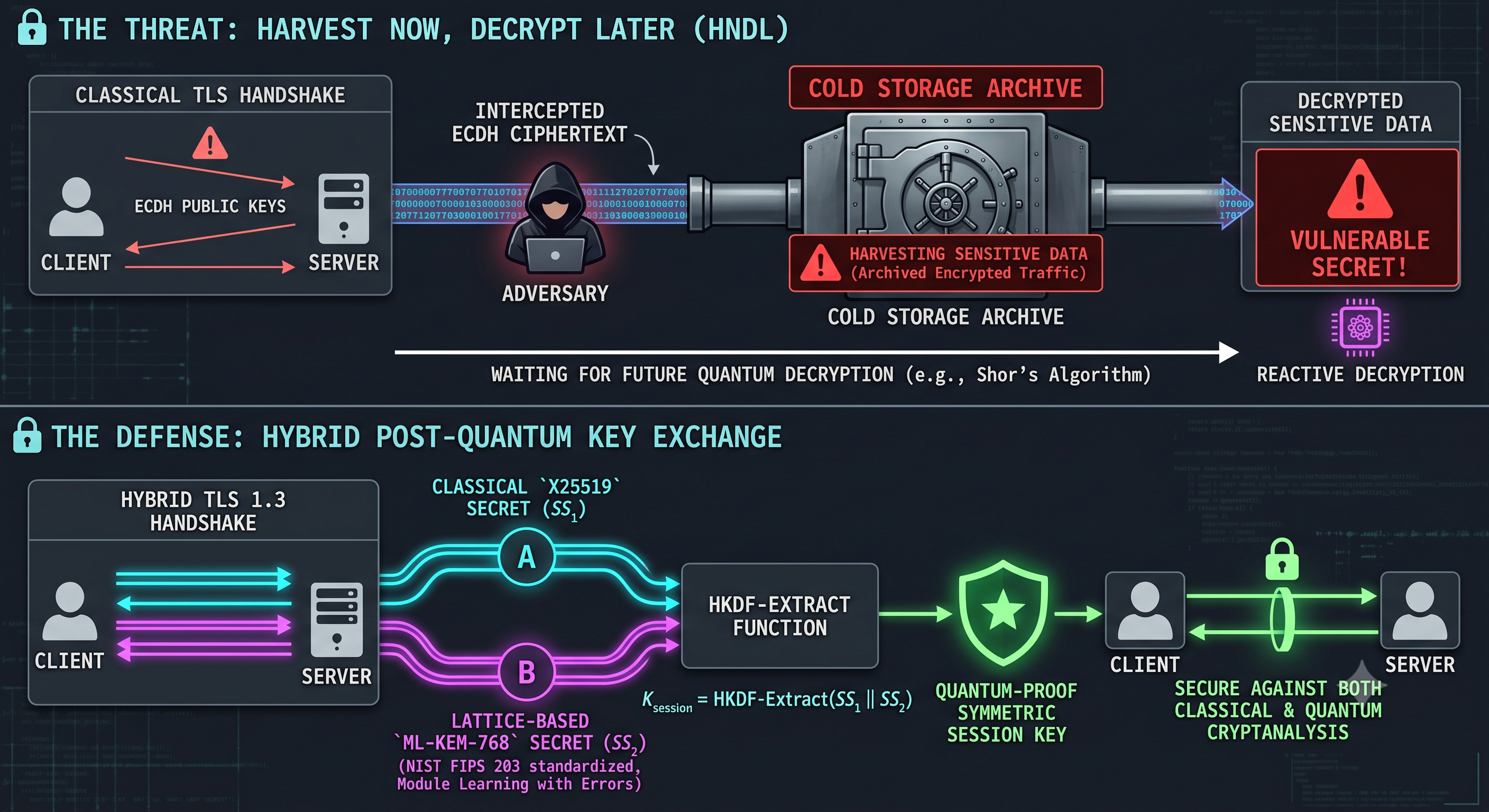
The greatest immediate threat from quantum computing is not real-time decryption; it is HNDL (Harvest Now, Decrypt Later). Adversaries intercept and archive encrypted sessions containing long-lived secrets (financial ledgers, state secrets, medical records, proprietary source code), banking on future quantum hardware running Shor’s algorithm to factor discrete logarithms and derive private keys retroactively.
The Solution: Hybrid Key Encapsulation
Rather than ripping out battle-tested classical cryptography overnight, security engineering teams are implementing Hybrid Post-Quantum Key Exchange (e.g., X25519MLKEM768):
Dual Key Agreement: The client and server generate two key pairs during the TLS 1.3 handshake:
A classical Elliptic Curve Diffie-Hellman key pair (X25519).
A lattice-based Post-Quantum Key Encapsulation Mechanism key pair (ML-KEM-768, standardized under NIST FIPS 203).
Dual Shared Secret Generation: The key exchange derives two distinct shared secrets (SS classical and SS pqr over the wire.HKDF Combination: The final symmetric encryption session key is derived by feeding both secrets into a single Key Derivation Function:
K session = HKDF-Extract SS classical // SSpqc
The Security Takeaway:
An adversary must break both independent mathematical problems (the elliptic curve discrete logarithm AND Module Learning with Errors) to decrypt the captured traffic. If either algorithm holds, the entire session remains secure against retrospective decryption.
Discussion Question & Poll
What is your organization's biggest hurdle in deploying Post-Quantum Cryptography (PQC)?
📊 A) Larger key/ciphertext sizes causing network MTU fragmentation
📊 B) Upgrading legacy hardware/embedded devices with crypto-agility
📊 C) Managing complex PKI, certificate authority, and code-signing transitions
📊 D) Lack of audit visibility into existing cryptographic inventories
What's your current timeline for enabling hybrid PQC in your edge gateways and load balancers? Let's discuss in the comments!
Call to Action (CTA)
Ready to master offensive security, defensive engineering, and modern cryptographic protocols?
👉 Join Cybersecurity & Ethical Hacking to analyze real-world vulnerabilities, audit security architectures, and connect with security researchers.
The greatest immediate threat from quantum computing is not real-time decryption; it is HNDL (Harvest Now, Decrypt Later). Adversaries intercept and archive encrypted sessions containing long-lived secrets (financial ledgers, state secrets, medical records, proprietary source code), banking on future quantum hardware running Shor’s algorithm to factor discrete logarithms and derive private keys retroactively.
The Solution: Hybrid Key Encapsulation
Rather than ripping out battle-tested classical cryptography overnight, security engineering teams are implementing Hybrid Post-Quantum Key Exchange (e.g., X25519MLKEM768):
Dual Key Agreement: The client and server generate two key pairs during the TLS 1.3 handshake:
A classical Elliptic Curve Diffie-Hellman key pair (X25519).
A lattice-based Post-Quantum Key Encapsulation Mechanism key pair (ML-KEM-768, standardized under NIST FIPS 203).
Dual Shared Secret Generation: The key exchange derives two distinct shared secrets (SS classical and SS pqr over the wire.HKDF Combination: The final symmetric encryption session key is derived by feeding both secrets into a single Key Derivation Function:
K session = HKDF-Extract SS classical // SSpqc
The Security Takeaway:
An adversary must break both independent mathematical problems (the elliptic curve discrete logarithm AND Module Learning with Errors) to decrypt the captured traffic. If either algorithm holds, the entire session remains secure against retrospective decryption.
Discussion Question & Poll
What is your organization's biggest hurdle in deploying Post-Quantum Cryptography (PQC)?
📊 A) Larger key/ciphertext sizes causing network MTU fragmentation
📊 B) Upgrading legacy hardware/embedded devices with crypto-agility
📊 C) Managing complex PKI, certificate authority, and code-signing transitions
📊 D) Lack of audit visibility into existing cryptographic inventories
What's your current timeline for enabling hybrid PQC in your edge gateways and load balancers? Let's discuss in the comments!
Call to Action (CTA)
Ready to master offensive security, defensive engineering, and modern cryptographic protocols?
👉 Join Cybersecurity & Ethical Hacking to analyze real-world vulnerabilities, audit security architectures, and connect with security researchers.
Why Classical TLS Handshakes Are Vulnerable Today: The Mechanics of "Harvest Now, Decrypt Later" and Hybrid Key Exchange
The greatest immediate threat from quantum computing is not real-time decryption; it is HNDL (Harvest Now, Decrypt Later). Adversaries intercept and archive encrypted sessions containing long-lived secrets (financial ledgers, state secrets, medical records, proprietary source code), banking on future quantum hardware running Shor’s algorithm to factor discrete logarithms and derive private keys retroactively.
The Solution: Hybrid Key Encapsulation
Rather than ripping out battle-tested classical cryptography overnight, security engineering teams are implementing Hybrid Post-Quantum Key Exchange (e.g., X25519MLKEM768):
Dual Key Agreement: The client and server generate two key pairs during the TLS 1.3 handshake:
A classical Elliptic Curve Diffie-Hellman key pair (X25519).
A lattice-based Post-Quantum Key Encapsulation Mechanism key pair (ML-KEM-768, standardized under NIST FIPS 203).
Dual Shared Secret Generation: The key exchange derives two distinct shared secrets (SS classical and SS pqr over the wire.HKDF Combination: The final symmetric encryption session key is derived by feeding both secrets into a single Key Derivation Function:
K session = HKDF-Extract SS classical // SSpqc
The Security Takeaway:
An adversary must break both independent mathematical problems (the elliptic curve discrete logarithm AND Module Learning with Errors) to decrypt the captured traffic. If either algorithm holds, the entire session remains secure against retrospective decryption.
Discussion Question & Poll
What is your organization's biggest hurdle in deploying Post-Quantum Cryptography (PQC)?
📊 A) Larger key/ciphertext sizes causing network MTU fragmentation
📊 B) Upgrading legacy hardware/embedded devices with crypto-agility
📊 C) Managing complex PKI, certificate authority, and code-signing transitions
📊 D) Lack of audit visibility into existing cryptographic inventories
What's your current timeline for enabling hybrid PQC in your edge gateways and load balancers? Let's discuss in the comments!
Call to Action (CTA)
Ready to master offensive security, defensive engineering, and modern cryptographic protocols?
👉 Join Cybersecurity & Ethical Hacking to analyze real-world vulnerabilities, audit security architectures, and connect with security researchers.

 English
 Arabic
 French
 Spanish
 Portuguese
 Deutsch
 Turkish
 Dutch
Dutch
 Italiano
 Russian
 Romaian
 Portuguese (Brazil)