


Why File-Listing Is Dead in Modern Data Warehousing: How Open Table Formats Eliminate Query Latency
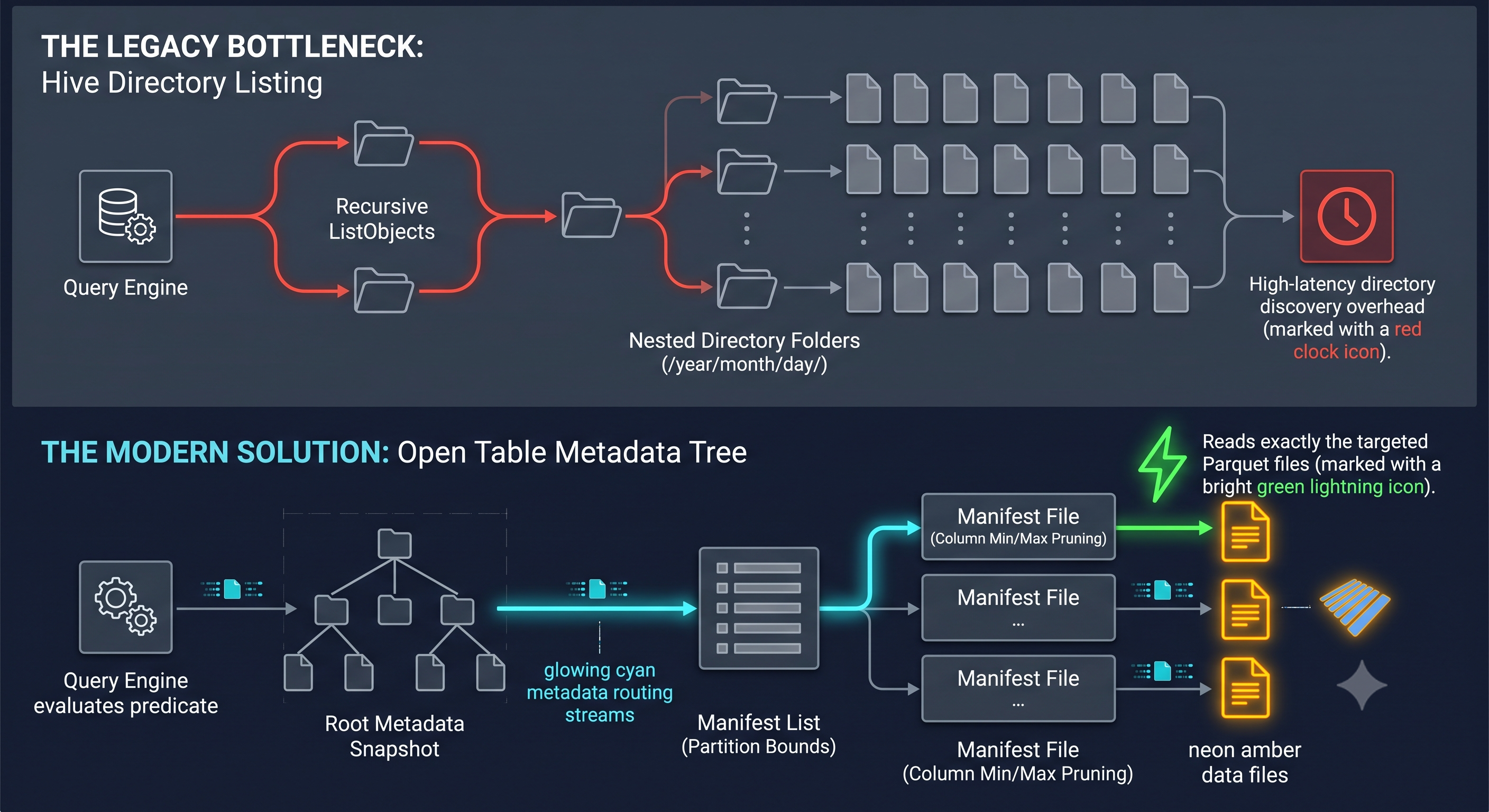
In traditional object-storage architectures, tables are structured as nested folders (/year=2026/month=08/day=26/). To answer a simple analytical SQL query, the query engine must execute recursive directory listing calls (ListObjects) against cloud storage:
The Scale Bottleneck: When a table grows to 500,000 files, listing files over high-latency object storage REST APIs can take several minutes before a single row of data is even read.
Lack of ACID Guarantees: Updating a partition requires physical file movement or directory renames, risking corrupted or partial reads if a write job crashes mid-operation.
The Solution: Hierarchical Metadata Trees
Open table formats replace brittle directory structures with an immutable 3-Tier Metadata Tree:
Top-Level Table Metadata & Catalogs: Tracks the current table schema, partition spec, and an atomic pointer to the current snapshot version. Commits are atomic metadata pointer swaps (snapshot isolation).
Manifest Lists: Each snapshot points to an Avro-based manifest list containing summary statistics (partition boundaries and file ranges) for all referenced manifests.
Manifest Files & File Pruning: Each manifest indexes individual Parquet data files alongside detailed column-level metadata (min/max bounds, null counts, deletion vectors).
The Analytics Takeaway:
Because the query engine evaluates predicate filters against manifest min/max statistics in-memory at the metadata layer, it skips 90%+ of irrelevant files without making a single directory-listing request to object storage.
Discussion Question & Poll
What is the primary table format standard across your organization's modern data lakehouse?
📊 A) Apache Iceberg (Vendor-neutral REST catalogs / multi-engine)
📊 B) Delta Lake (Databricks / UniForm / Unity Catalog)
📊 C) Apache Hudi (Streaming-first / record-level updates)
📊 D) Legacy Hive Metastore / Flat Cloud Storage Directories
Which query engine are you pairing with your lakehouse (Trino, DuckDB, Spark, Snowflake, or ClickHouse)? Let's discuss in the comments!
Call to Action (CTA)
Ready to design resilient data platforms, master lakehouse architectures, and optimize high-scale analytical pipelines?
👉 Join Data Science & Analytics to collaborate with data engineers, analytics leads, and BI architects building the future of data infrastructure.
In traditional object-storage architectures, tables are structured as nested folders (/year=2026/month=08/day=26/). To answer a simple analytical SQL query, the query engine must execute recursive directory listing calls (ListObjects) against cloud storage:
The Scale Bottleneck: When a table grows to 500,000 files, listing files over high-latency object storage REST APIs can take several minutes before a single row of data is even read.
Lack of ACID Guarantees: Updating a partition requires physical file movement or directory renames, risking corrupted or partial reads if a write job crashes mid-operation.
The Solution: Hierarchical Metadata Trees
Open table formats replace brittle directory structures with an immutable 3-Tier Metadata Tree:
Top-Level Table Metadata & Catalogs: Tracks the current table schema, partition spec, and an atomic pointer to the current snapshot version. Commits are atomic metadata pointer swaps (snapshot isolation).
Manifest Lists: Each snapshot points to an Avro-based manifest list containing summary statistics (partition boundaries and file ranges) for all referenced manifests.
Manifest Files & File Pruning: Each manifest indexes individual Parquet data files alongside detailed column-level metadata (min/max bounds, null counts, deletion vectors).
The Analytics Takeaway:
Because the query engine evaluates predicate filters against manifest min/max statistics in-memory at the metadata layer, it skips 90%+ of irrelevant files without making a single directory-listing request to object storage.
Discussion Question & Poll
What is the primary table format standard across your organization's modern data lakehouse?
📊 A) Apache Iceberg (Vendor-neutral REST catalogs / multi-engine)
📊 B) Delta Lake (Databricks / UniForm / Unity Catalog)
📊 C) Apache Hudi (Streaming-first / record-level updates)
📊 D) Legacy Hive Metastore / Flat Cloud Storage Directories
Which query engine are you pairing with your lakehouse (Trino, DuckDB, Spark, Snowflake, or ClickHouse)? Let's discuss in the comments!
Call to Action (CTA)
Ready to design resilient data platforms, master lakehouse architectures, and optimize high-scale analytical pipelines?
👉 Join Data Science & Analytics to collaborate with data engineers, analytics leads, and BI architects building the future of data infrastructure.
Why File-Listing Is Dead in Modern Data Warehousing: How Open Table Formats Eliminate Query Latency
In traditional object-storage architectures, tables are structured as nested folders (/year=2026/month=08/day=26/). To answer a simple analytical SQL query, the query engine must execute recursive directory listing calls (ListObjects) against cloud storage:
The Scale Bottleneck: When a table grows to 500,000 files, listing files over high-latency object storage REST APIs can take several minutes before a single row of data is even read.
Lack of ACID Guarantees: Updating a partition requires physical file movement or directory renames, risking corrupted or partial reads if a write job crashes mid-operation.
The Solution: Hierarchical Metadata Trees
Open table formats replace brittle directory structures with an immutable 3-Tier Metadata Tree:
Top-Level Table Metadata & Catalogs: Tracks the current table schema, partition spec, and an atomic pointer to the current snapshot version. Commits are atomic metadata pointer swaps (snapshot isolation).
Manifest Lists: Each snapshot points to an Avro-based manifest list containing summary statistics (partition boundaries and file ranges) for all referenced manifests.
Manifest Files & File Pruning: Each manifest indexes individual Parquet data files alongside detailed column-level metadata (min/max bounds, null counts, deletion vectors).
The Analytics Takeaway:
Because the query engine evaluates predicate filters against manifest min/max statistics in-memory at the metadata layer, it skips 90%+ of irrelevant files without making a single directory-listing request to object storage.
Discussion Question & Poll
What is the primary table format standard across your organization's modern data lakehouse?
📊 A) Apache Iceberg (Vendor-neutral REST catalogs / multi-engine)
📊 B) Delta Lake (Databricks / UniForm / Unity Catalog)
📊 C) Apache Hudi (Streaming-first / record-level updates)
📊 D) Legacy Hive Metastore / Flat Cloud Storage Directories
Which query engine are you pairing with your lakehouse (Trino, DuckDB, Spark, Snowflake, or ClickHouse)? Let's discuss in the comments!
Call to Action (CTA)
Ready to design resilient data platforms, master lakehouse architectures, and optimize high-scale analytical pipelines?
👉 Join Data Science & Analytics to collaborate with data engineers, analytics leads, and BI architects building the future of data infrastructure.

 English
 Arabic
 French
 Spanish
 Portuguese
 Turkish
 Dutch
Dutch
 Italiano
 Russian
 Romaian
 Portuguese (Brazil)
 Greek
Greek