


ETL vs. ELT: Is Modern Cloud Computing rendering Traditional Data Pipelines Obsolete?
The ongoing debate between Extract-Transform-Load (ETL) and Extract-Load-Transform (ELT) isn't just about letter order—it defines how an organization manages compute costs, pipeline latency, and data governance.
Understanding where each architecture excels allows data engineers to build resilient, cost-effective data pipelines:
1. Traditional ETL (Extract, Transform, Load)
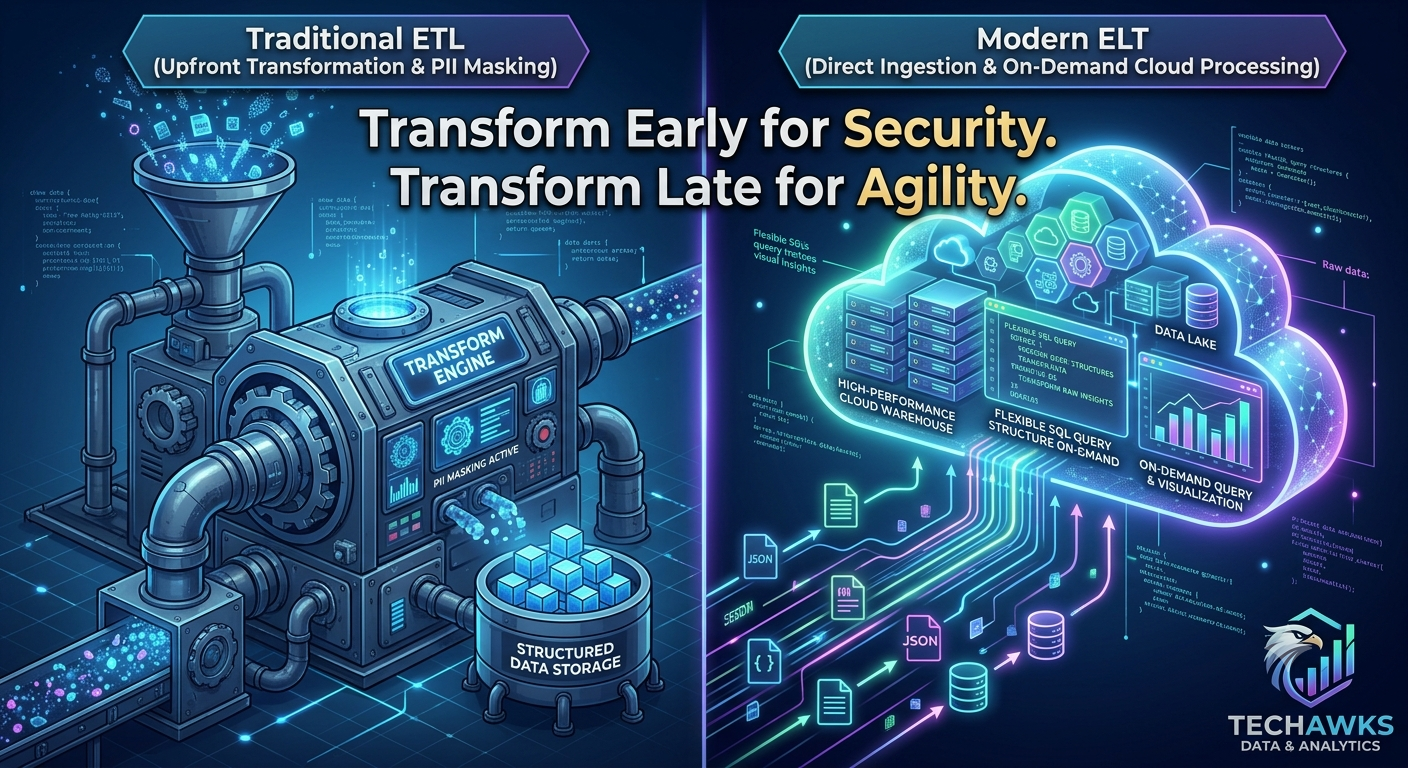
The Mechanism: Raw data is extracted from source systems, processed and transformed in an intermediate staging server (or ETL engine), and then loaded into a target database or data warehouse.
Where It Succeeds: Strict compliance and privacy workflows. Transforming data before loading ensures sensitive personally identifiable information (PII) is masked or encrypted before reaching storage. It also saves expensive storage space by filtering out junk data early.
The Drawbacks: Compute-heavy staging environments, slower pipeline speeds for large datasets, and rigid schema restrictions that make ad-hoc exploration difficult for analysts.
2. Modern ELT (Extract, Load, Transform)
The Mechanism: Raw data is extracted and loaded directly into a high-performance cloud data warehouse or lakehouse first. Transformations are executed on-demand inside the target warehouse using tools like SQL or dbt.
Where It Succeeds: Scalability and speed. Cloud warehouses handle massive parallel processing (MPP), allowing analysts to iterate on raw data without breaking underlying pipelines. It enables true "schema-on-read" flexibility.
The Drawbacks: Uncontrolled query costs if transformation queries are unoptimized, potential storage bloat from raw data, and higher exposure risks if raw security controls are weak.
Actionable Advice for Pipeline Architects
Instead of viewing this as a binary choice, modern data teams build hybrid architectures based on data sensitivity and query requirements:
Use ETL for Sensitive Ingestion: Mask healthcare, financial, or personal user data via microservices or edge workers before landing it in central storage.
Use ELT for Business Intelligence: Load raw product logs, clickstreams, and application databases directly into cloud storage, enabling SQL-driven transformations (dbt) for flexible BI modeling.
Monitor Compute Costs: In ELT models, strictly govern warehouse compute usage by setting query timeouts, auto-suspending idle clusters, and indexing high-cardinality columns.
Key Takeaways
Compute Power Drove the Shift: ELT gained dominance because cloud warehouses can process transformations faster and cheaper than separate ETL servers.
Data Governance Dictates Choice: Highly regulated data (HIPAA, GDPR) often demands upfront transformation (ETL) to prevent unmasked PII exposure.
Transformation Decoupling: Modern stack setups leverage ELT to separate raw data ingestion from analytical logic, making code maintenance vastly easier.
CTA
How is your team structuring its pipeline architecture this year? Are you sticking with traditional ETL for security, or fully committed to ELT with dbt? Join Data Science & Analytics to share your pipeline benchmarks, discuss data modeling strategies, and collaborate with fellow data professionals.
The ongoing debate between Extract-Transform-Load (ETL) and Extract-Load-Transform (ELT) isn't just about letter order—it defines how an organization manages compute costs, pipeline latency, and data governance.
Understanding where each architecture excels allows data engineers to build resilient, cost-effective data pipelines:
1. Traditional ETL (Extract, Transform, Load)
The Mechanism: Raw data is extracted from source systems, processed and transformed in an intermediate staging server (or ETL engine), and then loaded into a target database or data warehouse.
Where It Succeeds: Strict compliance and privacy workflows. Transforming data before loading ensures sensitive personally identifiable information (PII) is masked or encrypted before reaching storage. It also saves expensive storage space by filtering out junk data early.
The Drawbacks: Compute-heavy staging environments, slower pipeline speeds for large datasets, and rigid schema restrictions that make ad-hoc exploration difficult for analysts.
2. Modern ELT (Extract, Load, Transform)
The Mechanism: Raw data is extracted and loaded directly into a high-performance cloud data warehouse or lakehouse first. Transformations are executed on-demand inside the target warehouse using tools like SQL or dbt.
Where It Succeeds: Scalability and speed. Cloud warehouses handle massive parallel processing (MPP), allowing analysts to iterate on raw data without breaking underlying pipelines. It enables true "schema-on-read" flexibility.
The Drawbacks: Uncontrolled query costs if transformation queries are unoptimized, potential storage bloat from raw data, and higher exposure risks if raw security controls are weak.
Actionable Advice for Pipeline Architects
Instead of viewing this as a binary choice, modern data teams build hybrid architectures based on data sensitivity and query requirements:
Use ETL for Sensitive Ingestion: Mask healthcare, financial, or personal user data via microservices or edge workers before landing it in central storage.
Use ELT for Business Intelligence: Load raw product logs, clickstreams, and application databases directly into cloud storage, enabling SQL-driven transformations (dbt) for flexible BI modeling.
Monitor Compute Costs: In ELT models, strictly govern warehouse compute usage by setting query timeouts, auto-suspending idle clusters, and indexing high-cardinality columns.
Key Takeaways
Compute Power Drove the Shift: ELT gained dominance because cloud warehouses can process transformations faster and cheaper than separate ETL servers.
Data Governance Dictates Choice: Highly regulated data (HIPAA, GDPR) often demands upfront transformation (ETL) to prevent unmasked PII exposure.
Transformation Decoupling: Modern stack setups leverage ELT to separate raw data ingestion from analytical logic, making code maintenance vastly easier.
CTA
How is your team structuring its pipeline architecture this year? Are you sticking with traditional ETL for security, or fully committed to ELT with dbt? Join Data Science & Analytics to share your pipeline benchmarks, discuss data modeling strategies, and collaborate with fellow data professionals.
ETL vs. ELT: Is Modern Cloud Computing rendering Traditional Data Pipelines Obsolete?
The ongoing debate between Extract-Transform-Load (ETL) and Extract-Load-Transform (ELT) isn't just about letter order—it defines how an organization manages compute costs, pipeline latency, and data governance.
Understanding where each architecture excels allows data engineers to build resilient, cost-effective data pipelines:
1. Traditional ETL (Extract, Transform, Load)
The Mechanism: Raw data is extracted from source systems, processed and transformed in an intermediate staging server (or ETL engine), and then loaded into a target database or data warehouse.
Where It Succeeds: Strict compliance and privacy workflows. Transforming data before loading ensures sensitive personally identifiable information (PII) is masked or encrypted before reaching storage. It also saves expensive storage space by filtering out junk data early.
The Drawbacks: Compute-heavy staging environments, slower pipeline speeds for large datasets, and rigid schema restrictions that make ad-hoc exploration difficult for analysts.
2. Modern ELT (Extract, Load, Transform)
The Mechanism: Raw data is extracted and loaded directly into a high-performance cloud data warehouse or lakehouse first. Transformations are executed on-demand inside the target warehouse using tools like SQL or dbt.
Where It Succeeds: Scalability and speed. Cloud warehouses handle massive parallel processing (MPP), allowing analysts to iterate on raw data without breaking underlying pipelines. It enables true "schema-on-read" flexibility.
The Drawbacks: Uncontrolled query costs if transformation queries are unoptimized, potential storage bloat from raw data, and higher exposure risks if raw security controls are weak.
Actionable Advice for Pipeline Architects
Instead of viewing this as a binary choice, modern data teams build hybrid architectures based on data sensitivity and query requirements:
Use ETL for Sensitive Ingestion: Mask healthcare, financial, or personal user data via microservices or edge workers before landing it in central storage.
Use ELT for Business Intelligence: Load raw product logs, clickstreams, and application databases directly into cloud storage, enabling SQL-driven transformations (dbt) for flexible BI modeling.
Monitor Compute Costs: In ELT models, strictly govern warehouse compute usage by setting query timeouts, auto-suspending idle clusters, and indexing high-cardinality columns.
Key Takeaways
Compute Power Drove the Shift: ELT gained dominance because cloud warehouses can process transformations faster and cheaper than separate ETL servers.
Data Governance Dictates Choice: Highly regulated data (HIPAA, GDPR) often demands upfront transformation (ETL) to prevent unmasked PII exposure.
Transformation Decoupling: Modern stack setups leverage ELT to separate raw data ingestion from analytical logic, making code maintenance vastly easier.
CTA
How is your team structuring its pipeline architecture this year? Are you sticking with traditional ETL for security, or fully committed to ELT with dbt? Join Data Science & Analytics to share your pipeline benchmarks, discuss data modeling strategies, and collaborate with fellow data professionals.

 English
 Arabic
 Spanish
 Portuguese
 Deutsch
 Turkish
 Dutch
Dutch
 Italiano
 Russian
 Romaian
 Portuguese (Brazil)
 Greek
Greek