


The End of "You Build It, You Run It": Why Platform Engineering is Replacing Ticket-Based DevOps
The original promise of DevOps was breaking down silos between dev and ops. But in modern cloud-native environments running multi-tenant Kubernetes clusters, service meshes, and eBPF-based observability stacks, that philosophy morphed into dumping infrastructure complexity straight onto feature developers.
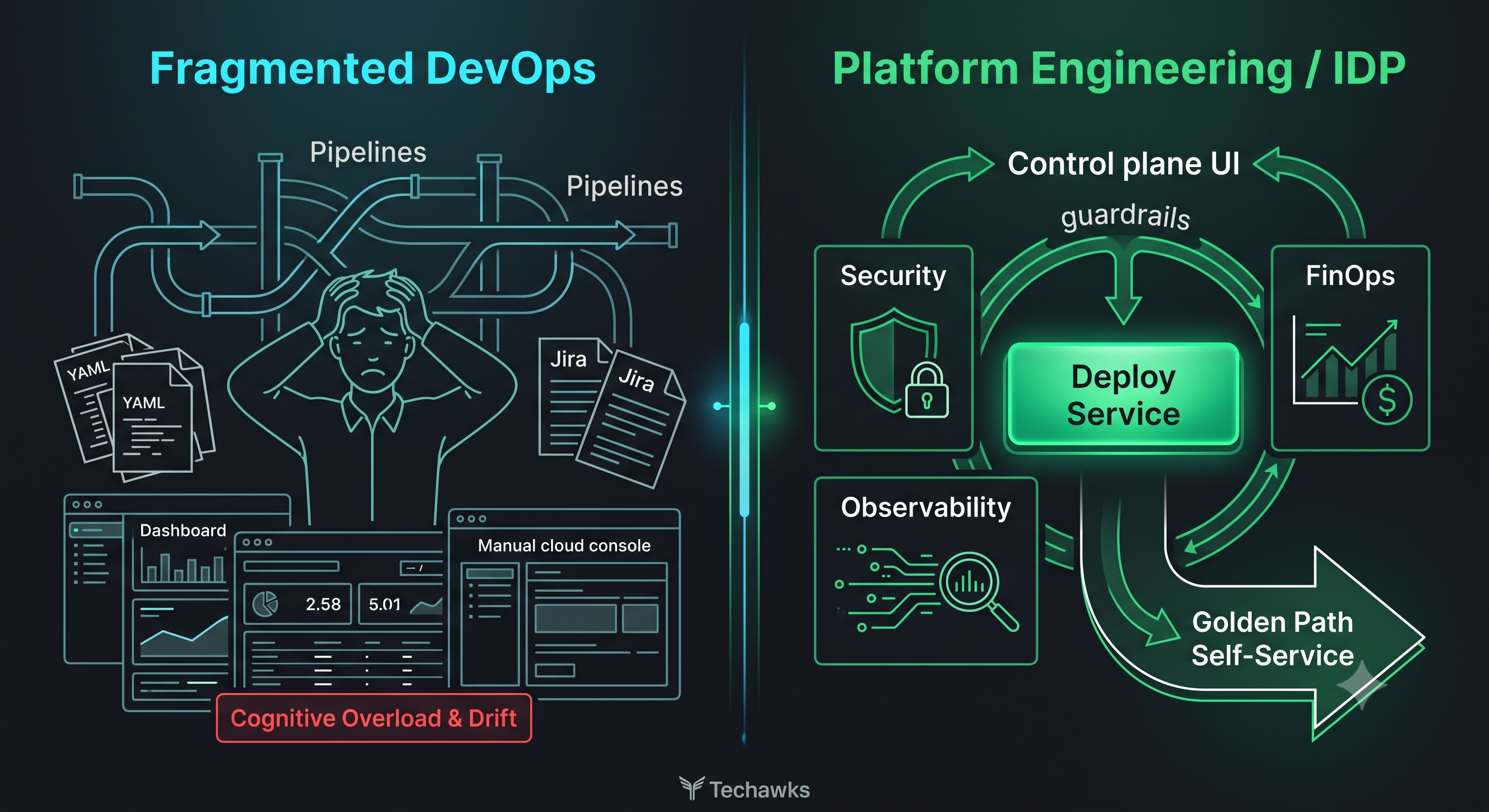
Cloud teams are solving this by treating the infrastructure layer as an Internal Developer Platform (IDP) rather than an ad-hoc set of shared scripts:
Paved Paths Over Ticket Queues: Instead of filing a ticket for a database or wrestling with raw YAML, engineers consume self-service, curated "Golden Paths" that provision compliant environments in minutes.
Guardrails via Admission Controllers: Security and FinOps policies (like OPA/Gatekeeper or Kyverno) are enforced deterministically at the Kubernetes API layer, eliminating human review bottlenecks while preventing runaway resource limits.
Standardized Telemetry Contracts: Observability is baked in at deployment time via sidecarless eBPF instrumentation, ensuring uniform tracing and error budgeting across every service by default.
Platform engineering doesn't remove ops; it shifts the ops role from reactive gatekeeping to building reusable, scalable platform products for internal engineers.
Discussion Question (Poll)
Where does the biggest deployment bottleneck sit in your team's current delivery cycle?
🔘 A: Writing and debugging Kubernetes/Helm manifests
🔘 B: Manual security, IAM, and compliance approvals
🔘 C: Cloud cost overruns and misconfigured resource limits
🔘 D: Fully automated via self-service Golden Paths / IDP
CTA
Join Cloud, DevOps & Open Source by Techawks to get production-grade architectural blueprints, platform patterns, and Kubernetes deep dives daily.
The original promise of DevOps was breaking down silos between dev and ops. But in modern cloud-native environments running multi-tenant Kubernetes clusters, service meshes, and eBPF-based observability stacks, that philosophy morphed into dumping infrastructure complexity straight onto feature developers.
Cloud teams are solving this by treating the infrastructure layer as an Internal Developer Platform (IDP) rather than an ad-hoc set of shared scripts:
Paved Paths Over Ticket Queues: Instead of filing a ticket for a database or wrestling with raw YAML, engineers consume self-service, curated "Golden Paths" that provision compliant environments in minutes.
Guardrails via Admission Controllers: Security and FinOps policies (like OPA/Gatekeeper or Kyverno) are enforced deterministically at the Kubernetes API layer, eliminating human review bottlenecks while preventing runaway resource limits.
Standardized Telemetry Contracts: Observability is baked in at deployment time via sidecarless eBPF instrumentation, ensuring uniform tracing and error budgeting across every service by default.
Platform engineering doesn't remove ops; it shifts the ops role from reactive gatekeeping to building reusable, scalable platform products for internal engineers.
Discussion Question (Poll)
Where does the biggest deployment bottleneck sit in your team's current delivery cycle?
🔘 A: Writing and debugging Kubernetes/Helm manifests
🔘 B: Manual security, IAM, and compliance approvals
🔘 C: Cloud cost overruns and misconfigured resource limits
🔘 D: Fully automated via self-service Golden Paths / IDP
CTA
Join Cloud, DevOps & Open Source by Techawks to get production-grade architectural blueprints, platform patterns, and Kubernetes deep dives daily.
The End of "You Build It, You Run It": Why Platform Engineering is Replacing Ticket-Based DevOps
The original promise of DevOps was breaking down silos between dev and ops. But in modern cloud-native environments running multi-tenant Kubernetes clusters, service meshes, and eBPF-based observability stacks, that philosophy morphed into dumping infrastructure complexity straight onto feature developers.
Cloud teams are solving this by treating the infrastructure layer as an Internal Developer Platform (IDP) rather than an ad-hoc set of shared scripts:
Paved Paths Over Ticket Queues: Instead of filing a ticket for a database or wrestling with raw YAML, engineers consume self-service, curated "Golden Paths" that provision compliant environments in minutes.
Guardrails via Admission Controllers: Security and FinOps policies (like OPA/Gatekeeper or Kyverno) are enforced deterministically at the Kubernetes API layer, eliminating human review bottlenecks while preventing runaway resource limits.
Standardized Telemetry Contracts: Observability is baked in at deployment time via sidecarless eBPF instrumentation, ensuring uniform tracing and error budgeting across every service by default.
Platform engineering doesn't remove ops; it shifts the ops role from reactive gatekeeping to building reusable, scalable platform products for internal engineers.
Discussion Question (Poll)
Where does the biggest deployment bottleneck sit in your team's current delivery cycle?
🔘 A: Writing and debugging Kubernetes/Helm manifests
🔘 B: Manual security, IAM, and compliance approvals
🔘 C: Cloud cost overruns and misconfigured resource limits
🔘 D: Fully automated via self-service Golden Paths / IDP
CTA
Join Cloud, DevOps & Open Source by Techawks to get production-grade architectural blueprints, platform patterns, and Kubernetes deep dives daily.

 English
 Arabic
 French
 Spanish
 Portuguese
 Deutsch
 Turkish
 Dutch
Dutch
 Italiano
 Russian
 Romaian
 Portuguese (Brazil)