


Stop Prompting, Start Orchestrating: The 4-Pattern Blueprint for Agentic Software Architecture
n modern systems engineering, production-grade LLM applications aren’t defined by the size of the underlying model, but by the orchestration framework wrapping it.
When you transition from Passive Text Completion to Agentic Workflows, an LLM stops acting as an oracle and starts acting as an autonomous reasoning engine.
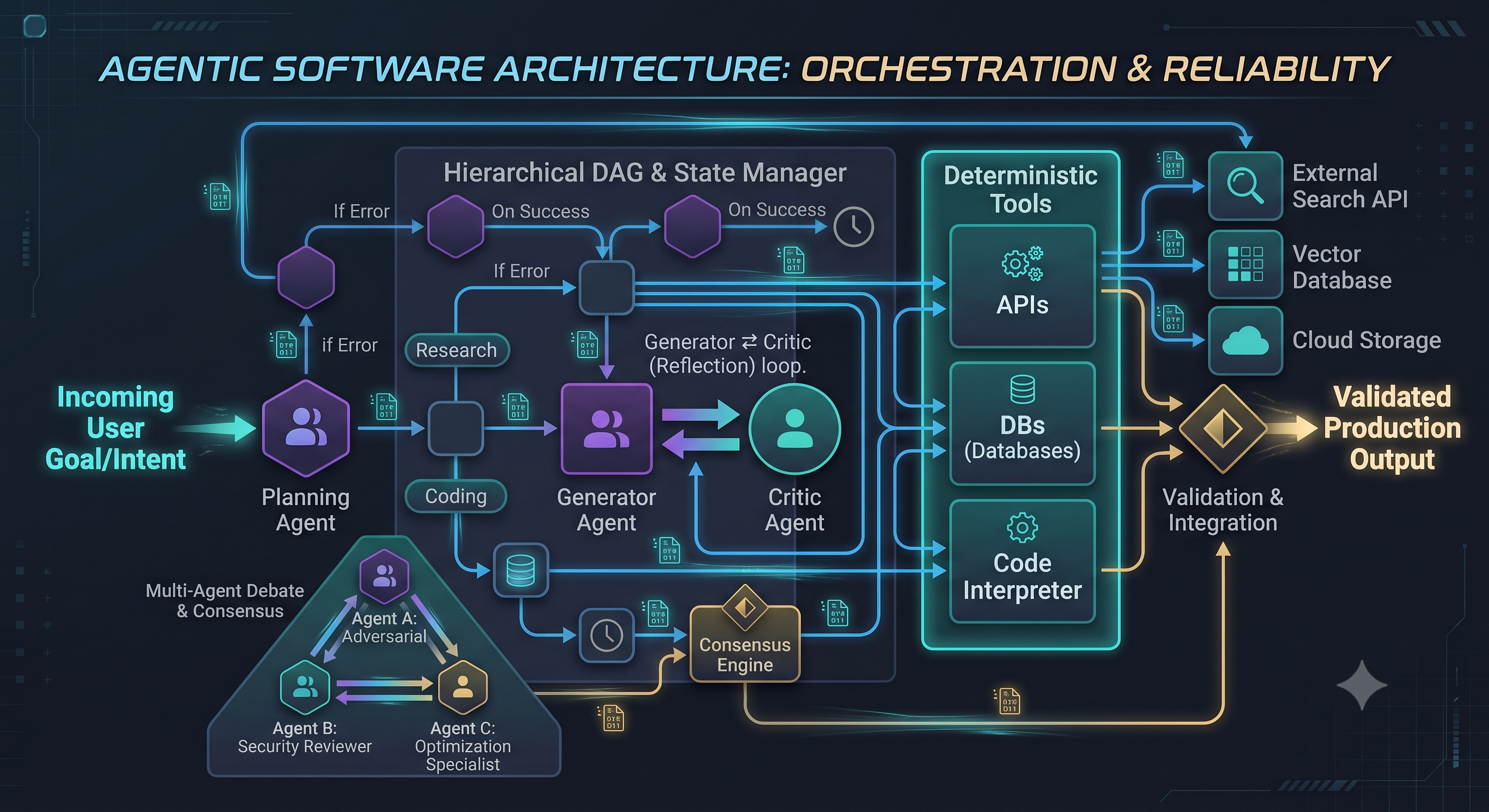
If you are designing agentic systems this week, master these 4 Core Architectural Patterns:
1. Reflection & Self-Correction Loop
Instead of accepting the model’s first-pass generation, wrap the output in a secondary validation agent.
Execution: Generator Agent produces code/data → Evaluator Agent checks syntax, edge cases, and unit tests → If it fails, feedback loops back with explicit diff logs.
Impact: Eliminates hallucinations and syntax bugs before hitting downstream services.
2. Deterministic Tool-Use (ReAct Framework)
Never let an LLM perform raw arithmetic, state mutations, or database lookups natively.
Execution: Structure the agent around Reasoning + Action. The model articulates a thought, selects an explicit schema-defined tool (e.g., REST API, SQL client, Python REPL), parses structured JSON outputs, and continues based on execution state.
Impact: Replaces probabilistic guessing with deterministic runtime computation.
3. Dynamic Planning & Task Decomposition
Monolithic prompts crumble under high-context or multi-step logic.
Execution: Break execution into a two-tier hierarchy. A Planner Agent breaks a high-level goal into an acyclic task graph (DAG). Specialized sub-agents execute individual nodes concurrently or sequentially.
Impact: Isolates errors to specific sub-tasks without crashing the entire workflow.
4. Multi-Agent Debate & Collaboration
Single agents suffer from systemic cognitive bias and drift.
Execution: Deploy distinct agents with opposing system prompts (e.g., Architect vs. Security Reviewer vs. Optimization Specialist). Have them critique and iterate across a shared state buffer until consensus criteria are met.
Impact: Drastically boosts code quality, security posture, and edge-case discovery.
The takeaway for engineers: High performance in AI engineering is no longer about writing clever prompts; it is about building robust state machines, clean interfaces, and resilient agent feedback loops.
Discussion Question
Which agentic architecture pattern has delivered the highest reliability in your production stack: Reflection loops, multi-agent debate, or deterministic tool orchestration? Let’s compare implementation trade-offs below.
CTA
Accelerate your engineering journey and build with the top minds in tech.
👉 Join the Techawks General Community to access production-ready architectures, technical deep-dives, and peer code discussions: [Insert Link / bio link]
n modern systems engineering, production-grade LLM applications aren’t defined by the size of the underlying model, but by the orchestration framework wrapping it.
When you transition from Passive Text Completion to Agentic Workflows, an LLM stops acting as an oracle and starts acting as an autonomous reasoning engine.
If you are designing agentic systems this week, master these 4 Core Architectural Patterns:
1. Reflection & Self-Correction Loop
Instead of accepting the model’s first-pass generation, wrap the output in a secondary validation agent.
Execution: Generator Agent produces code/data → Evaluator Agent checks syntax, edge cases, and unit tests → If it fails, feedback loops back with explicit diff logs.
Impact: Eliminates hallucinations and syntax bugs before hitting downstream services.
2. Deterministic Tool-Use (ReAct Framework)
Never let an LLM perform raw arithmetic, state mutations, or database lookups natively.
Execution: Structure the agent around Reasoning + Action. The model articulates a thought, selects an explicit schema-defined tool (e.g., REST API, SQL client, Python REPL), parses structured JSON outputs, and continues based on execution state.
Impact: Replaces probabilistic guessing with deterministic runtime computation.
3. Dynamic Planning & Task Decomposition
Monolithic prompts crumble under high-context or multi-step logic.
Execution: Break execution into a two-tier hierarchy. A Planner Agent breaks a high-level goal into an acyclic task graph (DAG). Specialized sub-agents execute individual nodes concurrently or sequentially.
Impact: Isolates errors to specific sub-tasks without crashing the entire workflow.
4. Multi-Agent Debate & Collaboration
Single agents suffer from systemic cognitive bias and drift.
Execution: Deploy distinct agents with opposing system prompts (e.g., Architect vs. Security Reviewer vs. Optimization Specialist). Have them critique and iterate across a shared state buffer until consensus criteria are met.
Impact: Drastically boosts code quality, security posture, and edge-case discovery.
The takeaway for engineers: High performance in AI engineering is no longer about writing clever prompts; it is about building robust state machines, clean interfaces, and resilient agent feedback loops.
Discussion Question
Which agentic architecture pattern has delivered the highest reliability in your production stack: Reflection loops, multi-agent debate, or deterministic tool orchestration? Let’s compare implementation trade-offs below.
CTA
Accelerate your engineering journey and build with the top minds in tech.
👉 Join the Techawks General Community to access production-ready architectures, technical deep-dives, and peer code discussions: [Insert Link / bio link]
Stop Prompting, Start Orchestrating: The 4-Pattern Blueprint for Agentic Software Architecture
n modern systems engineering, production-grade LLM applications aren’t defined by the size of the underlying model, but by the orchestration framework wrapping it.
When you transition from Passive Text Completion to Agentic Workflows, an LLM stops acting as an oracle and starts acting as an autonomous reasoning engine.
If you are designing agentic systems this week, master these 4 Core Architectural Patterns:
1. Reflection & Self-Correction Loop
Instead of accepting the model’s first-pass generation, wrap the output in a secondary validation agent.
Execution: Generator Agent produces code/data → Evaluator Agent checks syntax, edge cases, and unit tests → If it fails, feedback loops back with explicit diff logs.
Impact: Eliminates hallucinations and syntax bugs before hitting downstream services.
2. Deterministic Tool-Use (ReAct Framework)
Never let an LLM perform raw arithmetic, state mutations, or database lookups natively.
Execution: Structure the agent around Reasoning + Action. The model articulates a thought, selects an explicit schema-defined tool (e.g., REST API, SQL client, Python REPL), parses structured JSON outputs, and continues based on execution state.
Impact: Replaces probabilistic guessing with deterministic runtime computation.
3. Dynamic Planning & Task Decomposition
Monolithic prompts crumble under high-context or multi-step logic.
Execution: Break execution into a two-tier hierarchy. A Planner Agent breaks a high-level goal into an acyclic task graph (DAG). Specialized sub-agents execute individual nodes concurrently or sequentially.
Impact: Isolates errors to specific sub-tasks without crashing the entire workflow.
4. Multi-Agent Debate & Collaboration
Single agents suffer from systemic cognitive bias and drift.
Execution: Deploy distinct agents with opposing system prompts (e.g., Architect vs. Security Reviewer vs. Optimization Specialist). Have them critique and iterate across a shared state buffer until consensus criteria are met.
Impact: Drastically boosts code quality, security posture, and edge-case discovery.
The takeaway for engineers: High performance in AI engineering is no longer about writing clever prompts; it is about building robust state machines, clean interfaces, and resilient agent feedback loops.
Discussion Question
Which agentic architecture pattern has delivered the highest reliability in your production stack: Reflection loops, multi-agent debate, or deterministic tool orchestration? Let’s compare implementation trade-offs below.
CTA
Accelerate your engineering journey and build with the top minds in tech.
👉 Join the Techawks General Community to access production-ready architectures, technical deep-dives, and peer code discussions: [Insert Link / bio link]

 English
 Arabic
 French
 Portuguese
 Deutsch
 Turkish
 Dutch
Dutch
 Italiano
 Russian
 Romaian
 Portuguese (Brazil)
 Greek
Greek