


Monolithic vs. Microservices Architecture: Choosing the Right Infrastructure Strategy for System Scalability
Choosing between a Monolithic and Microservices architecture isn't about following trends—it's a trade-off between deployment simplicity and independent operational scalability.
Here is an educational breakdown of how both architectural paradigms function and when to deploy each:
1. Monolithic Architecture (Unified Codebase & Deployment)
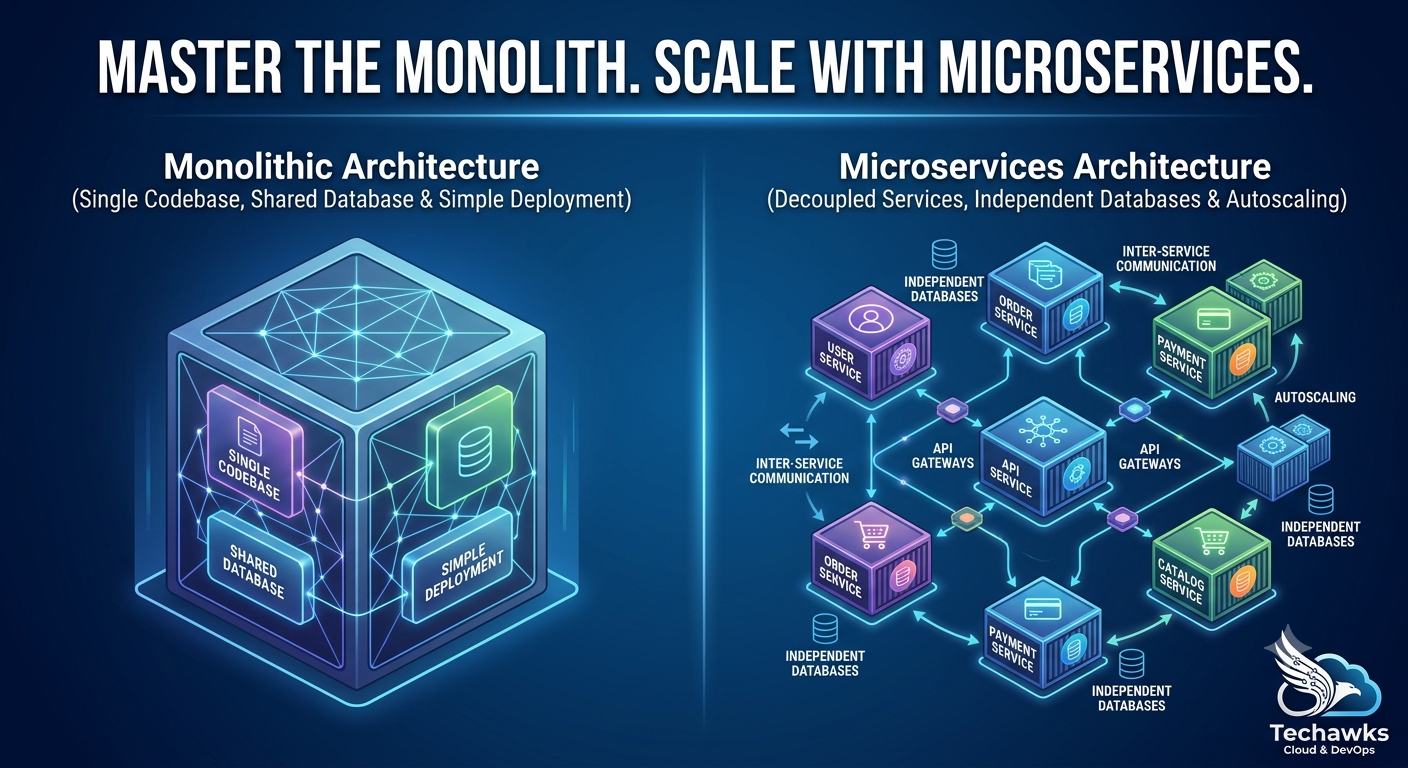
In a monolithic application, all functional modules (user authentication, payment processing, notification pipelines) reside within a single codebase and run on shared compute infrastructure.
Core Characteristics: Tightly coupled components, single-deployment pipelines, shared databases, and straightforward local debugging.
Best Used For: Early-stage applications, small engineering teams (under 15–20 developers), and domain models that are still actively evolving.
Operational Advantages: Zero network latency between internal service calls, simple end-to-end testing, and low infrastructure overhead.
The Challenges: A single failing component can bring down the entire runtime; scaling requires scaling the entire application rather than isolated hot paths.
2. Microservices Architecture (Decoupled & Distributed Systems)
Microservices break application features into loosely coupled, independently deployable services that communicate over lightweight network protocols (REST, gRPC, or event buses like Kafka).
Core Characteristics: Domain-driven design, independent CI/CD pipelines, polyglot technology stacks, and decentralized data management (database-per-service pattern).
Best Used For: Large organizations with distinct domain teams, complex enterprise applications with high concurrency, and systems where specific modules require independent autoscaling.
Operational Advantages: High fault isolation, independent feature deployments, and fine-grained resource allocation per service.
The Challenges: Operational overhead (requires robust Kubernetes orchestration, service meshes, and distributed logging), eventual data consistency complexities, and network serialization costs.
Practical Guidance for Cloud Architects
To avoid premature complexity while preserving room for growth, follow these three core guidelines:
Start with a Modular Monolith: Build clean domain boundaries inside a unified codebase first. Clearly separated domain modules make future extraction into independent microservices straightforward when load demands it.
Decompose Around Scalability Hotspots: Only extract a module into a microservice when it exhibits drastically different scaling characteristics (e.g., extracting a CPU-heavy media processing pipeline away from a low-latency web server).
Invest in Platform Infrastructure First: Never migrate to microservices without established infrastructure fundamentals—specifically automated CI/CD, centralized log aggregation (ELK/OpenTelemetry), container orchestration (Kubernetes), and infrastructure-as-code (Terraform).
Key Takeaways
Complexity Has a Cost: Microservices solve organizational and scaling bottlenecks at the price of significantly higher infrastructure and operational complexity.
Domain Clarity Over Service Count: Good microservices reflect well-defined domain boundaries; poorly defined boundaries lead to a distributed monolith with worst-case performance.
Infrastructure Readiness is Mandatory: Solid CI/CD automation and observability must precede any architectural decomposition.
CTA
How is your team managing architectural trade-offs in the cloud this year? Join Cloud, DevOps & Open Source to discuss infrastructure strategies, review deployment pipelines, and collaborate with seasoned DevOps engineers.
Choosing between a Monolithic and Microservices architecture isn't about following trends—it's a trade-off between deployment simplicity and independent operational scalability.
Here is an educational breakdown of how both architectural paradigms function and when to deploy each:
1. Monolithic Architecture (Unified Codebase & Deployment)
In a monolithic application, all functional modules (user authentication, payment processing, notification pipelines) reside within a single codebase and run on shared compute infrastructure.
Core Characteristics: Tightly coupled components, single-deployment pipelines, shared databases, and straightforward local debugging.
Best Used For: Early-stage applications, small engineering teams (under 15–20 developers), and domain models that are still actively evolving.
Operational Advantages: Zero network latency between internal service calls, simple end-to-end testing, and low infrastructure overhead.
The Challenges: A single failing component can bring down the entire runtime; scaling requires scaling the entire application rather than isolated hot paths.
2. Microservices Architecture (Decoupled & Distributed Systems)
Microservices break application features into loosely coupled, independently deployable services that communicate over lightweight network protocols (REST, gRPC, or event buses like Kafka).
Core Characteristics: Domain-driven design, independent CI/CD pipelines, polyglot technology stacks, and decentralized data management (database-per-service pattern).
Best Used For: Large organizations with distinct domain teams, complex enterprise applications with high concurrency, and systems where specific modules require independent autoscaling.
Operational Advantages: High fault isolation, independent feature deployments, and fine-grained resource allocation per service.
The Challenges: Operational overhead (requires robust Kubernetes orchestration, service meshes, and distributed logging), eventual data consistency complexities, and network serialization costs.
Practical Guidance for Cloud Architects
To avoid premature complexity while preserving room for growth, follow these three core guidelines:
Start with a Modular Monolith: Build clean domain boundaries inside a unified codebase first. Clearly separated domain modules make future extraction into independent microservices straightforward when load demands it.
Decompose Around Scalability Hotspots: Only extract a module into a microservice when it exhibits drastically different scaling characteristics (e.g., extracting a CPU-heavy media processing pipeline away from a low-latency web server).
Invest in Platform Infrastructure First: Never migrate to microservices without established infrastructure fundamentals—specifically automated CI/CD, centralized log aggregation (ELK/OpenTelemetry), container orchestration (Kubernetes), and infrastructure-as-code (Terraform).
Key Takeaways
Complexity Has a Cost: Microservices solve organizational and scaling bottlenecks at the price of significantly higher infrastructure and operational complexity.
Domain Clarity Over Service Count: Good microservices reflect well-defined domain boundaries; poorly defined boundaries lead to a distributed monolith with worst-case performance.
Infrastructure Readiness is Mandatory: Solid CI/CD automation and observability must precede any architectural decomposition.
CTA
How is your team managing architectural trade-offs in the cloud this year? Join Cloud, DevOps & Open Source to discuss infrastructure strategies, review deployment pipelines, and collaborate with seasoned DevOps engineers.
Monolithic vs. Microservices Architecture: Choosing the Right Infrastructure Strategy for System Scalability
Choosing between a Monolithic and Microservices architecture isn't about following trends—it's a trade-off between deployment simplicity and independent operational scalability.
Here is an educational breakdown of how both architectural paradigms function and when to deploy each:
1. Monolithic Architecture (Unified Codebase & Deployment)
In a monolithic application, all functional modules (user authentication, payment processing, notification pipelines) reside within a single codebase and run on shared compute infrastructure.
Core Characteristics: Tightly coupled components, single-deployment pipelines, shared databases, and straightforward local debugging.
Best Used For: Early-stage applications, small engineering teams (under 15–20 developers), and domain models that are still actively evolving.
Operational Advantages: Zero network latency between internal service calls, simple end-to-end testing, and low infrastructure overhead.
The Challenges: A single failing component can bring down the entire runtime; scaling requires scaling the entire application rather than isolated hot paths.
2. Microservices Architecture (Decoupled & Distributed Systems)
Microservices break application features into loosely coupled, independently deployable services that communicate over lightweight network protocols (REST, gRPC, or event buses like Kafka).
Core Characteristics: Domain-driven design, independent CI/CD pipelines, polyglot technology stacks, and decentralized data management (database-per-service pattern).
Best Used For: Large organizations with distinct domain teams, complex enterprise applications with high concurrency, and systems where specific modules require independent autoscaling.
Operational Advantages: High fault isolation, independent feature deployments, and fine-grained resource allocation per service.
The Challenges: Operational overhead (requires robust Kubernetes orchestration, service meshes, and distributed logging), eventual data consistency complexities, and network serialization costs.
Practical Guidance for Cloud Architects
To avoid premature complexity while preserving room for growth, follow these three core guidelines:
Start with a Modular Monolith: Build clean domain boundaries inside a unified codebase first. Clearly separated domain modules make future extraction into independent microservices straightforward when load demands it.
Decompose Around Scalability Hotspots: Only extract a module into a microservice when it exhibits drastically different scaling characteristics (e.g., extracting a CPU-heavy media processing pipeline away from a low-latency web server).
Invest in Platform Infrastructure First: Never migrate to microservices without established infrastructure fundamentals—specifically automated CI/CD, centralized log aggregation (ELK/OpenTelemetry), container orchestration (Kubernetes), and infrastructure-as-code (Terraform).
Key Takeaways
Complexity Has a Cost: Microservices solve organizational and scaling bottlenecks at the price of significantly higher infrastructure and operational complexity.
Domain Clarity Over Service Count: Good microservices reflect well-defined domain boundaries; poorly defined boundaries lead to a distributed monolith with worst-case performance.
Infrastructure Readiness is Mandatory: Solid CI/CD automation and observability must precede any architectural decomposition.
CTA
How is your team managing architectural trade-offs in the cloud this year? Join Cloud, DevOps & Open Source to discuss infrastructure strategies, review deployment pipelines, and collaborate with seasoned DevOps engineers.

 Arabic
 French
 Spanish
 Portuguese
 Deutsch
 Turkish
 Dutch
Dutch
 Italiano
 Russian
 Romaian
 Portuguese (Brazil)
 Greek
Greek