


The Death of Vendor-Locked Warehouses: Building a Multi-Engine Analytics Stack with the Iceberg REST Catalog
Traditional data stacks tightly coupled compute engines to proprietary file layouts, turning data migration into a multi-million-dollar nightmare.
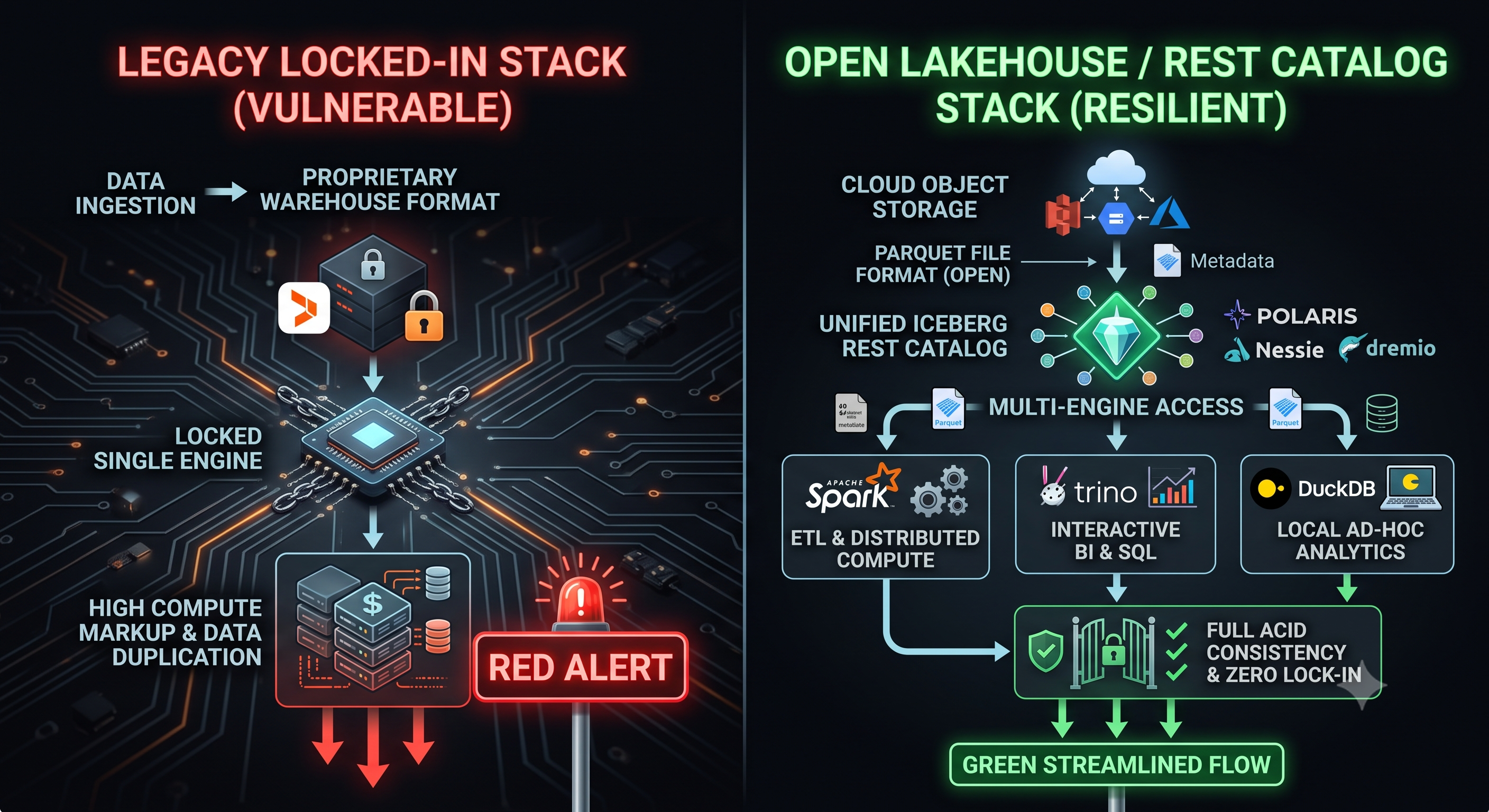
With Open Table Formats (like Apache Iceberg) and the Iceberg REST Catalog Specification, the table’s metadata tree is decoupled entirely from any single execution engine.
This unlocks true multi-engine interoperability: your ingestion pipelines, heavy distributed transformations, real-time BI queries, and local developer notebooks can all query the exact same Parquet files concurrently with full ACID consistency.
1. The Power of the Iceberg Metadata Tree
Unlike legacy Hive tables that relied on rigid folder directories (causing slow directory listings and "many small files" bottlenecks), Iceberg uses a hierarchical snapshot tree:
Catalog Pointer: Tracks the current metadata root file via atomic pointer swap.
Manifest List: An immutable snapshot indexing manifest files with partition-level metrics.
Manifest Files: Index actual Parquet data files, storing column-level min/max bounds and null counts.
The Result: Query engines skip irrelevant files at the metadata layer without opening a single Parquet file on object storage.
2. The Multi-Engine Tri-Tier Workflow
Instead of running expensive warehouse compute clusters for lightweight tasks, route workloads dynamically across specialized engines:
Batch & Stream Ingestion (Apache Spark / Flink): Ingest raw event streams, handle schema evolution, and commit snapshots to the REST catalog.
Interactive Enterprise BI (Trino / ClickHouse / Snowflake via External Catalog): Run sub-second concurrency queries against the registered tables without copying data.
Local Exploration & Data Science (DuckDB / Polars): Attach the REST catalog directly into a local DuckDB session or Python script to query petabyte-scale lakehouse tables with zero ingress compute cost.
3. Automatic Partition Evolution & Hidden Partitioning
In legacy platforms, changing a table’s partition scheme (e.g., from day to hour) required rewriting millions of historical files.
How It Works: Iceberg separates the physical column from the partition transform (e.g., identity, bucket(N), truncate(W)).
The Impact: When business requirements change, update the table schema. New data writes to the new partition layout while old data reads seamlessly from historical manifests—with zero downtime or manual file restructuring.
Discussion Question
Has your data team adopted open table formats (Iceberg/Delta) with an independent REST catalog, or are you still relying on managed warehouse storage? What latency or catalog sync challenges have you encountered?
CTA
Take control of your data platform architecture and master modern analytics engineering.
👉 Join Data Science & Analytics to access production lakehouse blueprints, benchmark teardowns, and SQL/Python data optimization guides: [Insert Link / bio link]
Traditional data stacks tightly coupled compute engines to proprietary file layouts, turning data migration into a multi-million-dollar nightmare.
With Open Table Formats (like Apache Iceberg) and the Iceberg REST Catalog Specification, the table’s metadata tree is decoupled entirely from any single execution engine.
This unlocks true multi-engine interoperability: your ingestion pipelines, heavy distributed transformations, real-time BI queries, and local developer notebooks can all query the exact same Parquet files concurrently with full ACID consistency.
1. The Power of the Iceberg Metadata Tree
Unlike legacy Hive tables that relied on rigid folder directories (causing slow directory listings and "many small files" bottlenecks), Iceberg uses a hierarchical snapshot tree:
Catalog Pointer: Tracks the current metadata root file via atomic pointer swap.
Manifest List: An immutable snapshot indexing manifest files with partition-level metrics.
Manifest Files: Index actual Parquet data files, storing column-level min/max bounds and null counts.
The Result: Query engines skip irrelevant files at the metadata layer without opening a single Parquet file on object storage.
2. The Multi-Engine Tri-Tier Workflow
Instead of running expensive warehouse compute clusters for lightweight tasks, route workloads dynamically across specialized engines:
Batch & Stream Ingestion (Apache Spark / Flink): Ingest raw event streams, handle schema evolution, and commit snapshots to the REST catalog.
Interactive Enterprise BI (Trino / ClickHouse / Snowflake via External Catalog): Run sub-second concurrency queries against the registered tables without copying data.
Local Exploration & Data Science (DuckDB / Polars): Attach the REST catalog directly into a local DuckDB session or Python script to query petabyte-scale lakehouse tables with zero ingress compute cost.
3. Automatic Partition Evolution & Hidden Partitioning
In legacy platforms, changing a table’s partition scheme (e.g., from day to hour) required rewriting millions of historical files.
How It Works: Iceberg separates the physical column from the partition transform (e.g., identity, bucket(N), truncate(W)).
The Impact: When business requirements change, update the table schema. New data writes to the new partition layout while old data reads seamlessly from historical manifests—with zero downtime or manual file restructuring.
Discussion Question
Has your data team adopted open table formats (Iceberg/Delta) with an independent REST catalog, or are you still relying on managed warehouse storage? What latency or catalog sync challenges have you encountered?
CTA
Take control of your data platform architecture and master modern analytics engineering.
👉 Join Data Science & Analytics to access production lakehouse blueprints, benchmark teardowns, and SQL/Python data optimization guides: [Insert Link / bio link]
The Death of Vendor-Locked Warehouses: Building a Multi-Engine Analytics Stack with the Iceberg REST Catalog
Traditional data stacks tightly coupled compute engines to proprietary file layouts, turning data migration into a multi-million-dollar nightmare.
With Open Table Formats (like Apache Iceberg) and the Iceberg REST Catalog Specification, the table’s metadata tree is decoupled entirely from any single execution engine.
This unlocks true multi-engine interoperability: your ingestion pipelines, heavy distributed transformations, real-time BI queries, and local developer notebooks can all query the exact same Parquet files concurrently with full ACID consistency.
1. The Power of the Iceberg Metadata Tree
Unlike legacy Hive tables that relied on rigid folder directories (causing slow directory listings and "many small files" bottlenecks), Iceberg uses a hierarchical snapshot tree:
Catalog Pointer: Tracks the current metadata root file via atomic pointer swap.
Manifest List: An immutable snapshot indexing manifest files with partition-level metrics.
Manifest Files: Index actual Parquet data files, storing column-level min/max bounds and null counts.
The Result: Query engines skip irrelevant files at the metadata layer without opening a single Parquet file on object storage.
2. The Multi-Engine Tri-Tier Workflow
Instead of running expensive warehouse compute clusters for lightweight tasks, route workloads dynamically across specialized engines:
Batch & Stream Ingestion (Apache Spark / Flink): Ingest raw event streams, handle schema evolution, and commit snapshots to the REST catalog.
Interactive Enterprise BI (Trino / ClickHouse / Snowflake via External Catalog): Run sub-second concurrency queries against the registered tables without copying data.
Local Exploration & Data Science (DuckDB / Polars): Attach the REST catalog directly into a local DuckDB session or Python script to query petabyte-scale lakehouse tables with zero ingress compute cost.
3. Automatic Partition Evolution & Hidden Partitioning
In legacy platforms, changing a table’s partition scheme (e.g., from day to hour) required rewriting millions of historical files.
How It Works: Iceberg separates the physical column from the partition transform (e.g., identity, bucket(N), truncate(W)).
The Impact: When business requirements change, update the table schema. New data writes to the new partition layout while old data reads seamlessly from historical manifests—with zero downtime or manual file restructuring.
Discussion Question
Has your data team adopted open table formats (Iceberg/Delta) with an independent REST catalog, or are you still relying on managed warehouse storage? What latency or catalog sync challenges have you encountered?
CTA
Take control of your data platform architecture and master modern analytics engineering.
👉 Join Data Science & Analytics to access production lakehouse blueprints, benchmark teardowns, and SQL/Python data optimization guides: [Insert Link / bio link]

 English
 Arabic
 French
 Portuguese
 Deutsch
 Turkish
 Dutch
Dutch
 Italiano
 Russian
 Romaian
 Portuguese (Brazil)
 Greek
Greek