


The Gateway API Migration: Why Ingress Is Deprecated and How to Architect Role-Oriented Traffic
The original Kubernetes Ingress spec had a fatal architectural flaw: it forced cluster operators and application developers to share a single, un-scoped YAML file.
To support advanced routing (like header matching, weighted canary splits, traffic mirroring, or cross-namespace references), teams had to litter manifests with brittle annotations like nginx.ingress.kubernetes.io/rewrite-target.
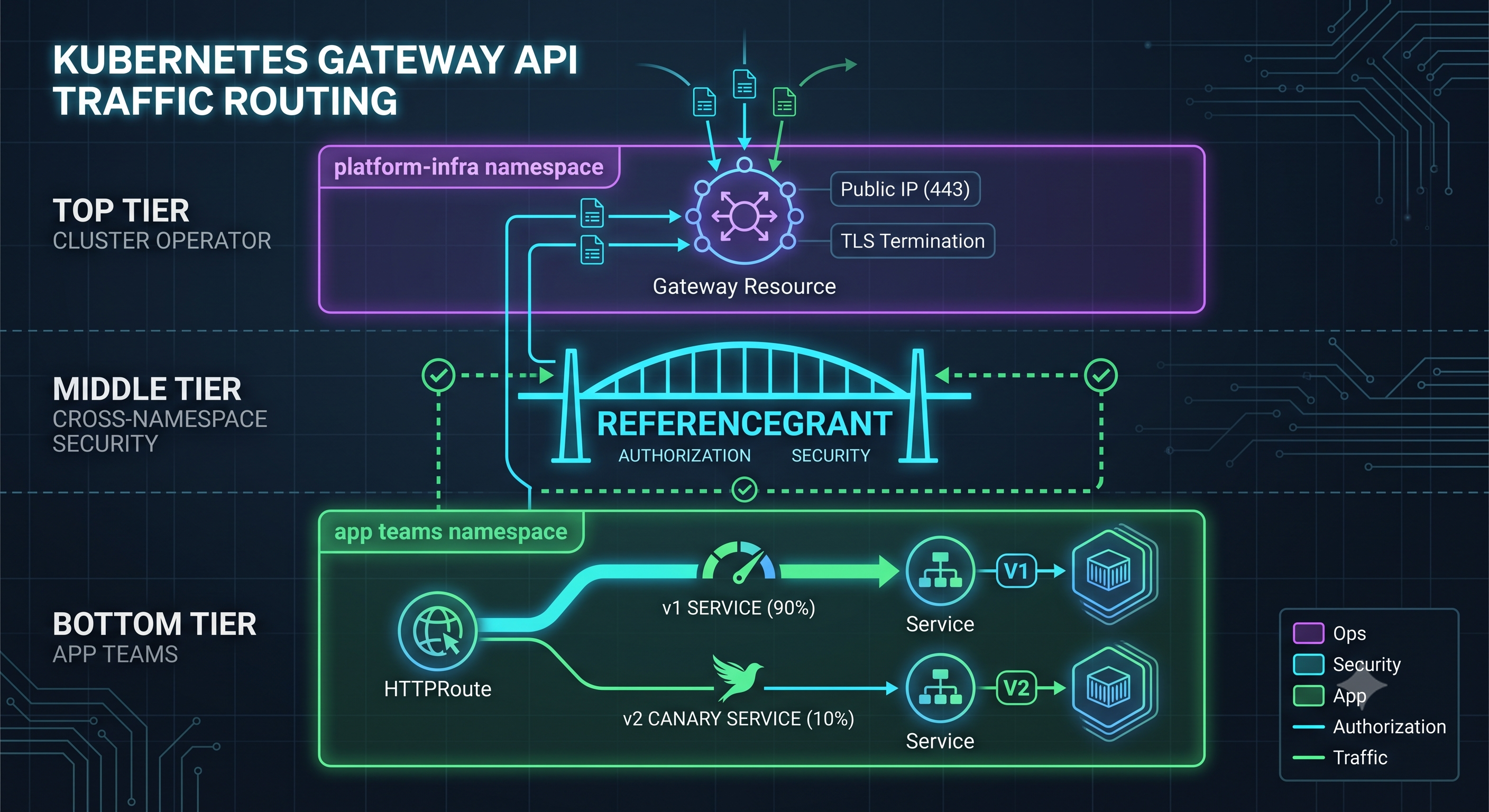
The Gateway API resolves this by introducing a role-oriented, decoupled API model divided across three operational personas:
┌───────────────────────────────────┐
│ Infrastructure Provider (GatewayClass: Envoy/Cilium) │
└───────────────────────────────────┘
│
┌─────────────────────────────────────┐
│ Cluster Operator (Gateway: IP, TLS, Allowed Namespaces│
└─────────────────────────────────────┘
│
┌──────────────────▼─────────────────┐
│ App Developer (HTTPRoute: Canary Splits, Path Rules) │
└────────────────────────────────────┘
1. The 3-Tier Resource Separation
Instead of one monolithic manifest, routing is split into distinct Custom Resources:
GatewayClass (Infra Level): Defines the underlying controller implementation (e.g., Envoy Gateway, Cilium eBPF, Istio).
Gateway (Platform/Ops Level): Declares physical network listeners, ports (80/443), TLS certificates, and allowed namespaces.
HTTPRoute / GRPCRoute (Developer Level): Defines routing logic (prefixes, header mutations, weight-based canary splits) and attaches dynamically to the Gateway.
2. Declarative Canary Splitting (Zero Annotations)
Under the legacy Ingress model, performing a 90/10 traffic split required proprietary controller plugins. With the Gateway API, weighted traffic splitting is a first-class, portable primitive:
YAML
apiVersion: gateway.networking.k8s.io/v1
kind: HTTPRoute
metadata:
name: payment-service-route
namespace: payments
spec:
parentRefs:
- name: enterprise-gateway
namespace: platform-infra
rules:
- matches:
- path:
type: PathPrefix
value: /v2/checkout
backendRefs:
- name: payment-v1
port: 8080
weight: 90
- name: payment-v2-canary
port: 8080
weight: 10
3. Cross-Namespace Routing with ReferenceGrant
A common failure in multi-tenant clusters is security isolation: how does a service in the payments namespace bind to a shared Gateway in the platform-infra namespace without creating privilege escalation?
The Mechanism: The Gateway API uses ReferenceGrant resources.
The Rule: The target namespace must explicitly authorize cross-namespace references from specific routes. If the platform-infra namespace does not have a ReferenceGrant permitting routes from payments, the controller rejects the attachment deterministically.
Discussion Question
Has your infrastructure team started transitioning production clusters from legacy Ingress controllers to the Kubernetes Gateway API (using Cilium, Envoy Gateway, or Istio)? What has been the biggest migration challenge?
CTA
Master cloud-native architecture, Kubernetes internals, and platform engineering.
👉 Join Cloud, DevOps & Open Source to access production-grade Helm/Terraform blueprints, migration playbooks, and systems architecture discussions: [Insert Link / bio link]
The original Kubernetes Ingress spec had a fatal architectural flaw: it forced cluster operators and application developers to share a single, un-scoped YAML file.
To support advanced routing (like header matching, weighted canary splits, traffic mirroring, or cross-namespace references), teams had to litter manifests with brittle annotations like nginx.ingress.kubernetes.io/rewrite-target.
The Gateway API resolves this by introducing a role-oriented, decoupled API model divided across three operational personas:
┌───────────────────────────────────┐
│ Infrastructure Provider (GatewayClass: Envoy/Cilium) │
└───────────────────────────────────┘
│
┌─────────────────────────────────────┐
│ Cluster Operator (Gateway: IP, TLS, Allowed Namespaces│
└─────────────────────────────────────┘
│
┌──────────────────▼─────────────────┐
│ App Developer (HTTPRoute: Canary Splits, Path Rules) │
└────────────────────────────────────┘
1. The 3-Tier Resource Separation
Instead of one monolithic manifest, routing is split into distinct Custom Resources:
GatewayClass (Infra Level): Defines the underlying controller implementation (e.g., Envoy Gateway, Cilium eBPF, Istio).
Gateway (Platform/Ops Level): Declares physical network listeners, ports (80/443), TLS certificates, and allowed namespaces.
HTTPRoute / GRPCRoute (Developer Level): Defines routing logic (prefixes, header mutations, weight-based canary splits) and attaches dynamically to the Gateway.
2. Declarative Canary Splitting (Zero Annotations)
Under the legacy Ingress model, performing a 90/10 traffic split required proprietary controller plugins. With the Gateway API, weighted traffic splitting is a first-class, portable primitive:
YAML
apiVersion: gateway.networking.k8s.io/v1
kind: HTTPRoute
metadata:
name: payment-service-route
namespace: payments
spec:
parentRefs:
- name: enterprise-gateway
namespace: platform-infra
rules:
- matches:
- path:
type: PathPrefix
value: /v2/checkout
backendRefs:
- name: payment-v1
port: 8080
weight: 90
- name: payment-v2-canary
port: 8080
weight: 10
3. Cross-Namespace Routing with ReferenceGrant
A common failure in multi-tenant clusters is security isolation: how does a service in the payments namespace bind to a shared Gateway in the platform-infra namespace without creating privilege escalation?
The Mechanism: The Gateway API uses ReferenceGrant resources.
The Rule: The target namespace must explicitly authorize cross-namespace references from specific routes. If the platform-infra namespace does not have a ReferenceGrant permitting routes from payments, the controller rejects the attachment deterministically.
Discussion Question
Has your infrastructure team started transitioning production clusters from legacy Ingress controllers to the Kubernetes Gateway API (using Cilium, Envoy Gateway, or Istio)? What has been the biggest migration challenge?
CTA
Master cloud-native architecture, Kubernetes internals, and platform engineering.
👉 Join Cloud, DevOps & Open Source to access production-grade Helm/Terraform blueprints, migration playbooks, and systems architecture discussions: [Insert Link / bio link]
The Gateway API Migration: Why Ingress Is Deprecated and How to Architect Role-Oriented Traffic
The original Kubernetes Ingress spec had a fatal architectural flaw: it forced cluster operators and application developers to share a single, un-scoped YAML file.
To support advanced routing (like header matching, weighted canary splits, traffic mirroring, or cross-namespace references), teams had to litter manifests with brittle annotations like nginx.ingress.kubernetes.io/rewrite-target.
The Gateway API resolves this by introducing a role-oriented, decoupled API model divided across three operational personas:
┌───────────────────────────────────┐
│ Infrastructure Provider (GatewayClass: Envoy/Cilium) │
└───────────────────────────────────┘
│
┌─────────────────────────────────────┐
│ Cluster Operator (Gateway: IP, TLS, Allowed Namespaces│
└─────────────────────────────────────┘
│
┌──────────────────▼─────────────────┐
│ App Developer (HTTPRoute: Canary Splits, Path Rules) │
└────────────────────────────────────┘
1. The 3-Tier Resource Separation
Instead of one monolithic manifest, routing is split into distinct Custom Resources:
GatewayClass (Infra Level): Defines the underlying controller implementation (e.g., Envoy Gateway, Cilium eBPF, Istio).
Gateway (Platform/Ops Level): Declares physical network listeners, ports (80/443), TLS certificates, and allowed namespaces.
HTTPRoute / GRPCRoute (Developer Level): Defines routing logic (prefixes, header mutations, weight-based canary splits) and attaches dynamically to the Gateway.
2. Declarative Canary Splitting (Zero Annotations)
Under the legacy Ingress model, performing a 90/10 traffic split required proprietary controller plugins. With the Gateway API, weighted traffic splitting is a first-class, portable primitive:
YAML
apiVersion: gateway.networking.k8s.io/v1
kind: HTTPRoute
metadata:
name: payment-service-route
namespace: payments
spec:
parentRefs:
- name: enterprise-gateway
namespace: platform-infra
rules:
- matches:
- path:
type: PathPrefix
value: /v2/checkout
backendRefs:
- name: payment-v1
port: 8080
weight: 90
- name: payment-v2-canary
port: 8080
weight: 10
3. Cross-Namespace Routing with ReferenceGrant
A common failure in multi-tenant clusters is security isolation: how does a service in the payments namespace bind to a shared Gateway in the platform-infra namespace without creating privilege escalation?
The Mechanism: The Gateway API uses ReferenceGrant resources.
The Rule: The target namespace must explicitly authorize cross-namespace references from specific routes. If the platform-infra namespace does not have a ReferenceGrant permitting routes from payments, the controller rejects the attachment deterministically.
Discussion Question
Has your infrastructure team started transitioning production clusters from legacy Ingress controllers to the Kubernetes Gateway API (using Cilium, Envoy Gateway, or Istio)? What has been the biggest migration challenge?
CTA
Master cloud-native architecture, Kubernetes internals, and platform engineering.
👉 Join Cloud, DevOps & Open Source to access production-grade Helm/Terraform blueprints, migration playbooks, and systems architecture discussions: [Insert Link / bio link]

 Arabic
 French
 Spanish
 Portuguese
 Deutsch
 Turkish
 Dutch
Dutch
 Italiano
 Russian
 Romaian
 Portuguese (Brazil)
 Greek
Greek