


Declarative vs. Imperative Infrastructure: Is Code-Driven Automation Leaving Scripting Behind?
The debate between Declarative Infrastructure as Code (IaC) and Imperative Infrastructure scripts shapes how cloud teams maintain reliability, prevent configuration drift, and manage deployment pipelines.
Understanding where each approach excels allows cloud engineers to build resilient, automated infrastructure:
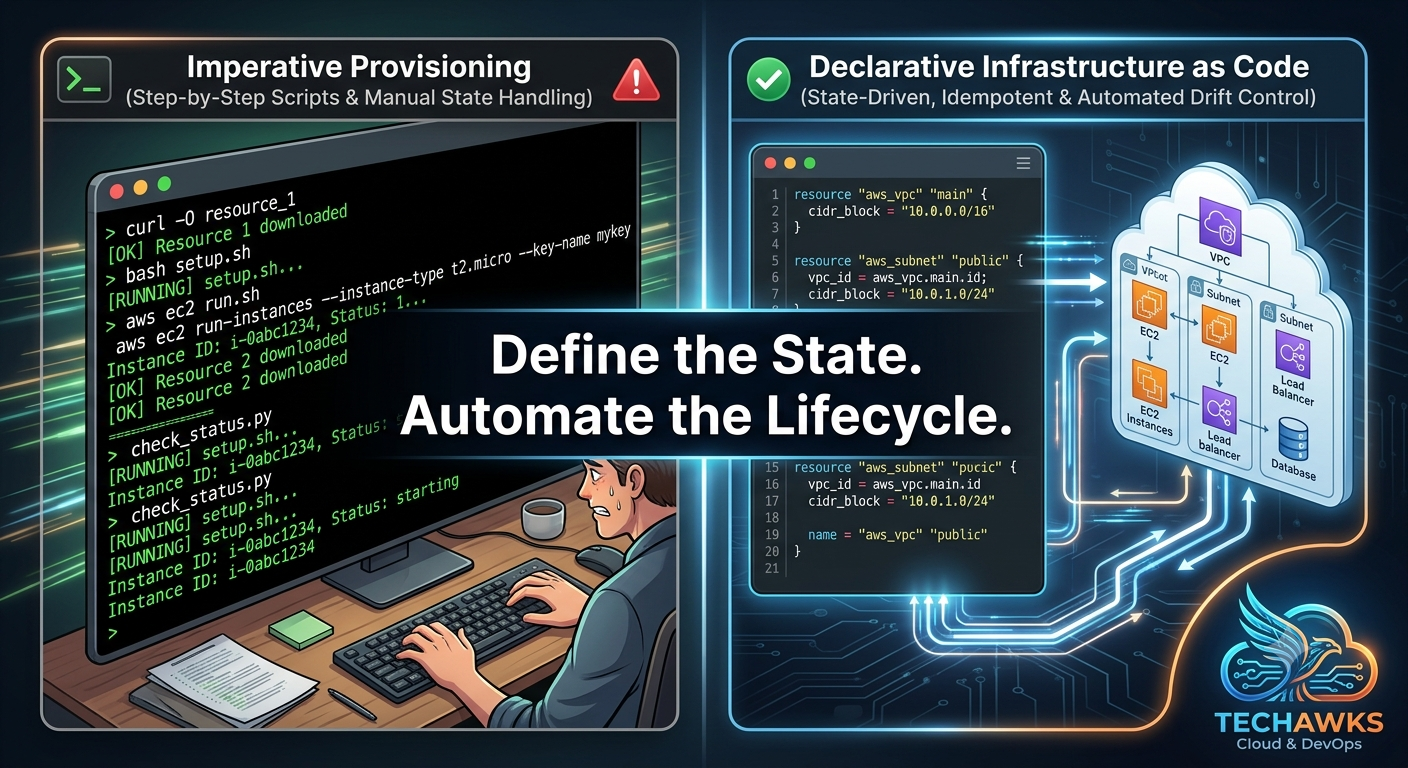
1. Imperative Provisioning (Step-by-Step Execution)
The Mechanism: You write scripts (using Bash, Python, or CLI commands like aws ec2 run-instances) that define the exact sequence of steps the cloud provider must execute to build infrastructure.
Where It Succeeds: Quick one-off tasks, operational troubleshooting, and ad-hoc automation scripts where full state tracking is unnecessary.
The Drawbacks: High operational fragility. Imperative scripts lack built-in state management. If a script fails halfway through execution, running it again often leads to duplicate resources, race conditions, or unhandled configuration errors.
2. Declarative Infrastructure (State-Driven Configuration)
The Mechanism: You write configuration files (using tools like Terraform, OpenTofu, or CloudFormation) that define the desired end state of your infrastructure. The underlying engine calculates the diff between reality and the configuration, executing only the necessary modifications.
Where It Succeeds: Enterprise cloud management, automated CI/CD pipelines, and multi-environment consistency. It natively prevents configuration drift and enables version-controlled infrastructure history.
The Drawbacks: Steeper initial learning curve, state file locks, and rigid abstractions that can complicate highly custom operational workflows.
Actionable Advice for Cloud Engineers
To maximize deployment speed while enforcing state reliability across environments, follow these practical rules:
Adopt Declarative for Provisioning (90%): Use declarative IaC tools to manage all long-lived cloud resources (VPCs, subnets, Kubernetes clusters, IAM roles, and databases). This guarantees reproducibility across staging and production.
Reserve Imperative for Orchestration & Hooks (10%): Use imperative scripts inside container entrypoints, CI/CD pipeline steps, or post-provisioning initialization tasks where sequential logic or external API calls are required.
Automate Drift Detection: Schedule automated daily pipeline runs (terraform plan) to detect and alert on unauthorized manual changes made directly in the cloud console.
Key Takeaways
State Management is Critical: Declarative tools maintain an explicit state file, ensuring infrastructure changes are predictable, repeatable, and idempotent.
Scripting Isn't Dead, Just Repositioned: Imperative scripting remains essential for operational glue and pipeline tasks, but should not manage core resource lifecycles.
Version Everything: Treating declarative templates as software source code brings code review, automated testing, and easy rollback capabilities to cloud operations.
CTA
How is your team managing infrastructure state and automation pipelines this year? Join Cloud, DevOps & Open Source to share IaC architecture patterns, debate module structures, and collaborate with experienced DevOps professionals.
The debate between Declarative Infrastructure as Code (IaC) and Imperative Infrastructure scripts shapes how cloud teams maintain reliability, prevent configuration drift, and manage deployment pipelines.
Understanding where each approach excels allows cloud engineers to build resilient, automated infrastructure:
1. Imperative Provisioning (Step-by-Step Execution)
The Mechanism: You write scripts (using Bash, Python, or CLI commands like aws ec2 run-instances) that define the exact sequence of steps the cloud provider must execute to build infrastructure.
Where It Succeeds: Quick one-off tasks, operational troubleshooting, and ad-hoc automation scripts where full state tracking is unnecessary.
The Drawbacks: High operational fragility. Imperative scripts lack built-in state management. If a script fails halfway through execution, running it again often leads to duplicate resources, race conditions, or unhandled configuration errors.
2. Declarative Infrastructure (State-Driven Configuration)
The Mechanism: You write configuration files (using tools like Terraform, OpenTofu, or CloudFormation) that define the desired end state of your infrastructure. The underlying engine calculates the diff between reality and the configuration, executing only the necessary modifications.
Where It Succeeds: Enterprise cloud management, automated CI/CD pipelines, and multi-environment consistency. It natively prevents configuration drift and enables version-controlled infrastructure history.
The Drawbacks: Steeper initial learning curve, state file locks, and rigid abstractions that can complicate highly custom operational workflows.
Actionable Advice for Cloud Engineers
To maximize deployment speed while enforcing state reliability across environments, follow these practical rules:
Adopt Declarative for Provisioning (90%): Use declarative IaC tools to manage all long-lived cloud resources (VPCs, subnets, Kubernetes clusters, IAM roles, and databases). This guarantees reproducibility across staging and production.
Reserve Imperative for Orchestration & Hooks (10%): Use imperative scripts inside container entrypoints, CI/CD pipeline steps, or post-provisioning initialization tasks where sequential logic or external API calls are required.
Automate Drift Detection: Schedule automated daily pipeline runs (terraform plan) to detect and alert on unauthorized manual changes made directly in the cloud console.
Key Takeaways
State Management is Critical: Declarative tools maintain an explicit state file, ensuring infrastructure changes are predictable, repeatable, and idempotent.
Scripting Isn't Dead, Just Repositioned: Imperative scripting remains essential for operational glue and pipeline tasks, but should not manage core resource lifecycles.
Version Everything: Treating declarative templates as software source code brings code review, automated testing, and easy rollback capabilities to cloud operations.
CTA
How is your team managing infrastructure state and automation pipelines this year? Join Cloud, DevOps & Open Source to share IaC architecture patterns, debate module structures, and collaborate with experienced DevOps professionals.
Declarative vs. Imperative Infrastructure: Is Code-Driven Automation Leaving Scripting Behind?
The debate between Declarative Infrastructure as Code (IaC) and Imperative Infrastructure scripts shapes how cloud teams maintain reliability, prevent configuration drift, and manage deployment pipelines.
Understanding where each approach excels allows cloud engineers to build resilient, automated infrastructure:
1. Imperative Provisioning (Step-by-Step Execution)
The Mechanism: You write scripts (using Bash, Python, or CLI commands like aws ec2 run-instances) that define the exact sequence of steps the cloud provider must execute to build infrastructure.
Where It Succeeds: Quick one-off tasks, operational troubleshooting, and ad-hoc automation scripts where full state tracking is unnecessary.
The Drawbacks: High operational fragility. Imperative scripts lack built-in state management. If a script fails halfway through execution, running it again often leads to duplicate resources, race conditions, or unhandled configuration errors.
2. Declarative Infrastructure (State-Driven Configuration)
The Mechanism: You write configuration files (using tools like Terraform, OpenTofu, or CloudFormation) that define the desired end state of your infrastructure. The underlying engine calculates the diff between reality and the configuration, executing only the necessary modifications.
Where It Succeeds: Enterprise cloud management, automated CI/CD pipelines, and multi-environment consistency. It natively prevents configuration drift and enables version-controlled infrastructure history.
The Drawbacks: Steeper initial learning curve, state file locks, and rigid abstractions that can complicate highly custom operational workflows.
Actionable Advice for Cloud Engineers
To maximize deployment speed while enforcing state reliability across environments, follow these practical rules:
Adopt Declarative for Provisioning (90%): Use declarative IaC tools to manage all long-lived cloud resources (VPCs, subnets, Kubernetes clusters, IAM roles, and databases). This guarantees reproducibility across staging and production.
Reserve Imperative for Orchestration & Hooks (10%): Use imperative scripts inside container entrypoints, CI/CD pipeline steps, or post-provisioning initialization tasks where sequential logic or external API calls are required.
Automate Drift Detection: Schedule automated daily pipeline runs (terraform plan) to detect and alert on unauthorized manual changes made directly in the cloud console.
Key Takeaways
State Management is Critical: Declarative tools maintain an explicit state file, ensuring infrastructure changes are predictable, repeatable, and idempotent.
Scripting Isn't Dead, Just Repositioned: Imperative scripting remains essential for operational glue and pipeline tasks, but should not manage core resource lifecycles.
Version Everything: Treating declarative templates as software source code brings code review, automated testing, and easy rollback capabilities to cloud operations.
CTA
How is your team managing infrastructure state and automation pipelines this year? Join Cloud, DevOps & Open Source to share IaC architecture patterns, debate module structures, and collaborate with experienced DevOps professionals.

 English
 Arabic
 French
 Spanish
 Portuguese
 Turkish
 Dutch
Dutch
 Italiano
 Russian
 Romaian
 Portuguese (Brazil)
 Greek
Greek