


Why Most "AI Agents" Fail in Production (And the Architecture Shift You Need)
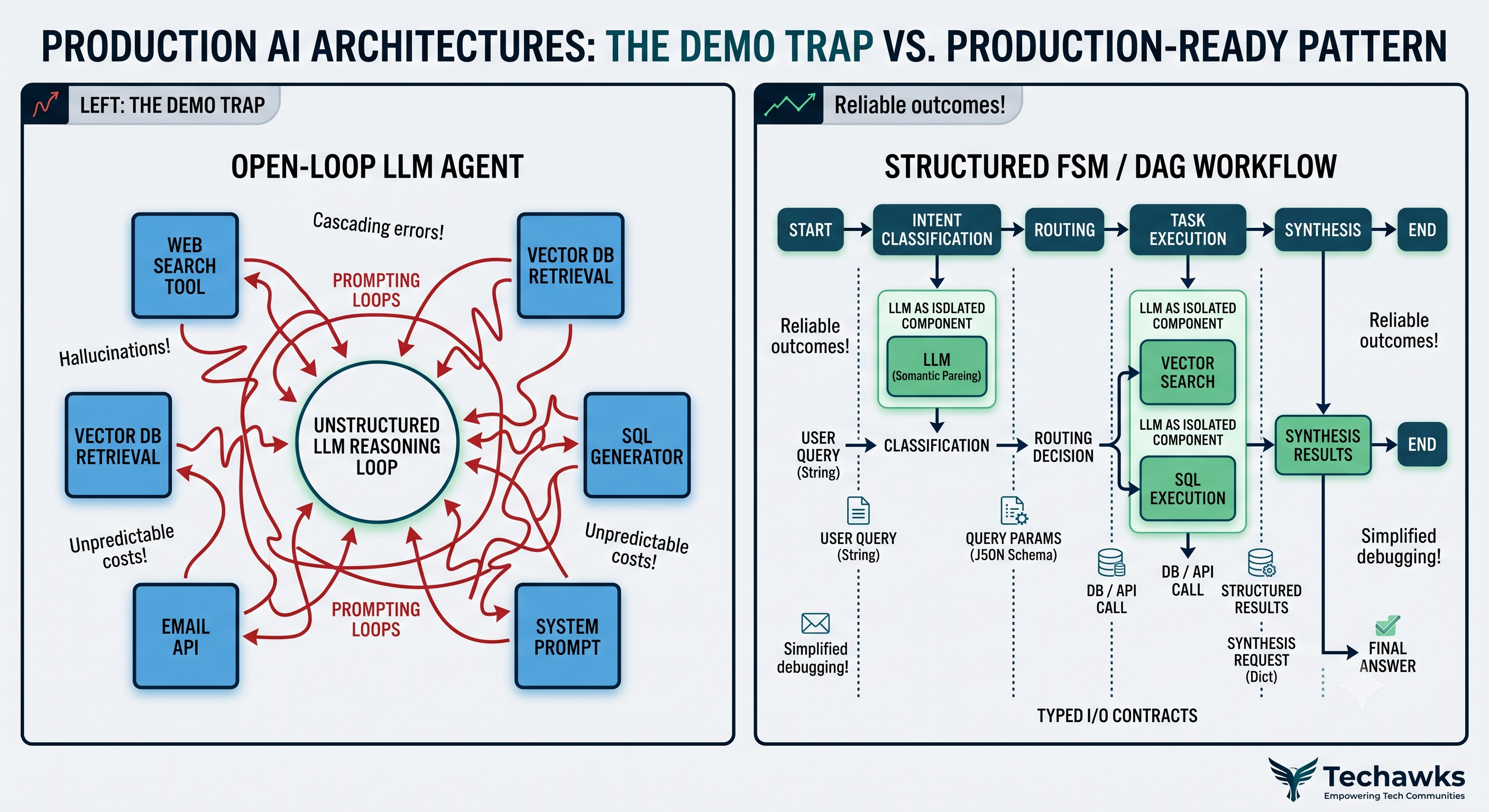
As engineering teams shift from AI prototypes to business-critical systems, a common failure mode has emerged: giving an LLM full autonomous control over execution flow.
When an agent enters open-ended loops, three problems compound quickly:
Error Cascading: One ambiguous tool output biases subsequent reasoning steps, leading to compounding hallucination loops.
Non-Deterministic Latency & Cost: Variable multi-step retry loops make latency SLAs and token budgets unpredictable.
Auditability Gaps: Debugging where an agentic decision went off course across dynamic chains is a tracing nightmare.
The Architectural Fix: Constrained State Machines
High-performing engineering teams separate reasoning from control flow:
Deterministic Routing (The Graph): Define transitions, states, and business rules explicitly using structured graphs (e.g., State Machines / DAGs) rather than letting the LLM decide which system step runs next.
Bounded Scopes for LLMs: Use the model strictly for tasks where semantic flexibility is needed—entity extraction, intent classification, or synthesizing unstructured context.
Strict Schema Validation & Guardrails: Wrap every tool call input and output in typed contracts (e.g., Pydantic schemas) with fallback policies for validation errors.
Stateful Evals in CI/CD: Test agentic logic against deterministic benchmark datasets to evaluate step-by-step state transitions, not just final output strings.
Rule of thumb: If the execution sequence is predictable, hardcode the pipeline. Reserve LLM non-determinism only for ambiguous inputs and natural language transformations.
Discussion Question
Where do you draw the line between hardcoded system logic and LLM-driven decision making in your current stack?
CTA
Ready to build resilient, production-grade systems alongside top software engineers and architects?
As engineering teams shift from AI prototypes to business-critical systems, a common failure mode has emerged: giving an LLM full autonomous control over execution flow.
When an agent enters open-ended loops, three problems compound quickly:
Error Cascading: One ambiguous tool output biases subsequent reasoning steps, leading to compounding hallucination loops.
Non-Deterministic Latency & Cost: Variable multi-step retry loops make latency SLAs and token budgets unpredictable.
Auditability Gaps: Debugging where an agentic decision went off course across dynamic chains is a tracing nightmare.
The Architectural Fix: Constrained State Machines
High-performing engineering teams separate reasoning from control flow:
Deterministic Routing (The Graph): Define transitions, states, and business rules explicitly using structured graphs (e.g., State Machines / DAGs) rather than letting the LLM decide which system step runs next.
Bounded Scopes for LLMs: Use the model strictly for tasks where semantic flexibility is needed—entity extraction, intent classification, or synthesizing unstructured context.
Strict Schema Validation & Guardrails: Wrap every tool call input and output in typed contracts (e.g., Pydantic schemas) with fallback policies for validation errors.
Stateful Evals in CI/CD: Test agentic logic against deterministic benchmark datasets to evaluate step-by-step state transitions, not just final output strings.
Rule of thumb: If the execution sequence is predictable, hardcode the pipeline. Reserve LLM non-determinism only for ambiguous inputs and natural language transformations.
Discussion Question
Where do you draw the line between hardcoded system logic and LLM-driven decision making in your current stack?
CTA
Ready to build resilient, production-grade systems alongside top software engineers and architects?
Why Most "AI Agents" Fail in Production (And the Architecture Shift You Need)
As engineering teams shift from AI prototypes to business-critical systems, a common failure mode has emerged: giving an LLM full autonomous control over execution flow.
When an agent enters open-ended loops, three problems compound quickly:
Error Cascading: One ambiguous tool output biases subsequent reasoning steps, leading to compounding hallucination loops.
Non-Deterministic Latency & Cost: Variable multi-step retry loops make latency SLAs and token budgets unpredictable.
Auditability Gaps: Debugging where an agentic decision went off course across dynamic chains is a tracing nightmare.
The Architectural Fix: Constrained State Machines
High-performing engineering teams separate reasoning from control flow:
Deterministic Routing (The Graph): Define transitions, states, and business rules explicitly using structured graphs (e.g., State Machines / DAGs) rather than letting the LLM decide which system step runs next.
Bounded Scopes for LLMs: Use the model strictly for tasks where semantic flexibility is needed—entity extraction, intent classification, or synthesizing unstructured context.
Strict Schema Validation & Guardrails: Wrap every tool call input and output in typed contracts (e.g., Pydantic schemas) with fallback policies for validation errors.
Stateful Evals in CI/CD: Test agentic logic against deterministic benchmark datasets to evaluate step-by-step state transitions, not just final output strings.
Rule of thumb: If the execution sequence is predictable, hardcode the pipeline. Reserve LLM non-determinism only for ambiguous inputs and natural language transformations.
Discussion Question
Where do you draw the line between hardcoded system logic and LLM-driven decision making in your current stack?
CTA
Ready to build resilient, production-grade systems alongside top software engineers and architects?

 English
 Arabic
 French
 Spanish
 Portuguese
 Turkish
 Dutch
Dutch
 Italiano
 Russian
 Romaian
 Portuguese (Brazil)
 Greek
Greek