


The 80% Gross Margin Trap: Why Seat-Based Pricing Destroys Modern AI Startups
The core assumption of classical B2B software is that serving 10,000 users costs almost the same infrastructure overhead as serving 100.
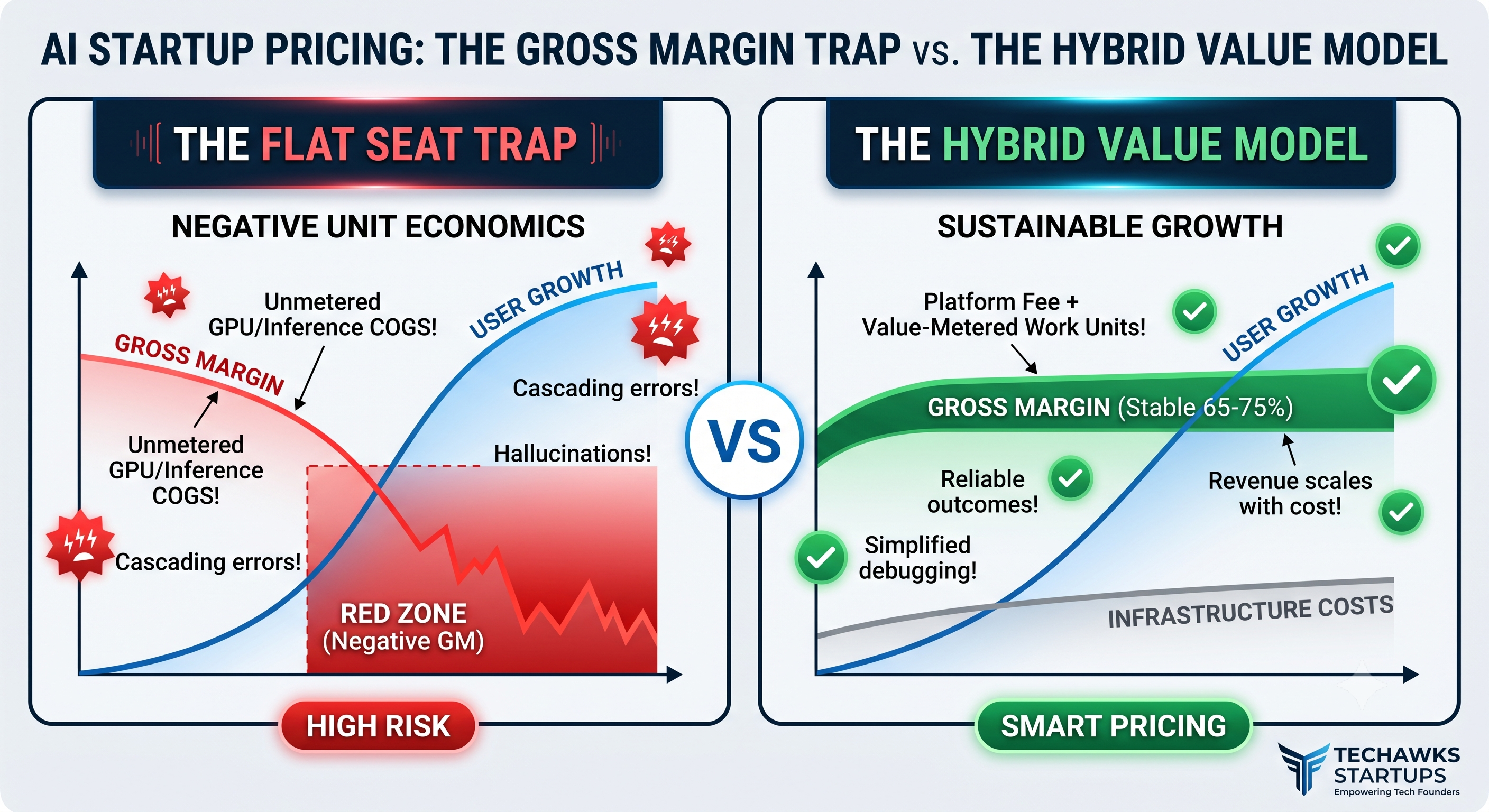
In AI-enabled systems, inference cost is direct Cost of Goods Sold (COGS). A flat $30/seat/month model creates a fatal inverse incentive:
Low-usage users generate high gross margin, but carry high churn risk.
High-intent power users burn thousands of agentic loops and multi-step tool calls, degrading your gross margin down to 30% or worse.
The 3-Tier Monetization Model for AI Founders
To build an investable, sustainable balance sheet, top founders are replacing flat seat licenses with a Hybrid Value-Metric Architecture:
Base Platform Fee (Predictable Core):
Charge a baseline recurring subscription for workspace access, security, compliance, team permissions, and integrations. This secures baseline ARR and satisfies enterprise procurement expectations for predictable billing.
Work-Unit Metering (Value-Aligned Consumption):
Avoid charging directly for raw "tokens" or "API calls"—enterprise buyers cannot budget for abstract technical metrics.
Instead, meter on discrete business outcomes: "Resolved Support Tickets," "Audited PRs," "Qualified Pipeline Accounts," or "Workflow Executions."
Compute Overages with Dynamic Model Tiering:
Package included work units per tier, backed by intelligent routing (e.g., routing simple entity extraction to fast, lightweight open models and reserving high-tier reasoning models only for ambiguous steps).
Enforce automatic usage thresholds and pre-paid credit top-ups so increased customer usage directly expands net revenue retention without margin erosion.
Founder Takeaway: Your pricing model dictates your architectural requirements. If your revenue is fixed per seat while your compute is variable per query, growth will drain your cash runway instead of fueling it.
Discussion Question
For founders and product leaders: What value metric have you found that aligns customer ROI with your underlying inference costs without introducing billing friction?
CTA
Looking to master startup unit economics, go-to-market strategies, and sustainable product monetization?
👉 Join Startup Founders & Entrepreneurs at Techawks
The core assumption of classical B2B software is that serving 10,000 users costs almost the same infrastructure overhead as serving 100.
In AI-enabled systems, inference cost is direct Cost of Goods Sold (COGS). A flat $30/seat/month model creates a fatal inverse incentive:
Low-usage users generate high gross margin, but carry high churn risk.
High-intent power users burn thousands of agentic loops and multi-step tool calls, degrading your gross margin down to 30% or worse.
The 3-Tier Monetization Model for AI Founders
To build an investable, sustainable balance sheet, top founders are replacing flat seat licenses with a Hybrid Value-Metric Architecture:
Base Platform Fee (Predictable Core):
Charge a baseline recurring subscription for workspace access, security, compliance, team permissions, and integrations. This secures baseline ARR and satisfies enterprise procurement expectations for predictable billing.
Work-Unit Metering (Value-Aligned Consumption):
Avoid charging directly for raw "tokens" or "API calls"—enterprise buyers cannot budget for abstract technical metrics.
Instead, meter on discrete business outcomes: "Resolved Support Tickets," "Audited PRs," "Qualified Pipeline Accounts," or "Workflow Executions."
Compute Overages with Dynamic Model Tiering:
Package included work units per tier, backed by intelligent routing (e.g., routing simple entity extraction to fast, lightweight open models and reserving high-tier reasoning models only for ambiguous steps).
Enforce automatic usage thresholds and pre-paid credit top-ups so increased customer usage directly expands net revenue retention without margin erosion.
Founder Takeaway: Your pricing model dictates your architectural requirements. If your revenue is fixed per seat while your compute is variable per query, growth will drain your cash runway instead of fueling it.
Discussion Question
For founders and product leaders: What value metric have you found that aligns customer ROI with your underlying inference costs without introducing billing friction?
CTA
Looking to master startup unit economics, go-to-market strategies, and sustainable product monetization?
👉 Join Startup Founders & Entrepreneurs at Techawks
The 80% Gross Margin Trap: Why Seat-Based Pricing Destroys Modern AI Startups
The core assumption of classical B2B software is that serving 10,000 users costs almost the same infrastructure overhead as serving 100.
In AI-enabled systems, inference cost is direct Cost of Goods Sold (COGS). A flat $30/seat/month model creates a fatal inverse incentive:
Low-usage users generate high gross margin, but carry high churn risk.
High-intent power users burn thousands of agentic loops and multi-step tool calls, degrading your gross margin down to 30% or worse.
The 3-Tier Monetization Model for AI Founders
To build an investable, sustainable balance sheet, top founders are replacing flat seat licenses with a Hybrid Value-Metric Architecture:
Base Platform Fee (Predictable Core):
Charge a baseline recurring subscription for workspace access, security, compliance, team permissions, and integrations. This secures baseline ARR and satisfies enterprise procurement expectations for predictable billing.
Work-Unit Metering (Value-Aligned Consumption):
Avoid charging directly for raw "tokens" or "API calls"—enterprise buyers cannot budget for abstract technical metrics.
Instead, meter on discrete business outcomes: "Resolved Support Tickets," "Audited PRs," "Qualified Pipeline Accounts," or "Workflow Executions."
Compute Overages with Dynamic Model Tiering:
Package included work units per tier, backed by intelligent routing (e.g., routing simple entity extraction to fast, lightweight open models and reserving high-tier reasoning models only for ambiguous steps).
Enforce automatic usage thresholds and pre-paid credit top-ups so increased customer usage directly expands net revenue retention without margin erosion.
Founder Takeaway: Your pricing model dictates your architectural requirements. If your revenue is fixed per seat while your compute is variable per query, growth will drain your cash runway instead of fueling it.
Discussion Question
For founders and product leaders: What value metric have you found that aligns customer ROI with your underlying inference costs without introducing billing friction?
CTA
Looking to master startup unit economics, go-to-market strategies, and sustainable product monetization?
👉 Join Startup Founders & Entrepreneurs at Techawks

 English
 Arabic
 French
 Spanish
 Portuguese
 Deutsch
 Turkish
 Dutch
Dutch
 Italiano
 Romaian
 Portuguese (Brazil)
 Greek
Greek