


Why 80% of "Working" AI Agents Fail in Production: The Trajectory Problem
Most engineering teams deploying autonomous workflows make the same architectural mistake: treating agent evaluation like traditional unit testing.
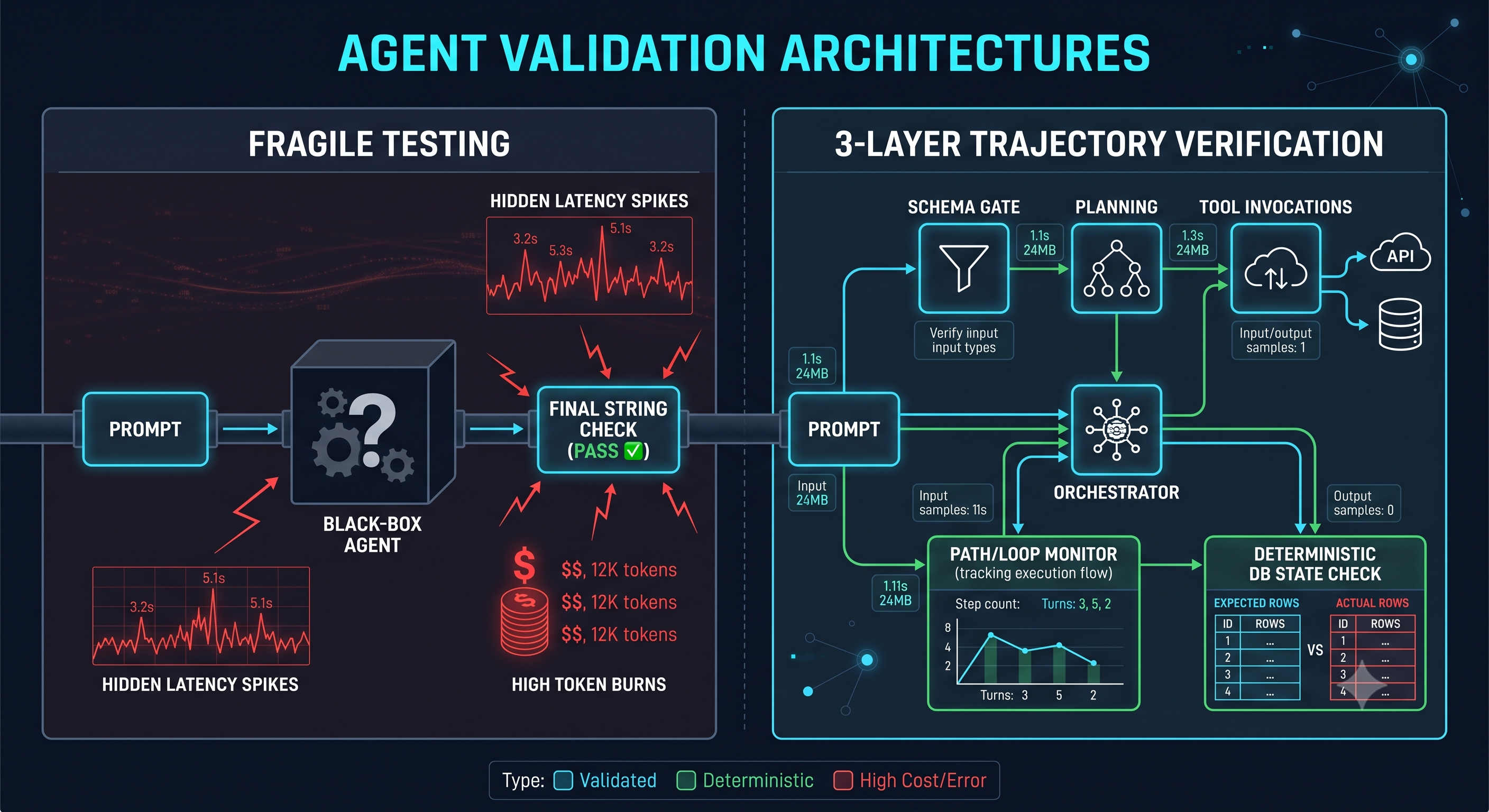
In classical software, given deterministic input A, you expect output B. But multi-turn agents involve non-deterministic planning, dynamic tool-calling loops, and contextual state drift. An agent that outputs the "correct" user response after 18 redundant database calls, 2 hallucinated intermediate schemas, and a near-infinite recovery loop is technically passing a basic pass/fail test—while quietly draining latency budgets and introducing critical edge-case risks.
To build production-grade agentic infrastructure, enterprise architectures are moving toward Three-Layer Execution-Based Verification:
Per-Turn Deterministic Verification:
Validate tool selection, parameter schema conformity, and safety boundaries on every single step rather than inspecting only the final payload.
Trajectory & Loop Scoring:
Measure path efficiency—penalizing circular tool invocations, excessive back-and-forth context retries, and suboptimal sub-agent delegations.
End-State Mutation Checks:
Never rely solely on an LLM-as-a-judge reading the final text. Verify actual state transitions in the environment (e.g., database writes, API mutations, sandbox execution returns).
The Architectural Takeaway:
Scaffolding and trajectory monitoring determine system stability far more than switching to the newest frontier foundation model. If you can't inspect the full execution trace deterministically, you don't have an autonomous architecture—you have an unmonitored script.
Discussion Question
How is your team currently validating non-deterministic tool chains in CI/CD? Are you measuring step-by-step trajectory efficiency, or relying on end-state LLM-as-a-judge evaluations?
CTA
Ready to dive deeper into modern systems design, agentic architectures, and distributed engineering?
👉 Join the Techawks General Community to connect with engineers worldwide building production-grade systems.
Most engineering teams deploying autonomous workflows make the same architectural mistake: treating agent evaluation like traditional unit testing.
In classical software, given deterministic input A, you expect output B. But multi-turn agents involve non-deterministic planning, dynamic tool-calling loops, and contextual state drift. An agent that outputs the "correct" user response after 18 redundant database calls, 2 hallucinated intermediate schemas, and a near-infinite recovery loop is technically passing a basic pass/fail test—while quietly draining latency budgets and introducing critical edge-case risks.
To build production-grade agentic infrastructure, enterprise architectures are moving toward Three-Layer Execution-Based Verification:
Per-Turn Deterministic Verification:
Validate tool selection, parameter schema conformity, and safety boundaries on every single step rather than inspecting only the final payload.
Trajectory & Loop Scoring:
Measure path efficiency—penalizing circular tool invocations, excessive back-and-forth context retries, and suboptimal sub-agent delegations.
End-State Mutation Checks:
Never rely solely on an LLM-as-a-judge reading the final text. Verify actual state transitions in the environment (e.g., database writes, API mutations, sandbox execution returns).
The Architectural Takeaway:
Scaffolding and trajectory monitoring determine system stability far more than switching to the newest frontier foundation model. If you can't inspect the full execution trace deterministically, you don't have an autonomous architecture—you have an unmonitored script.
Discussion Question
How is your team currently validating non-deterministic tool chains in CI/CD? Are you measuring step-by-step trajectory efficiency, or relying on end-state LLM-as-a-judge evaluations?
CTA
Ready to dive deeper into modern systems design, agentic architectures, and distributed engineering?
👉 Join the Techawks General Community to connect with engineers worldwide building production-grade systems.
Why 80% of "Working" AI Agents Fail in Production: The Trajectory Problem
Most engineering teams deploying autonomous workflows make the same architectural mistake: treating agent evaluation like traditional unit testing.
In classical software, given deterministic input A, you expect output B. But multi-turn agents involve non-deterministic planning, dynamic tool-calling loops, and contextual state drift. An agent that outputs the "correct" user response after 18 redundant database calls, 2 hallucinated intermediate schemas, and a near-infinite recovery loop is technically passing a basic pass/fail test—while quietly draining latency budgets and introducing critical edge-case risks.
To build production-grade agentic infrastructure, enterprise architectures are moving toward Three-Layer Execution-Based Verification:
Per-Turn Deterministic Verification:
Validate tool selection, parameter schema conformity, and safety boundaries on every single step rather than inspecting only the final payload.
Trajectory & Loop Scoring:
Measure path efficiency—penalizing circular tool invocations, excessive back-and-forth context retries, and suboptimal sub-agent delegations.
End-State Mutation Checks:
Never rely solely on an LLM-as-a-judge reading the final text. Verify actual state transitions in the environment (e.g., database writes, API mutations, sandbox execution returns).
The Architectural Takeaway:
Scaffolding and trajectory monitoring determine system stability far more than switching to the newest frontier foundation model. If you can't inspect the full execution trace deterministically, you don't have an autonomous architecture—you have an unmonitored script.
Discussion Question
How is your team currently validating non-deterministic tool chains in CI/CD? Are you measuring step-by-step trajectory efficiency, or relying on end-state LLM-as-a-judge evaluations?
CTA
Ready to dive deeper into modern systems design, agentic architectures, and distributed engineering?
👉 Join the Techawks General Community to connect with engineers worldwide building production-grade systems.

 English
 Arabic
 French
 Spanish
 Portuguese
 Turkish
 Dutch
Dutch
 Italiano
 Russian
 Romaian
 Portuguese (Brazil)
 Greek
Greek