


The 80% Gross Margin Illusion: Why AI-Native Startups Must Re-Engineer Unit Economics Before Scaling
For fifteen years, the playbook for software founders was clear: build once, sell infinitely, and enjoy near-zero marginal cost of delivery.
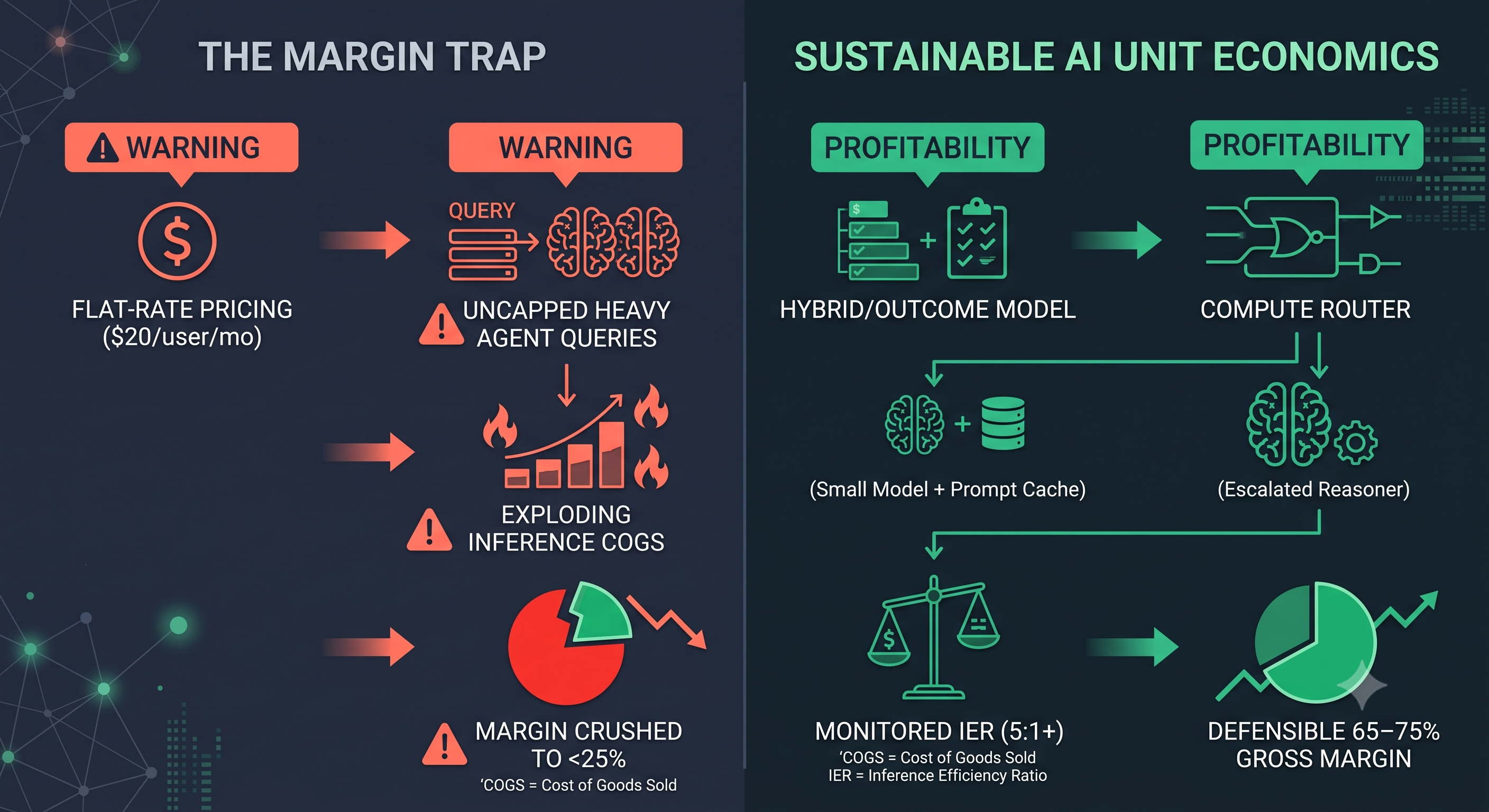
Embedding frontier foundation models and agentic toolchains permanently alters this math. Real-time inference, token retries, and context window expansions are not discretionary R&D—they are direct Cost of Goods Sold (COGS). Industry data shows AI-native software companies structurally compressing to 50–60% gross margins when relying on naive flat-rate pricing.
When your top 10% power users trigger heavy agentic loops, flat-rate tiers become margin-negative on an account-by-account basis.
To build a venture-scalable, margin-resilient startup, founders are restructuring their unit economics around Three Core Levers:
Calculate the Inference Efficiency Ratio (IER):Treat inference as an explicit COGS line item, not an undifferentiated cloud hosting bill. Benchmark your
IER = AI Product Revenue / Inference Spend.
A healthy AI-native target sits above 5:1. Anything below 3:1 signals that compute is consuming your gross profit before overhead.
Transition from Flat-Rate to Hybrid/Outcome Monetization:
Decouple pure per-seat subscription models. Protect margins with base platform access combined with metered credits, compute caps, or per-outcome billing (charging for completed tasks rather than raw token usage).
Enforce Dynamic Model Tiering at the Product Layer:
Treat every engineering decision as a financial decision. Route high-frequency deterministic tasks to distilled/small models and semantic cache layers; reserve frontier reasoning models strictly for escalated, high-ambiguity steps.
The Founder Takeaway:
Top-line ARR growth is meaningless if your cost to deliver scales linearly with user engagement. Real product-market fit requires an architecture where customer usage expands your gross margin, not compresses it.
Discussion Question
How is your startup pricing its AI-native features today? Have you moved away from standard per-seat tiers toward hybrid credit pools or outcome-based billing?
CTA
Ready to build, scale, and fund a resilient tech startup with sustainable unit economics?
👉 Join Startup Founders & Entrepreneurs at Techawks to exchange playbooks and scale faster with global builders.
For fifteen years, the playbook for software founders was clear: build once, sell infinitely, and enjoy near-zero marginal cost of delivery.
Embedding frontier foundation models and agentic toolchains permanently alters this math. Real-time inference, token retries, and context window expansions are not discretionary R&D—they are direct Cost of Goods Sold (COGS). Industry data shows AI-native software companies structurally compressing to 50–60% gross margins when relying on naive flat-rate pricing.
When your top 10% power users trigger heavy agentic loops, flat-rate tiers become margin-negative on an account-by-account basis.
To build a venture-scalable, margin-resilient startup, founders are restructuring their unit economics around Three Core Levers:
Calculate the Inference Efficiency Ratio (IER):Treat inference as an explicit COGS line item, not an undifferentiated cloud hosting bill. Benchmark your
IER = AI Product Revenue / Inference Spend.
A healthy AI-native target sits above 5:1. Anything below 3:1 signals that compute is consuming your gross profit before overhead.
Transition from Flat-Rate to Hybrid/Outcome Monetization:
Decouple pure per-seat subscription models. Protect margins with base platform access combined with metered credits, compute caps, or per-outcome billing (charging for completed tasks rather than raw token usage).
Enforce Dynamic Model Tiering at the Product Layer:
Treat every engineering decision as a financial decision. Route high-frequency deterministic tasks to distilled/small models and semantic cache layers; reserve frontier reasoning models strictly for escalated, high-ambiguity steps.
The Founder Takeaway:
Top-line ARR growth is meaningless if your cost to deliver scales linearly with user engagement. Real product-market fit requires an architecture where customer usage expands your gross margin, not compresses it.
Discussion Question
How is your startup pricing its AI-native features today? Have you moved away from standard per-seat tiers toward hybrid credit pools or outcome-based billing?
CTA
Ready to build, scale, and fund a resilient tech startup with sustainable unit economics?
👉 Join Startup Founders & Entrepreneurs at Techawks to exchange playbooks and scale faster with global builders.
The 80% Gross Margin Illusion: Why AI-Native Startups Must Re-Engineer Unit Economics Before Scaling
For fifteen years, the playbook for software founders was clear: build once, sell infinitely, and enjoy near-zero marginal cost of delivery.
Embedding frontier foundation models and agentic toolchains permanently alters this math. Real-time inference, token retries, and context window expansions are not discretionary R&D—they are direct Cost of Goods Sold (COGS). Industry data shows AI-native software companies structurally compressing to 50–60% gross margins when relying on naive flat-rate pricing.
When your top 10% power users trigger heavy agentic loops, flat-rate tiers become margin-negative on an account-by-account basis.
To build a venture-scalable, margin-resilient startup, founders are restructuring their unit economics around Three Core Levers:
Calculate the Inference Efficiency Ratio (IER):Treat inference as an explicit COGS line item, not an undifferentiated cloud hosting bill. Benchmark your
IER = AI Product Revenue / Inference Spend.
A healthy AI-native target sits above 5:1. Anything below 3:1 signals that compute is consuming your gross profit before overhead.
Transition from Flat-Rate to Hybrid/Outcome Monetization:
Decouple pure per-seat subscription models. Protect margins with base platform access combined with metered credits, compute caps, or per-outcome billing (charging for completed tasks rather than raw token usage).
Enforce Dynamic Model Tiering at the Product Layer:
Treat every engineering decision as a financial decision. Route high-frequency deterministic tasks to distilled/small models and semantic cache layers; reserve frontier reasoning models strictly for escalated, high-ambiguity steps.
The Founder Takeaway:
Top-line ARR growth is meaningless if your cost to deliver scales linearly with user engagement. Real product-market fit requires an architecture where customer usage expands your gross margin, not compresses it.
Discussion Question
How is your startup pricing its AI-native features today? Have you moved away from standard per-seat tiers toward hybrid credit pools or outcome-based billing?
CTA
Ready to build, scale, and fund a resilient tech startup with sustainable unit economics?
👉 Join Startup Founders & Entrepreneurs at Techawks to exchange playbooks and scale faster with global builders.

 English
 Arabic
 French
 Spanish
 Portuguese
 Deutsch
 Turkish
 Dutch
Dutch
 Italiano
 Russian
 Romaian
 Greek
Greek