


Why "It Runs Locally" Isn’t Enough: The CS Student’s Guide to Memory Leaks and Deterministic Resource Lifecycles
When studying Computer Science, coursework often rewards raw functional correctness: pass the autograder test cases, print the expected output, and submit.
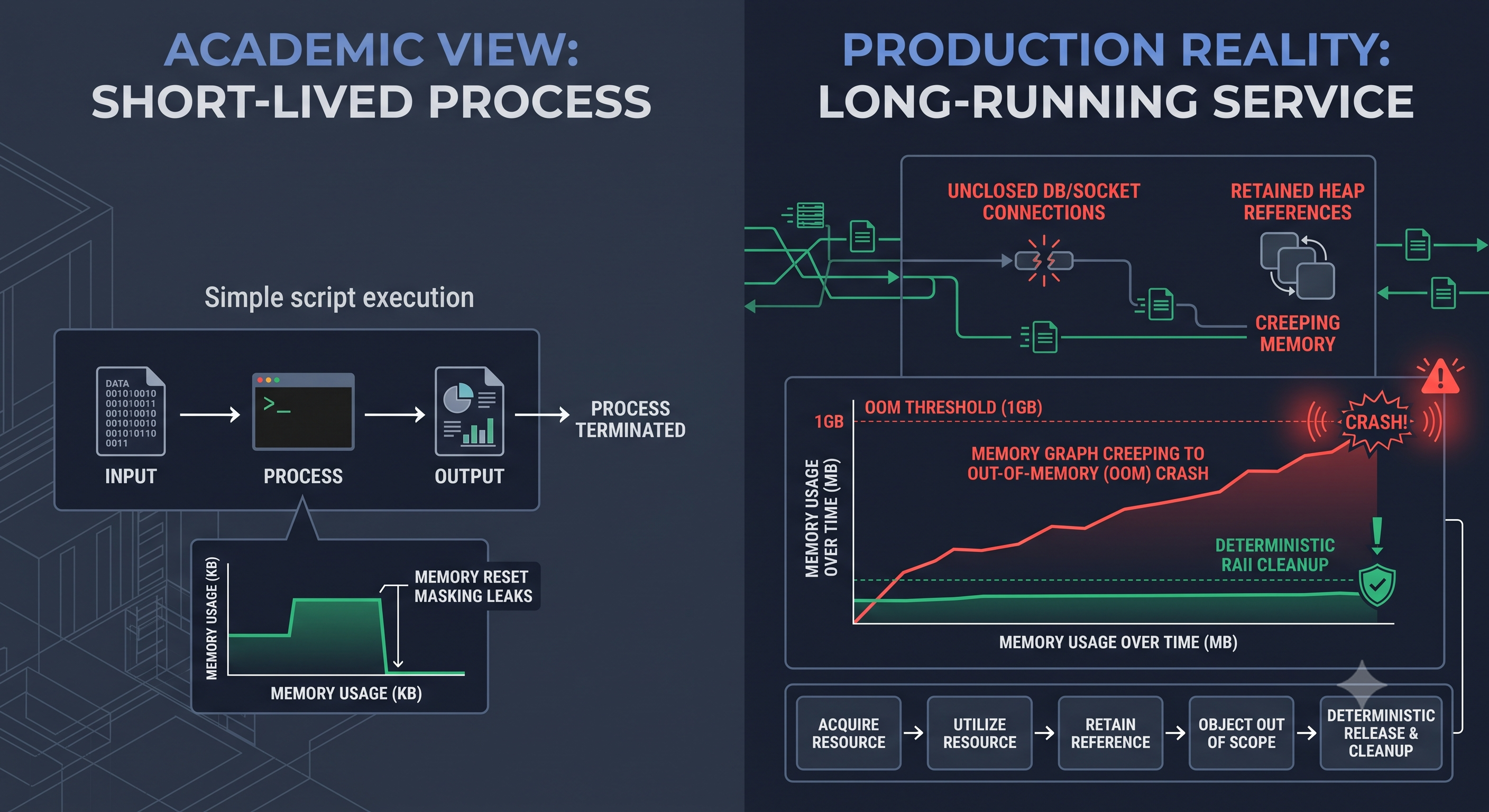
Because student test environments run short-lived processes, unmanaged resource consumption remains completely hidden. But when your application transitions to an always-on production service, naive resource handling leads directly to memory leaks, connection pool exhaustion, and cascading system crashes.
Understanding deterministic resource management turns theoretical CS concepts into real engineering authority:
Stack vs. Heap Awareness:
High-level languages manage memory with automatic Garbage Collection (GC), but GC does not mean "free memory." Holding onto object references in global state, event listeners, or unclosed closures prevents garbage collection, resulting in creeping memory fragmentation.
Deterministic Teardown & Scope Guards:
Every opened resource—database connection, file descriptor, TCP socket, or thread worker—must have a guaranteed exit path. Use language constructs like try-with-resources (Java), context managers with (Python), or RAII patterns (C++/Rust) to guarantee cleanup even when unhandled exceptions occur.
Observing State Under Load:
Never test only with single-execution runs. Profile your services using memory profilers, stress-test your endpoints with concurrent simulated requests, and inspect memory allocation graphs before declaring an application "done."
The Student Takeaway:
Writing code that works for 5 seconds is easy. Engineering systems that remain stable under 100,000 requests over 30 continuous days is what separates a student from a hired engineer.
Discussion Question
When building your course or personal projects, how do you handle resource cleanup and error boundaries? Have you ever run into a memory leak or connection limit in your own code?
CTA
Ready to bridge the gap between academic theory and real-world software engineering?
👉 Join Students in Tech at Techawks to learn system design, master foundational engineering practices, and build alongside peers worldwide.
When studying Computer Science, coursework often rewards raw functional correctness: pass the autograder test cases, print the expected output, and submit.
Because student test environments run short-lived processes, unmanaged resource consumption remains completely hidden. But when your application transitions to an always-on production service, naive resource handling leads directly to memory leaks, connection pool exhaustion, and cascading system crashes.
Understanding deterministic resource management turns theoretical CS concepts into real engineering authority:
Stack vs. Heap Awareness:
High-level languages manage memory with automatic Garbage Collection (GC), but GC does not mean "free memory." Holding onto object references in global state, event listeners, or unclosed closures prevents garbage collection, resulting in creeping memory fragmentation.
Deterministic Teardown & Scope Guards:
Every opened resource—database connection, file descriptor, TCP socket, or thread worker—must have a guaranteed exit path. Use language constructs like try-with-resources (Java), context managers with (Python), or RAII patterns (C++/Rust) to guarantee cleanup even when unhandled exceptions occur.
Observing State Under Load:
Never test only with single-execution runs. Profile your services using memory profilers, stress-test your endpoints with concurrent simulated requests, and inspect memory allocation graphs before declaring an application "done."
The Student Takeaway:
Writing code that works for 5 seconds is easy. Engineering systems that remain stable under 100,000 requests over 30 continuous days is what separates a student from a hired engineer.
Discussion Question
When building your course or personal projects, how do you handle resource cleanup and error boundaries? Have you ever run into a memory leak or connection limit in your own code?
CTA
Ready to bridge the gap between academic theory and real-world software engineering?
👉 Join Students in Tech at Techawks to learn system design, master foundational engineering practices, and build alongside peers worldwide.
Why "It Runs Locally" Isn’t Enough: The CS Student’s Guide to Memory Leaks and Deterministic Resource Lifecycles
When studying Computer Science, coursework often rewards raw functional correctness: pass the autograder test cases, print the expected output, and submit.
Because student test environments run short-lived processes, unmanaged resource consumption remains completely hidden. But when your application transitions to an always-on production service, naive resource handling leads directly to memory leaks, connection pool exhaustion, and cascading system crashes.
Understanding deterministic resource management turns theoretical CS concepts into real engineering authority:
Stack vs. Heap Awareness:
High-level languages manage memory with automatic Garbage Collection (GC), but GC does not mean "free memory." Holding onto object references in global state, event listeners, or unclosed closures prevents garbage collection, resulting in creeping memory fragmentation.
Deterministic Teardown & Scope Guards:
Every opened resource—database connection, file descriptor, TCP socket, or thread worker—must have a guaranteed exit path. Use language constructs like try-with-resources (Java), context managers with (Python), or RAII patterns (C++/Rust) to guarantee cleanup even when unhandled exceptions occur.
Observing State Under Load:
Never test only with single-execution runs. Profile your services using memory profilers, stress-test your endpoints with concurrent simulated requests, and inspect memory allocation graphs before declaring an application "done."
The Student Takeaway:
Writing code that works for 5 seconds is easy. Engineering systems that remain stable under 100,000 requests over 30 continuous days is what separates a student from a hired engineer.
Discussion Question
When building your course or personal projects, how do you handle resource cleanup and error boundaries? Have you ever run into a memory leak or connection limit in your own code?
CTA
Ready to bridge the gap between academic theory and real-world software engineering?
👉 Join Students in Tech at Techawks to learn system design, master foundational engineering practices, and build alongside peers worldwide.

 English
 Arabic
 French
 Spanish
 Portuguese
 Deutsch
 Dutch
Dutch
 Italiano
 Russian
 Romaian
 Portuguese (Brazil)
 Greek
Greek