


The Hidden Architecture Cost: Choosing Between Microservices and a Modular Monolith
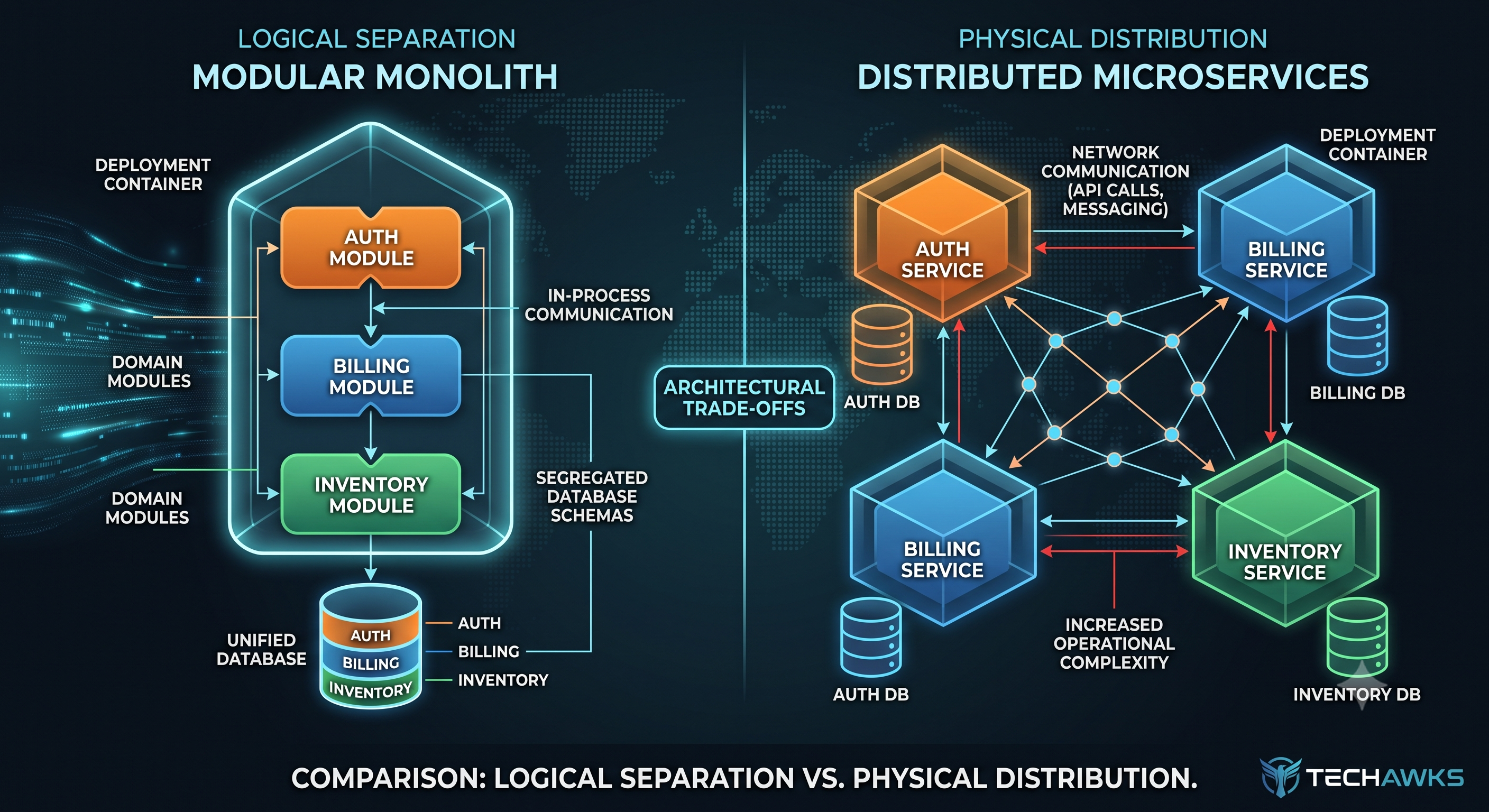
When scaling a system, the reflex is often to decompose everything into independent services. On paper, it promises autonomous teams, isolated deployments, and independent scaling.
In production, microservices introduce severe operational overhead before most teams actually need them:
Network Latency & Failure Modes: Local in-memory function calls turn into network hops with retries, timeouts, circuit breakers, and partial failure states.
Distributed Data Consistency: Transactions across domain boundaries require saga patterns or two-phase commits instead of simple ACID guarantees.
Observability Tax: Tracing a single user action requires dedicated telemetry infrastructure, distributed log aggregation, and complex correlation IDs.
Before splitting your application across repository and network boundaries, consider the Modular Monolith:
Define Strict Domain Boundaries: Enforce module isolation at the folder or package level. Modules should interact only through explicit public interfaces, never by reaching directly into another module’s database models.
Isolate Data Ownership: Even within a single database, assign specific tables to specific modules. Disallow cross-domain foreign keys and direct cross-table joins.
Decouple via Domain Events: Use an in-process event bus for asynchronous communication between modules. This prepares your architecture for external message brokers (e.g., Kafka, RabbitMQ) later without changing business logic.
If a specific bounded context eventually outgrows the shared infrastructure due to unique CPU, memory, or scaling requirements, you can carve it out into a standalone microservice in days—because the boundary is already clean.
Key Takeaways
Premature microservices replace code complexity with network and operational complexity.
A modular monolith enforces bounded contexts and domain separation within a single deployment unit.
True architectural decoupling happens at the data and interface layer, not the deployment layer.
CTA
Where does your team currently stand on the monolith vs. microservices spectrum? Have you ever had to migrate back to a monolith, or did microservices solve your scaling bottlenecks?
Share your real-world architecture tradeoffs below, and join the Techawks General Community to connect with engineers solving distributed systems challenges daily: [Link to Community]
When scaling a system, the reflex is often to decompose everything into independent services. On paper, it promises autonomous teams, isolated deployments, and independent scaling.
In production, microservices introduce severe operational overhead before most teams actually need them:
Network Latency & Failure Modes: Local in-memory function calls turn into network hops with retries, timeouts, circuit breakers, and partial failure states.
Distributed Data Consistency: Transactions across domain boundaries require saga patterns or two-phase commits instead of simple ACID guarantees.
Observability Tax: Tracing a single user action requires dedicated telemetry infrastructure, distributed log aggregation, and complex correlation IDs.
Before splitting your application across repository and network boundaries, consider the Modular Monolith:
Define Strict Domain Boundaries: Enforce module isolation at the folder or package level. Modules should interact only through explicit public interfaces, never by reaching directly into another module’s database models.
Isolate Data Ownership: Even within a single database, assign specific tables to specific modules. Disallow cross-domain foreign keys and direct cross-table joins.
Decouple via Domain Events: Use an in-process event bus for asynchronous communication between modules. This prepares your architecture for external message brokers (e.g., Kafka, RabbitMQ) later without changing business logic.
If a specific bounded context eventually outgrows the shared infrastructure due to unique CPU, memory, or scaling requirements, you can carve it out into a standalone microservice in days—because the boundary is already clean.
Key Takeaways
Premature microservices replace code complexity with network and operational complexity.
A modular monolith enforces bounded contexts and domain separation within a single deployment unit.
True architectural decoupling happens at the data and interface layer, not the deployment layer.
CTA
Where does your team currently stand on the monolith vs. microservices spectrum? Have you ever had to migrate back to a monolith, or did microservices solve your scaling bottlenecks?
Share your real-world architecture tradeoffs below, and join the Techawks General Community to connect with engineers solving distributed systems challenges daily: [Link to Community]
The Hidden Architecture Cost: Choosing Between Microservices and a Modular Monolith
When scaling a system, the reflex is often to decompose everything into independent services. On paper, it promises autonomous teams, isolated deployments, and independent scaling.
In production, microservices introduce severe operational overhead before most teams actually need them:
Network Latency & Failure Modes: Local in-memory function calls turn into network hops with retries, timeouts, circuit breakers, and partial failure states.
Distributed Data Consistency: Transactions across domain boundaries require saga patterns or two-phase commits instead of simple ACID guarantees.
Observability Tax: Tracing a single user action requires dedicated telemetry infrastructure, distributed log aggregation, and complex correlation IDs.
Before splitting your application across repository and network boundaries, consider the Modular Monolith:
Define Strict Domain Boundaries: Enforce module isolation at the folder or package level. Modules should interact only through explicit public interfaces, never by reaching directly into another module’s database models.
Isolate Data Ownership: Even within a single database, assign specific tables to specific modules. Disallow cross-domain foreign keys and direct cross-table joins.
Decouple via Domain Events: Use an in-process event bus for asynchronous communication between modules. This prepares your architecture for external message brokers (e.g., Kafka, RabbitMQ) later without changing business logic.
If a specific bounded context eventually outgrows the shared infrastructure due to unique CPU, memory, or scaling requirements, you can carve it out into a standalone microservice in days—because the boundary is already clean.
Key Takeaways
Premature microservices replace code complexity with network and operational complexity.
A modular monolith enforces bounded contexts and domain separation within a single deployment unit.
True architectural decoupling happens at the data and interface layer, not the deployment layer.
CTA
Where does your team currently stand on the monolith vs. microservices spectrum? Have you ever had to migrate back to a monolith, or did microservices solve your scaling bottlenecks?
Share your real-world architecture tradeoffs below, and join the Techawks General Community to connect with engineers solving distributed systems challenges daily: [Link to Community]

 English
 Arabic
 French
 Spanish
 Portuguese
 Deutsch
 Turkish
 Dutch
Dutch
 Italiano
 Russian
 Romaian
 Portuguese (Brazil)