


Beyond Prompt Engineering: The Architectural Blueprint of Production Context Engineering
HookIn production environments, teams are discovering a costly bottleneck: context rot and prompt cache thrashing.
When developers move from single-turn prompts to autonomous agents and complex RAG workflows, simply dumping tool outputs, history, and document chunks into a 1M-token context window causes severe degradation. Models lose track of initial objectives ("lost-in-the-middle"), latency spikes, and KV-cache hits plummet toward zero.
Production AI engineering has shifted from prompt tuning to Context Engineering—treating the context window as a dynamic, low-latency computational runtime rather than a scratchpad.
Here is how high-performance AI architectures manage context at scale:
1. Deterministic Prefix Invariance (Preserving the KV-Cache)Modern inference engines rely on prefix/KV-caching to reduce Time-to-First-Token (TTFT) and slash operational costs by up to 80%.
The Antipattern: Placing dynamic variables (e.g., current timestamps, user session tokens) at the top of your system prompt. A single early token mutation invalidates downstream cache lines.
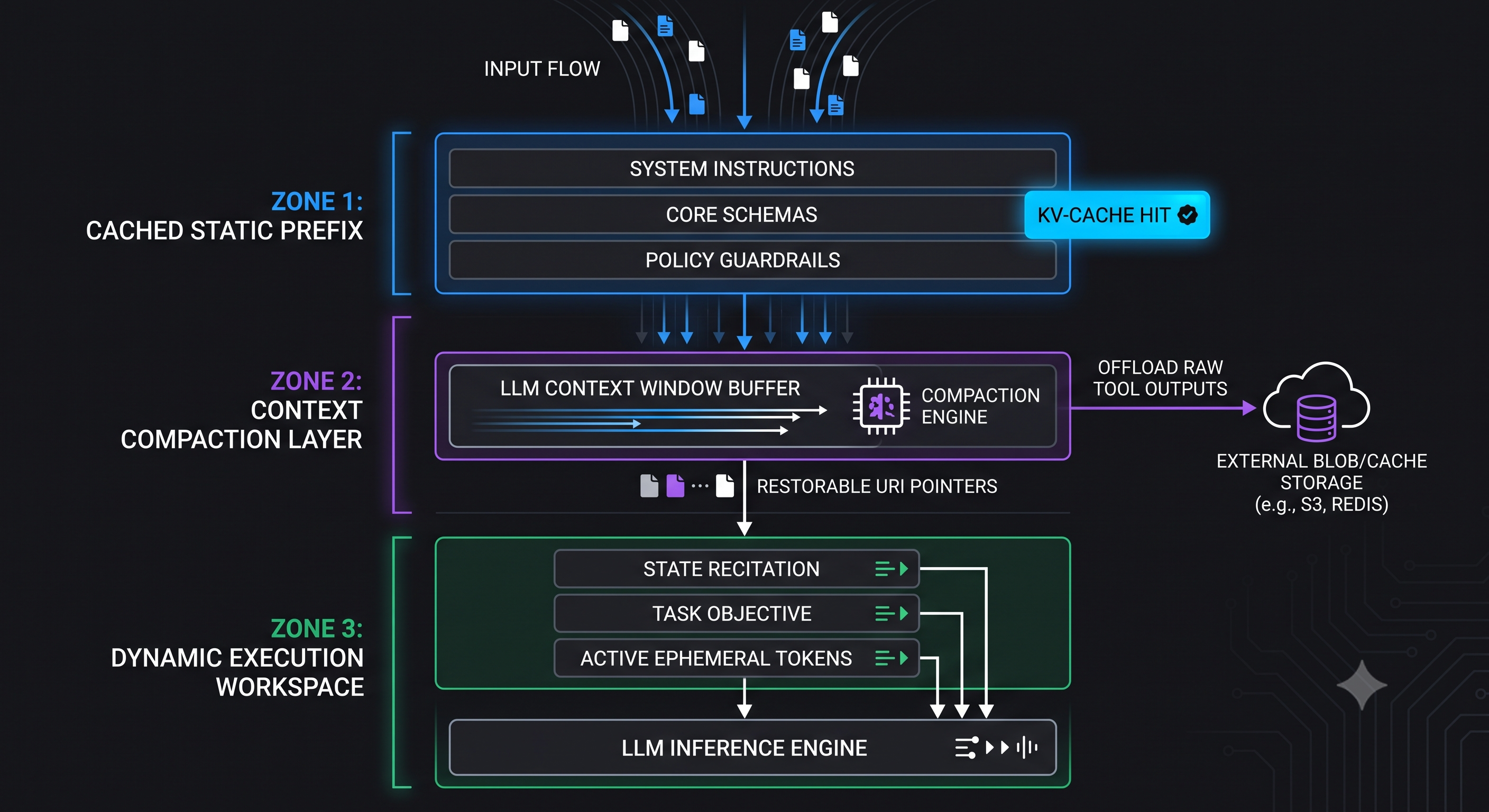
The Engineering Fix: Segment the context window into strict zones:
Static Prefix: Immutable system policies, core tools, and canonical definitions (cached across calls).
Append-Only Buffer: Execution state and tool responses serialized with deterministic JSON keys.
Dynamic Tail: Ephemeral user instructions and runtime variables.
Restorable State Compaction
Instead of letting accumulated tool outputs bloat the context window until reasoning degrades, implement lossless offloading:
Never keep raw PDF or web dumps in active memory across iterative reasoning loops.
Store full responses in an isolated runtime cache/sandbox (e.g., Redis, object storage) and pass only the deterministic handle/URI and a compact schema back to the context.
Allow the agent to re-fetch discrete slices only when explicitly needed.
3. Dynamic Tool Pruning (Loadout Management)
Benchmark research consistently shows that exposing too many function declarations simultaneously degrades accuracy and triggers invalid invocations.
Implement semantic tool retrieval: treat tool schemas like knowledge chunks. Index your tool catalog and inject only the 3–5 candidate tools relevant to the immediate step, keeping tool loadout lean and precision high.
Key Takeaway:
Stop treating LLMs like conversationalists. Treat them as probabilistic processing units governed by deterministic memory pipelines.
Discussion Question
When scaling your AI agents, what has been your biggest bottleneck: context window saturation, tool-calling latency, or maintaining KV-cache efficiency?
CTA (Join Techawks General Community)
Want to build resilient, production-ready AI architectures? Join the Techawks General Community to access production playbooks, collaborate with system architects, and master modern software engineering. [Link in Bio/Comments]
HookIn production environments, teams are discovering a costly bottleneck: context rot and prompt cache thrashing.
When developers move from single-turn prompts to autonomous agents and complex RAG workflows, simply dumping tool outputs, history, and document chunks into a 1M-token context window causes severe degradation. Models lose track of initial objectives ("lost-in-the-middle"), latency spikes, and KV-cache hits plummet toward zero.
Production AI engineering has shifted from prompt tuning to Context Engineering—treating the context window as a dynamic, low-latency computational runtime rather than a scratchpad.
Here is how high-performance AI architectures manage context at scale:
1. Deterministic Prefix Invariance (Preserving the KV-Cache)Modern inference engines rely on prefix/KV-caching to reduce Time-to-First-Token (TTFT) and slash operational costs by up to 80%.
The Antipattern: Placing dynamic variables (e.g., current timestamps, user session tokens) at the top of your system prompt. A single early token mutation invalidates downstream cache lines.
The Engineering Fix: Segment the context window into strict zones:
Static Prefix: Immutable system policies, core tools, and canonical definitions (cached across calls).
Append-Only Buffer: Execution state and tool responses serialized with deterministic JSON keys.
Dynamic Tail: Ephemeral user instructions and runtime variables.
Restorable State Compaction
Instead of letting accumulated tool outputs bloat the context window until reasoning degrades, implement lossless offloading:
Never keep raw PDF or web dumps in active memory across iterative reasoning loops.
Store full responses in an isolated runtime cache/sandbox (e.g., Redis, object storage) and pass only the deterministic handle/URI and a compact schema back to the context.
Allow the agent to re-fetch discrete slices only when explicitly needed.
3. Dynamic Tool Pruning (Loadout Management)
Benchmark research consistently shows that exposing too many function declarations simultaneously degrades accuracy and triggers invalid invocations.
Implement semantic tool retrieval: treat tool schemas like knowledge chunks. Index your tool catalog and inject only the 3–5 candidate tools relevant to the immediate step, keeping tool loadout lean and precision high.
Key Takeaway:
Stop treating LLMs like conversationalists. Treat them as probabilistic processing units governed by deterministic memory pipelines.
Discussion Question
When scaling your AI agents, what has been your biggest bottleneck: context window saturation, tool-calling latency, or maintaining KV-cache efficiency?
CTA (Join Techawks General Community)
Want to build resilient, production-ready AI architectures? Join the Techawks General Community to access production playbooks, collaborate with system architects, and master modern software engineering. [Link in Bio/Comments]
Beyond Prompt Engineering: The Architectural Blueprint of Production Context Engineering
HookIn production environments, teams are discovering a costly bottleneck: context rot and prompt cache thrashing.
When developers move from single-turn prompts to autonomous agents and complex RAG workflows, simply dumping tool outputs, history, and document chunks into a 1M-token context window causes severe degradation. Models lose track of initial objectives ("lost-in-the-middle"), latency spikes, and KV-cache hits plummet toward zero.
Production AI engineering has shifted from prompt tuning to Context Engineering—treating the context window as a dynamic, low-latency computational runtime rather than a scratchpad.
Here is how high-performance AI architectures manage context at scale:
1. Deterministic Prefix Invariance (Preserving the KV-Cache)Modern inference engines rely on prefix/KV-caching to reduce Time-to-First-Token (TTFT) and slash operational costs by up to 80%.
The Antipattern: Placing dynamic variables (e.g., current timestamps, user session tokens) at the top of your system prompt. A single early token mutation invalidates downstream cache lines.
The Engineering Fix: Segment the context window into strict zones:
Static Prefix: Immutable system policies, core tools, and canonical definitions (cached across calls).
Append-Only Buffer: Execution state and tool responses serialized with deterministic JSON keys.
Dynamic Tail: Ephemeral user instructions and runtime variables.
Restorable State Compaction
Instead of letting accumulated tool outputs bloat the context window until reasoning degrades, implement lossless offloading:
Never keep raw PDF or web dumps in active memory across iterative reasoning loops.
Store full responses in an isolated runtime cache/sandbox (e.g., Redis, object storage) and pass only the deterministic handle/URI and a compact schema back to the context.
Allow the agent to re-fetch discrete slices only when explicitly needed.
3. Dynamic Tool Pruning (Loadout Management)
Benchmark research consistently shows that exposing too many function declarations simultaneously degrades accuracy and triggers invalid invocations.
Implement semantic tool retrieval: treat tool schemas like knowledge chunks. Index your tool catalog and inject only the 3–5 candidate tools relevant to the immediate step, keeping tool loadout lean and precision high.
Key Takeaway:
Stop treating LLMs like conversationalists. Treat them as probabilistic processing units governed by deterministic memory pipelines.
Discussion Question
When scaling your AI agents, what has been your biggest bottleneck: context window saturation, tool-calling latency, or maintaining KV-cache efficiency?
CTA (Join Techawks General Community)
Want to build resilient, production-ready AI architectures? Join the Techawks General Community to access production playbooks, collaborate with system architects, and master modern software engineering. [Link in Bio/Comments]

 English
 Arabic
 French
 Spanish
 Portuguese
 Turkish
 Dutch
Dutch
 Italiano
 Russian
 Romaian
 Portuguese (Brazil)
 Greek
Greek