


The AI Startup Gross Margin Checklist: Auditing Unit Economics Beyond the 80% SaaS Illusion
Founders building AI products often celebrate rapid user acquisition while walking straight into an operational trap: compute-driven margin compression.
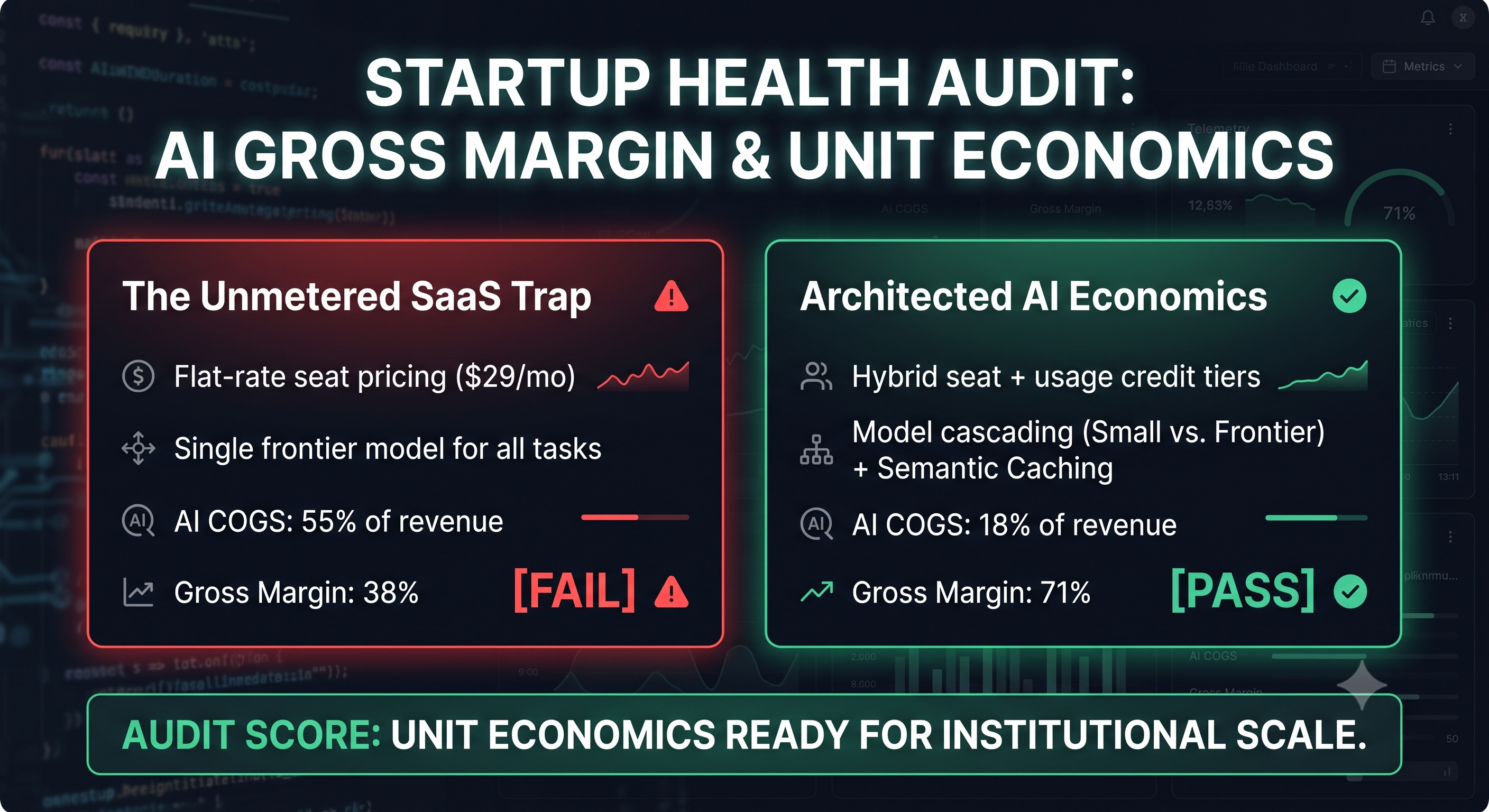
In traditional SaaS, serving the next 10,000 requests adds negligible hosting cost. In AI-native software, every API call, autonomous reasoning turn, and vector search hits your Cost of Goods Sold (COGS). When high-usage accounts join on an unmetered flat plan, your gross margins collapse from a healthy 70% down to a catastrophic 30%—or worse, negative contribution margin.
Investors and technical buyers aren't funding growth at all costs. They evaluate sustainable unit economics.
Run this AI Startup Margin Audit Checklist across your pricing, product, and architecture before raising your next round:
Markdown
[ ] 1. INFERENCE COGS ISOLATION & ATTRIBUTION
- [ ] Real-Time Customer COGS Tracking: Attribute token and GPU inference spend down to the exact workspace/user account, not an aggregated monthly cloud bill.
- [ ] Negative Margin Alarm: Set automated alerts when any customer's daily compute consumption exceeds 40% of their proportional subscription revenue.
- [ ] Non-Inference Scrubbing: Segregate pure model training/fine-tuning (R&D) from active customer inference workloads (COGS) to report accurate gross margins.
[ ] 2. ARCHITECTURAL COST SQUASHING (PRE-ROUTING)
- [ ] Model Tiering / Cascade Router: Route basic requests (classification, simple extraction) to small, specialized local models (~$0.0001/call) rather than default flagship frontier LLMs.
- [ ] Semantic Caching: Cache deterministic query-response pairs across similar user sessions to bypass model inference entirely on repeated lookups.
- [ ] Prompt & Context Trimming: Strip conversational bloat, raw JSON schemas, and redundant context chunks before executing multi-turn tool loops.
[ ] 3. PRICING ARCHITECTURE & SEAT PROTECTION
- [ ] Hybrid Consumption Model: Eliminate pure "unlimited" seats. Wrap base pricing around seat licenses with hard credit caps or hybrid usage-based overages.
- [ ] Margin-Safe SLA Guardrails: Enforce concurrency limits and rate bounds on power-user accounts to protect against batch scraping and bot scripts.
- [ ] Vendor Price Shock Buffer: Price your platform against standard retail token rates with a built-in 3x markup buffer to insulate against third-party API rate revisions.
[ ] 4. OBSERVABILITY & RETRIEVAL HYGIENE
- [ ] RAG Pipeline Cost Audit: Audit embedding calls and chunk sizes—ensure your retrieval top-k parameter fetches only the exact context required for the prompt.
- [ ] Multi-Agent Circuit Breakers: Place strict deterministic timeouts and max-hop caps on autonomous reasoning agents to prevent recursive loop billing spikes.
[ ] 5. INVESTOR-READY METRIC REPORTING
- [ ] Target Compute-Adjusted Gross Margin: Maintain gross margins after direct compute of 55%+ at Seed, targeting a path toward 65–70% by Series A.
- [ ] Compute-Adjusted LTV:CAC: Calculate customer lifetime value using gross margin *after* compute costs, rather than top-line contract value.
Rule of Thumb: If your top 5% power users cost more to service than they pay each month, you don't have a software business—you have a subsidized GPU brokerage.
Discussion Question
For founders building AI products: Are you currently charging flat seat rates, pure usage-based pricing, or a hybrid credit model? What has your experience been with margin compression?
CTA (Join Startup Founders & Entrepreneurs)
Want to build a venture that scales sustainably with institutional-grade unit economics? Join Startup Founders & Entrepreneurs by Techawks for access to teardowns, financial modeling frameworks, and discussions with peer founders.
Founders building AI products often celebrate rapid user acquisition while walking straight into an operational trap: compute-driven margin compression.
In traditional SaaS, serving the next 10,000 requests adds negligible hosting cost. In AI-native software, every API call, autonomous reasoning turn, and vector search hits your Cost of Goods Sold (COGS). When high-usage accounts join on an unmetered flat plan, your gross margins collapse from a healthy 70% down to a catastrophic 30%—or worse, negative contribution margin.
Investors and technical buyers aren't funding growth at all costs. They evaluate sustainable unit economics.
Run this AI Startup Margin Audit Checklist across your pricing, product, and architecture before raising your next round:
Markdown
[ ] 1. INFERENCE COGS ISOLATION & ATTRIBUTION
- [ ] Real-Time Customer COGS Tracking: Attribute token and GPU inference spend down to the exact workspace/user account, not an aggregated monthly cloud bill.
- [ ] Negative Margin Alarm: Set automated alerts when any customer's daily compute consumption exceeds 40% of their proportional subscription revenue.
- [ ] Non-Inference Scrubbing: Segregate pure model training/fine-tuning (R&D) from active customer inference workloads (COGS) to report accurate gross margins.
[ ] 2. ARCHITECTURAL COST SQUASHING (PRE-ROUTING)
- [ ] Model Tiering / Cascade Router: Route basic requests (classification, simple extraction) to small, specialized local models (~$0.0001/call) rather than default flagship frontier LLMs.
- [ ] Semantic Caching: Cache deterministic query-response pairs across similar user sessions to bypass model inference entirely on repeated lookups.
- [ ] Prompt & Context Trimming: Strip conversational bloat, raw JSON schemas, and redundant context chunks before executing multi-turn tool loops.
[ ] 3. PRICING ARCHITECTURE & SEAT PROTECTION
- [ ] Hybrid Consumption Model: Eliminate pure "unlimited" seats. Wrap base pricing around seat licenses with hard credit caps or hybrid usage-based overages.
- [ ] Margin-Safe SLA Guardrails: Enforce concurrency limits and rate bounds on power-user accounts to protect against batch scraping and bot scripts.
- [ ] Vendor Price Shock Buffer: Price your platform against standard retail token rates with a built-in 3x markup buffer to insulate against third-party API rate revisions.
[ ] 4. OBSERVABILITY & RETRIEVAL HYGIENE
- [ ] RAG Pipeline Cost Audit: Audit embedding calls and chunk sizes—ensure your retrieval top-k parameter fetches only the exact context required for the prompt.
- [ ] Multi-Agent Circuit Breakers: Place strict deterministic timeouts and max-hop caps on autonomous reasoning agents to prevent recursive loop billing spikes.
[ ] 5. INVESTOR-READY METRIC REPORTING
- [ ] Target Compute-Adjusted Gross Margin: Maintain gross margins after direct compute of 55%+ at Seed, targeting a path toward 65–70% by Series A.
- [ ] Compute-Adjusted LTV:CAC: Calculate customer lifetime value using gross margin *after* compute costs, rather than top-line contract value.
Rule of Thumb: If your top 5% power users cost more to service than they pay each month, you don't have a software business—you have a subsidized GPU brokerage.
Discussion Question
For founders building AI products: Are you currently charging flat seat rates, pure usage-based pricing, or a hybrid credit model? What has your experience been with margin compression?
CTA (Join Startup Founders & Entrepreneurs)
Want to build a venture that scales sustainably with institutional-grade unit economics? Join Startup Founders & Entrepreneurs by Techawks for access to teardowns, financial modeling frameworks, and discussions with peer founders.
The AI Startup Gross Margin Checklist: Auditing Unit Economics Beyond the 80% SaaS Illusion
Founders building AI products often celebrate rapid user acquisition while walking straight into an operational trap: compute-driven margin compression.
In traditional SaaS, serving the next 10,000 requests adds negligible hosting cost. In AI-native software, every API call, autonomous reasoning turn, and vector search hits your Cost of Goods Sold (COGS). When high-usage accounts join on an unmetered flat plan, your gross margins collapse from a healthy 70% down to a catastrophic 30%—or worse, negative contribution margin.
Investors and technical buyers aren't funding growth at all costs. They evaluate sustainable unit economics.
Run this AI Startup Margin Audit Checklist across your pricing, product, and architecture before raising your next round:
Markdown
[ ] 1. INFERENCE COGS ISOLATION & ATTRIBUTION
- [ ] Real-Time Customer COGS Tracking: Attribute token and GPU inference spend down to the exact workspace/user account, not an aggregated monthly cloud bill.
- [ ] Negative Margin Alarm: Set automated alerts when any customer's daily compute consumption exceeds 40% of their proportional subscription revenue.
- [ ] Non-Inference Scrubbing: Segregate pure model training/fine-tuning (R&D) from active customer inference workloads (COGS) to report accurate gross margins.
[ ] 2. ARCHITECTURAL COST SQUASHING (PRE-ROUTING)
- [ ] Model Tiering / Cascade Router: Route basic requests (classification, simple extraction) to small, specialized local models (~$0.0001/call) rather than default flagship frontier LLMs.
- [ ] Semantic Caching: Cache deterministic query-response pairs across similar user sessions to bypass model inference entirely on repeated lookups.
- [ ] Prompt & Context Trimming: Strip conversational bloat, raw JSON schemas, and redundant context chunks before executing multi-turn tool loops.
[ ] 3. PRICING ARCHITECTURE & SEAT PROTECTION
- [ ] Hybrid Consumption Model: Eliminate pure "unlimited" seats. Wrap base pricing around seat licenses with hard credit caps or hybrid usage-based overages.
- [ ] Margin-Safe SLA Guardrails: Enforce concurrency limits and rate bounds on power-user accounts to protect against batch scraping and bot scripts.
- [ ] Vendor Price Shock Buffer: Price your platform against standard retail token rates with a built-in 3x markup buffer to insulate against third-party API rate revisions.
[ ] 4. OBSERVABILITY & RETRIEVAL HYGIENE
- [ ] RAG Pipeline Cost Audit: Audit embedding calls and chunk sizes—ensure your retrieval top-k parameter fetches only the exact context required for the prompt.
- [ ] Multi-Agent Circuit Breakers: Place strict deterministic timeouts and max-hop caps on autonomous reasoning agents to prevent recursive loop billing spikes.
[ ] 5. INVESTOR-READY METRIC REPORTING
- [ ] Target Compute-Adjusted Gross Margin: Maintain gross margins after direct compute of 55%+ at Seed, targeting a path toward 65–70% by Series A.
- [ ] Compute-Adjusted LTV:CAC: Calculate customer lifetime value using gross margin *after* compute costs, rather than top-line contract value.
Rule of Thumb: If your top 5% power users cost more to service than they pay each month, you don't have a software business—you have a subsidized GPU brokerage.
Discussion Question
For founders building AI products: Are you currently charging flat seat rates, pure usage-based pricing, or a hybrid credit model? What has your experience been with margin compression?
CTA (Join Startup Founders & Entrepreneurs)
Want to build a venture that scales sustainably with institutional-grade unit economics? Join Startup Founders & Entrepreneurs by Techawks for access to teardowns, financial modeling frameworks, and discussions with peer founders.

 English
 Arabic
 French
 Spanish
 Portuguese
 Deutsch
 Turkish
 Dutch
Dutch
 Russian
 Romaian
 Portuguese (Brazil)
 Greek
Greek