


The Student GitHub Audit: How to Turn Academic Projects into Production-Grade Proof
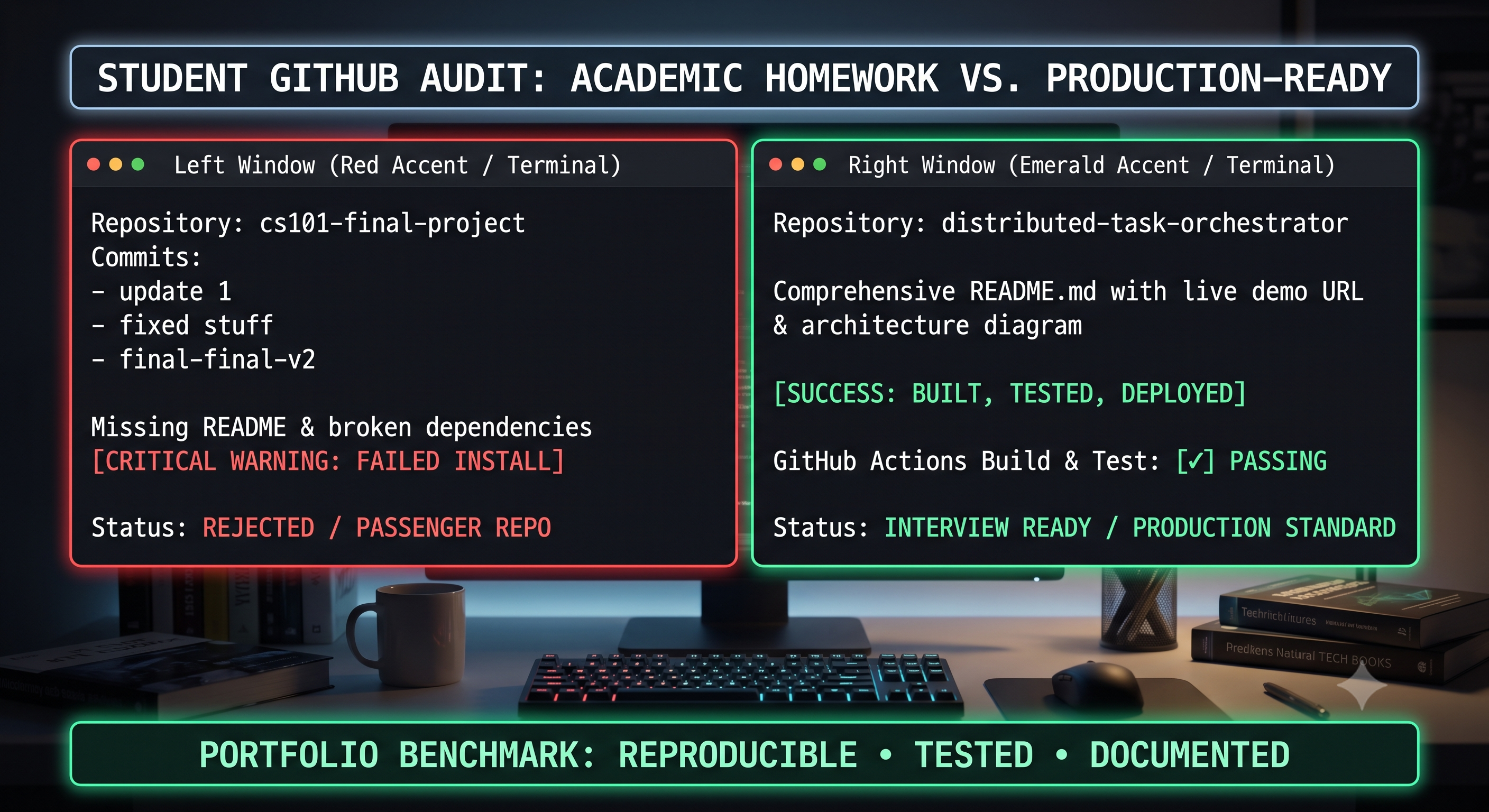
Most students believe having 20+ public repositories full of green contribution squares guarantees internship callbacks. In reality, engineering managers look for evidence of production hygiene, maintainability, and engineering maturity.
A single, battle-tested full-stack project or an accepted open-source pull request carries far more weight than a dozen cloned to-do apps.
Transform your GitHub from an academic homework archive into an undeniable engineering portfolio with this Student GitHub Production Checklist:
Markdown
[ ] 1. THE 30-SECOND README TEST
- [ ] One-Sentence Value Prop: State the exact problem your project solves and its core architecture at the top of the README.
- [ ] Live Demo & Visual Walkthrough: Provide an accessible live deployment link (Vercel, Render, Railway) alongside a 5-second GIF or WebM demonstrating core functionality.
- [ ] One-Command Local Boot: Include an exact, working reproduction block (`git clone`, copy `.env.example`, `docker compose up` or `npm run dev`).
[ ] 2. REPOSITORY HYGIENE & SECRETS MANAGEMENT
- [ ] Strict .gitignore Enforcement: Audit commit history to ensure `.env`, API keys, `node_modules`, `__pycache__`, or local database files are never checked in.
- [ ] Sanitized Environment Templates: Provide a clear `.env.example` file documenting all required configuration variables and third-party keys.
- [ ] Atomic Semantic Commits: Replace vague commit messages ("fixed bugs", "update") with Conventional Commits (`feat: implement rate limiting on auth route`, `fix: resolve stale cache race condition`).
[ ] 3. TESTING & AUTOMATION GATES (CI/CD)
- [ ] Automated Test Pipeline: Implement a simple GitHub Actions workflow running unit and integration tests automatically on every PR.
- [ ] Static Analysis & Linting: Wire pre-commit hooks or CI checks using industry linters (ESLint, Ruff, Biome) to enforce clean styling and prevent syntax anti-patterns.
- [ ] Code Coverage Signal: Maintain a visible coverage badge demonstrating genuine integration tests around critical business logic.
[ ] 4. CODE QUALITY BEYOND TUTORIAL CODE
- [ ] Resilient Error Handling: Replace empty `catch` blocks and generic 500 errors with structured error responses, status codes, and graceful client fallbacks.
- [ ] Data Persistence & Isolation: Use relational schemas or migration scripts (Prisma, Alembic, Flyway) instead of hardcoded mock JSON arrays in memory.
- [ ] Rate Limits & Input Validation: Protect public-facing API endpoints with input validation (Zod, Pydantic) to demonstrate security-first thinking.
[ ] 5. COMMUNITY & OPEN SOURCE REASONING
- [ ] Technical Trade-Off Documentation: Include an "Architectural Decisions" section in your README explaining why you chose PostgreSQL over MongoDB or Redis over in-memory cache.
- [ ] Open Source Traceability: Highlight real pull requests made to external open-source projects or university organizations over isolated solo scripts.
Rule of Thumb: Don’t build projects to show that you know how to write code. Build projects that prove you know how software operates in production.
Discussion Question
What is the biggest challenge you face when building portfolio projects outside of class—setting up proper CI/CD pipelines, handling cloud deployments, or choosing unique problem statements?
CTA (Join Students in Tech)
Ready to build projects that get you hired and connect with ambitious student engineers worldwide? Join Students in Tech by Techawks for open-source sprints, code reviews, and mentorship from industry professionals.
Most students believe having 20+ public repositories full of green contribution squares guarantees internship callbacks. In reality, engineering managers look for evidence of production hygiene, maintainability, and engineering maturity.
A single, battle-tested full-stack project or an accepted open-source pull request carries far more weight than a dozen cloned to-do apps.
Transform your GitHub from an academic homework archive into an undeniable engineering portfolio with this Student GitHub Production Checklist:
Markdown
[ ] 1. THE 30-SECOND README TEST
- [ ] One-Sentence Value Prop: State the exact problem your project solves and its core architecture at the top of the README.
- [ ] Live Demo & Visual Walkthrough: Provide an accessible live deployment link (Vercel, Render, Railway) alongside a 5-second GIF or WebM demonstrating core functionality.
- [ ] One-Command Local Boot: Include an exact, working reproduction block (`git clone`, copy `.env.example`, `docker compose up` or `npm run dev`).
[ ] 2. REPOSITORY HYGIENE & SECRETS MANAGEMENT
- [ ] Strict .gitignore Enforcement: Audit commit history to ensure `.env`, API keys, `node_modules`, `__pycache__`, or local database files are never checked in.
- [ ] Sanitized Environment Templates: Provide a clear `.env.example` file documenting all required configuration variables and third-party keys.
- [ ] Atomic Semantic Commits: Replace vague commit messages ("fixed bugs", "update") with Conventional Commits (`feat: implement rate limiting on auth route`, `fix: resolve stale cache race condition`).
[ ] 3. TESTING & AUTOMATION GATES (CI/CD)
- [ ] Automated Test Pipeline: Implement a simple GitHub Actions workflow running unit and integration tests automatically on every PR.
- [ ] Static Analysis & Linting: Wire pre-commit hooks or CI checks using industry linters (ESLint, Ruff, Biome) to enforce clean styling and prevent syntax anti-patterns.
- [ ] Code Coverage Signal: Maintain a visible coverage badge demonstrating genuine integration tests around critical business logic.
[ ] 4. CODE QUALITY BEYOND TUTORIAL CODE
- [ ] Resilient Error Handling: Replace empty `catch` blocks and generic 500 errors with structured error responses, status codes, and graceful client fallbacks.
- [ ] Data Persistence & Isolation: Use relational schemas or migration scripts (Prisma, Alembic, Flyway) instead of hardcoded mock JSON arrays in memory.
- [ ] Rate Limits & Input Validation: Protect public-facing API endpoints with input validation (Zod, Pydantic) to demonstrate security-first thinking.
[ ] 5. COMMUNITY & OPEN SOURCE REASONING
- [ ] Technical Trade-Off Documentation: Include an "Architectural Decisions" section in your README explaining why you chose PostgreSQL over MongoDB or Redis over in-memory cache.
- [ ] Open Source Traceability: Highlight real pull requests made to external open-source projects or university organizations over isolated solo scripts.
Rule of Thumb: Don’t build projects to show that you know how to write code. Build projects that prove you know how software operates in production.
Discussion Question
What is the biggest challenge you face when building portfolio projects outside of class—setting up proper CI/CD pipelines, handling cloud deployments, or choosing unique problem statements?
CTA (Join Students in Tech)
Ready to build projects that get you hired and connect with ambitious student engineers worldwide? Join Students in Tech by Techawks for open-source sprints, code reviews, and mentorship from industry professionals.
The Student GitHub Audit: How to Turn Academic Projects into Production-Grade Proof
Most students believe having 20+ public repositories full of green contribution squares guarantees internship callbacks. In reality, engineering managers look for evidence of production hygiene, maintainability, and engineering maturity.
A single, battle-tested full-stack project or an accepted open-source pull request carries far more weight than a dozen cloned to-do apps.
Transform your GitHub from an academic homework archive into an undeniable engineering portfolio with this Student GitHub Production Checklist:
Markdown
[ ] 1. THE 30-SECOND README TEST
- [ ] One-Sentence Value Prop: State the exact problem your project solves and its core architecture at the top of the README.
- [ ] Live Demo & Visual Walkthrough: Provide an accessible live deployment link (Vercel, Render, Railway) alongside a 5-second GIF or WebM demonstrating core functionality.
- [ ] One-Command Local Boot: Include an exact, working reproduction block (`git clone`, copy `.env.example`, `docker compose up` or `npm run dev`).
[ ] 2. REPOSITORY HYGIENE & SECRETS MANAGEMENT
- [ ] Strict .gitignore Enforcement: Audit commit history to ensure `.env`, API keys, `node_modules`, `__pycache__`, or local database files are never checked in.
- [ ] Sanitized Environment Templates: Provide a clear `.env.example` file documenting all required configuration variables and third-party keys.
- [ ] Atomic Semantic Commits: Replace vague commit messages ("fixed bugs", "update") with Conventional Commits (`feat: implement rate limiting on auth route`, `fix: resolve stale cache race condition`).
[ ] 3. TESTING & AUTOMATION GATES (CI/CD)
- [ ] Automated Test Pipeline: Implement a simple GitHub Actions workflow running unit and integration tests automatically on every PR.
- [ ] Static Analysis & Linting: Wire pre-commit hooks or CI checks using industry linters (ESLint, Ruff, Biome) to enforce clean styling and prevent syntax anti-patterns.
- [ ] Code Coverage Signal: Maintain a visible coverage badge demonstrating genuine integration tests around critical business logic.
[ ] 4. CODE QUALITY BEYOND TUTORIAL CODE
- [ ] Resilient Error Handling: Replace empty `catch` blocks and generic 500 errors with structured error responses, status codes, and graceful client fallbacks.
- [ ] Data Persistence & Isolation: Use relational schemas or migration scripts (Prisma, Alembic, Flyway) instead of hardcoded mock JSON arrays in memory.
- [ ] Rate Limits & Input Validation: Protect public-facing API endpoints with input validation (Zod, Pydantic) to demonstrate security-first thinking.
[ ] 5. COMMUNITY & OPEN SOURCE REASONING
- [ ] Technical Trade-Off Documentation: Include an "Architectural Decisions" section in your README explaining why you chose PostgreSQL over MongoDB or Redis over in-memory cache.
- [ ] Open Source Traceability: Highlight real pull requests made to external open-source projects or university organizations over isolated solo scripts.
Rule of Thumb: Don’t build projects to show that you know how to write code. Build projects that prove you know how software operates in production.
Discussion Question
What is the biggest challenge you face when building portfolio projects outside of class—setting up proper CI/CD pipelines, handling cloud deployments, or choosing unique problem statements?
CTA (Join Students in Tech)
Ready to build projects that get you hired and connect with ambitious student engineers worldwide? Join Students in Tech by Techawks for open-source sprints, code reviews, and mentorship from industry professionals.

 English
 Arabic
 French
 Spanish
 Portuguese
 Turkish
 Dutch
Dutch
 Italiano
 Russian
 Romaian
 Portuguese (Brazil)
 Greek
Greek