


Stop Building for 6 Months: The 7-Day Customer Pre-Sale Challenge
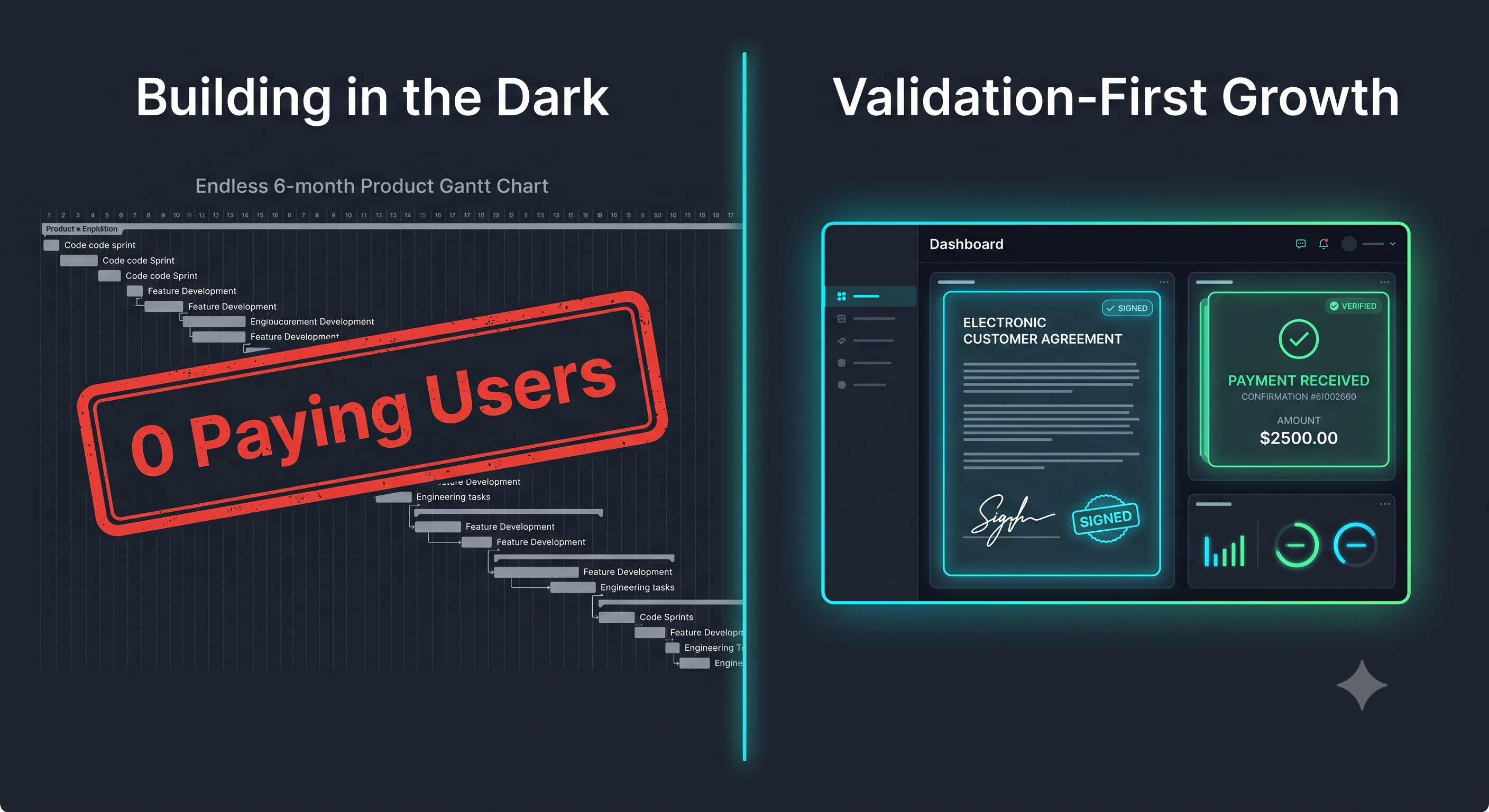
The most common startup failure mode is not a technical crash; it is building something nobody cares enough to pay for. Founders spend six months polishing UI, configuring multi-region cloud infrastructure, and rewriting features based on casual feedback from friends who say, "That sounds cool."
Compliments are free. Commitment costs capital.
If your product solves an urgent, hair-on-fire problem, a prospect will pay for the solution before the software even exists. Stop writing code this week and take the 7-Day Pre-Sale Challenge:
Define the Pain Point in One Sentence
Strip away the feature set. Articulate the exact cost of the problem your prospect faces right now: "Companies lose $12,000 every quarter to untracked SaaS license renewals." If your value proposition cannot be quantified in saved hours or recovered revenue, refine it until it can.
Build a Concierge Workaround
Instead of engineering an automated workflow, offer to execute the outcome manually. If you are building automated invoice reconciliation, do the reconciliation by hand in a spreadsheet for the first three clients. Delivering the outcome manually teaches you the true operational edge cases and proves demand long before you commit engineering hours.
Ask for an Upfront Commitment
Get on five discovery calls with target users. Walk them through the manual solution or a static workflow deck. Close the call with a concrete ask:
Option A: A discounted annual pre-order invoice.
Option B: A signed letter of intent (LOI) with explicit deployment criteria and pricing.
If five qualified prospects refuse to commit cash or sign an LOI for a manual solution, an automated version will not change their minds.
Great founders don't build software to discover customer demand. They confirm acute customer pain first, then build software to scale the delivery.
Key Takeaways
Polite feedback and user sign-ups are false signals; payment and signed commitments are real validation.
Run concierge MVPs manually to discover critical process edge cases before writing automation code.
Quantify your solution in concrete terms of money saved, revenue generated, or operational risk removed.
If a customer won't pay for the manual outcome, they won't pay for the automated product.
CTA
Ready to stop building in the dark and validate scalable business models? Join the Startup Founders & Entrepreneurs community to trade validation playbooks, teardown go-to-market strategies, and scale with fellow operators. Link below.
The most common startup failure mode is not a technical crash; it is building something nobody cares enough to pay for. Founders spend six months polishing UI, configuring multi-region cloud infrastructure, and rewriting features based on casual feedback from friends who say, "That sounds cool."
Compliments are free. Commitment costs capital.
If your product solves an urgent, hair-on-fire problem, a prospect will pay for the solution before the software even exists. Stop writing code this week and take the 7-Day Pre-Sale Challenge:
Define the Pain Point in One Sentence
Strip away the feature set. Articulate the exact cost of the problem your prospect faces right now: "Companies lose $12,000 every quarter to untracked SaaS license renewals." If your value proposition cannot be quantified in saved hours or recovered revenue, refine it until it can.
Build a Concierge Workaround
Instead of engineering an automated workflow, offer to execute the outcome manually. If you are building automated invoice reconciliation, do the reconciliation by hand in a spreadsheet for the first three clients. Delivering the outcome manually teaches you the true operational edge cases and proves demand long before you commit engineering hours.
Ask for an Upfront Commitment
Get on five discovery calls with target users. Walk them through the manual solution or a static workflow deck. Close the call with a concrete ask:
Option A: A discounted annual pre-order invoice.
Option B: A signed letter of intent (LOI) with explicit deployment criteria and pricing.
If five qualified prospects refuse to commit cash or sign an LOI for a manual solution, an automated version will not change their minds.
Great founders don't build software to discover customer demand. They confirm acute customer pain first, then build software to scale the delivery.
Key Takeaways
Polite feedback and user sign-ups are false signals; payment and signed commitments are real validation.
Run concierge MVPs manually to discover critical process edge cases before writing automation code.
Quantify your solution in concrete terms of money saved, revenue generated, or operational risk removed.
If a customer won't pay for the manual outcome, they won't pay for the automated product.
CTA
Ready to stop building in the dark and validate scalable business models? Join the Startup Founders & Entrepreneurs community to trade validation playbooks, teardown go-to-market strategies, and scale with fellow operators. Link below.
Stop Building for 6 Months: The 7-Day Customer Pre-Sale Challenge
The most common startup failure mode is not a technical crash; it is building something nobody cares enough to pay for. Founders spend six months polishing UI, configuring multi-region cloud infrastructure, and rewriting features based on casual feedback from friends who say, "That sounds cool."
Compliments are free. Commitment costs capital.
If your product solves an urgent, hair-on-fire problem, a prospect will pay for the solution before the software even exists. Stop writing code this week and take the 7-Day Pre-Sale Challenge:
Define the Pain Point in One Sentence
Strip away the feature set. Articulate the exact cost of the problem your prospect faces right now: "Companies lose $12,000 every quarter to untracked SaaS license renewals." If your value proposition cannot be quantified in saved hours or recovered revenue, refine it until it can.
Build a Concierge Workaround
Instead of engineering an automated workflow, offer to execute the outcome manually. If you are building automated invoice reconciliation, do the reconciliation by hand in a spreadsheet for the first three clients. Delivering the outcome manually teaches you the true operational edge cases and proves demand long before you commit engineering hours.
Ask for an Upfront Commitment
Get on five discovery calls with target users. Walk them through the manual solution or a static workflow deck. Close the call with a concrete ask:
Option A: A discounted annual pre-order invoice.
Option B: A signed letter of intent (LOI) with explicit deployment criteria and pricing.
If five qualified prospects refuse to commit cash or sign an LOI for a manual solution, an automated version will not change their minds.
Great founders don't build software to discover customer demand. They confirm acute customer pain first, then build software to scale the delivery.
Key Takeaways
Polite feedback and user sign-ups are false signals; payment and signed commitments are real validation.
Run concierge MVPs manually to discover critical process edge cases before writing automation code.
Quantify your solution in concrete terms of money saved, revenue generated, or operational risk removed.
If a customer won't pay for the manual outcome, they won't pay for the automated product.
CTA
Ready to stop building in the dark and validate scalable business models? Join the Startup Founders & Entrepreneurs community to trade validation playbooks, teardown go-to-market strategies, and scale with fellow operators. Link below.

 English
 Arabic
 French
 Spanish
 Portuguese
 Deutsch
 Turkish
 Dutch
Dutch
 Russian
 Romaian
 Portuguese (Brazil)
 Greek
Greek