


The Multi-Agent AI Fallacy: When More Autonomous Agents Hurt System Performance
As agentic frameworks and multi-agent workflows dominate current production roadmaps, many engineering teams operate under an unspoken assumption: decomposing a problem across multiple autonomous agents naturally improves system accuracy and resilience.
It doesn't always work that way.
Recent systems research and production benchmarks highlight a recurring failure mode known as agent cascading error: when autonomous agents communicate in unstructured natural language loops, error probabilities compound exponentially across handoffs.
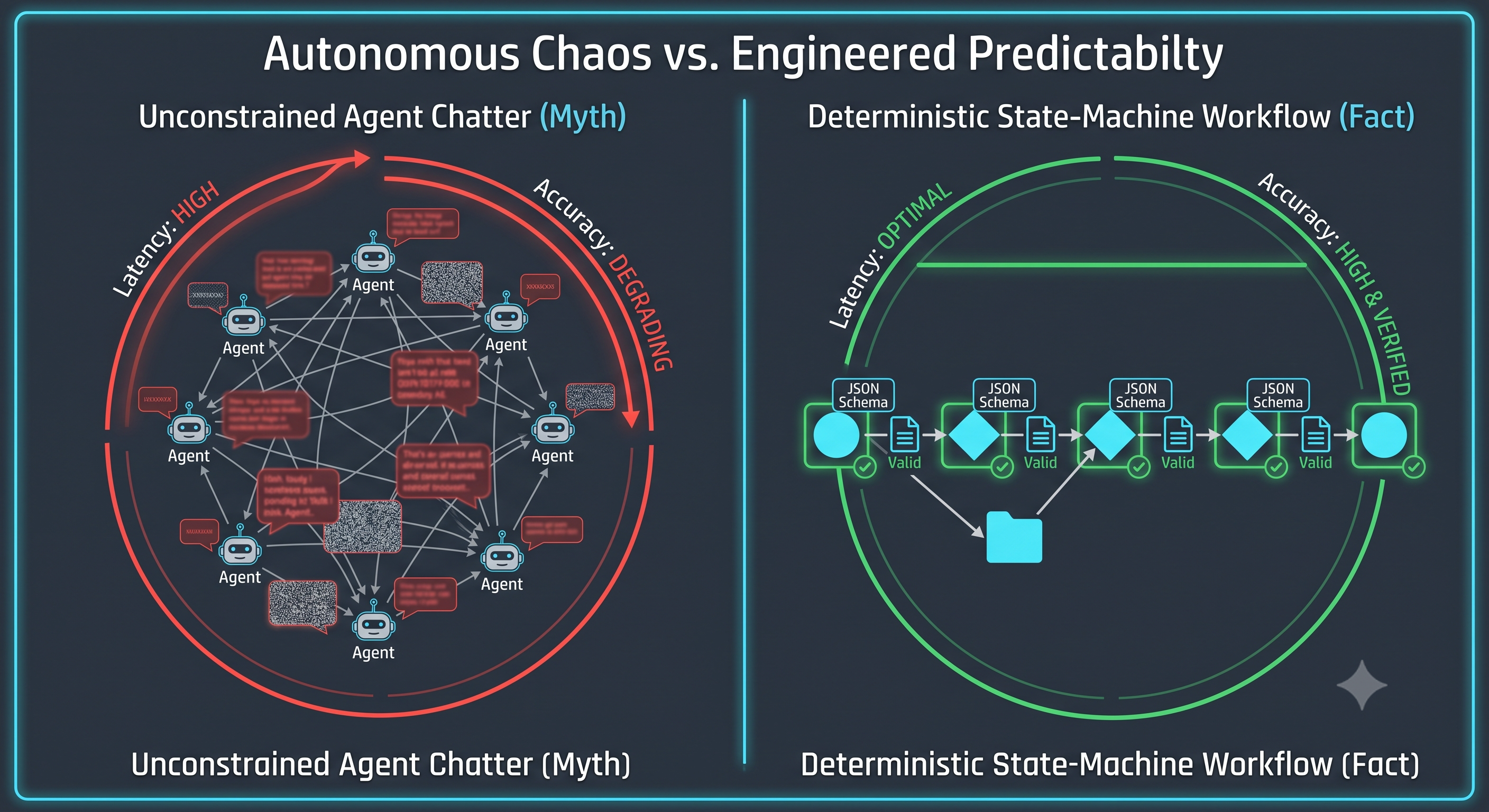
Myth: Dividing a complex workflow across specialized autonomous agents always yields higher accuracy and better reasoning.
Fact: Multi-agent architectures introduce non-deterministic communication boundaries. Without strict schema validation and bounded state handoffs, adding agents increases latency, burns token budgets, and often degrades end-to-end task completion rates compared to deterministic pipelines.
Why this matters for your engineering stack:
When Agent A summarizes data with a 90% confidence score and hands that unstructured prose to Agent B, Agent B reasons on an imperfect premise. By the time Agent D receives the payload, the context drift has amplified hallucination rates.
How to architect reliable multi-agent systems:
Never pass unstructured prose across agent boundaries. Enforce typed schemas (JSON, Pydantic, Protobuf) for every agent-to-agent interface.
Use deterministic code for routing. Replace conversational supervisor agents with deterministic state machines (DAGs). Agents should execute atomic functions; standard code should decide what runs next.
Establish rollback checkpoints. If an agent's output fails schema assertions, route to an error handler or human fallback instead of letting downstream agents speculate on corrupted state.
Intelligence in production isn't about how many agents talk to each other. It’s about how strictly software controls the state between them.
Discussion Question
Where does your team draw the line between using an autonomous agent vs. a deterministic programmatic pipeline in production workflows?
CTA
Looking to architect robust, production-ready systems without the hype? Join the Techawks General Community to discuss distributed architectures, benchmark real-world AI pipelines, and exchange insights with engineers worldwide.
As agentic frameworks and multi-agent workflows dominate current production roadmaps, many engineering teams operate under an unspoken assumption: decomposing a problem across multiple autonomous agents naturally improves system accuracy and resilience.
It doesn't always work that way.
Recent systems research and production benchmarks highlight a recurring failure mode known as agent cascading error: when autonomous agents communicate in unstructured natural language loops, error probabilities compound exponentially across handoffs.
Myth: Dividing a complex workflow across specialized autonomous agents always yields higher accuracy and better reasoning.
Fact: Multi-agent architectures introduce non-deterministic communication boundaries. Without strict schema validation and bounded state handoffs, adding agents increases latency, burns token budgets, and often degrades end-to-end task completion rates compared to deterministic pipelines.
Why this matters for your engineering stack:
When Agent A summarizes data with a 90% confidence score and hands that unstructured prose to Agent B, Agent B reasons on an imperfect premise. By the time Agent D receives the payload, the context drift has amplified hallucination rates.
How to architect reliable multi-agent systems:
Never pass unstructured prose across agent boundaries. Enforce typed schemas (JSON, Pydantic, Protobuf) for every agent-to-agent interface.
Use deterministic code for routing. Replace conversational supervisor agents with deterministic state machines (DAGs). Agents should execute atomic functions; standard code should decide what runs next.
Establish rollback checkpoints. If an agent's output fails schema assertions, route to an error handler or human fallback instead of letting downstream agents speculate on corrupted state.
Intelligence in production isn't about how many agents talk to each other. It’s about how strictly software controls the state between them.
Discussion Question
Where does your team draw the line between using an autonomous agent vs. a deterministic programmatic pipeline in production workflows?
CTA
Looking to architect robust, production-ready systems without the hype? Join the Techawks General Community to discuss distributed architectures, benchmark real-world AI pipelines, and exchange insights with engineers worldwide.
The Multi-Agent AI Fallacy: When More Autonomous Agents Hurt System Performance
As agentic frameworks and multi-agent workflows dominate current production roadmaps, many engineering teams operate under an unspoken assumption: decomposing a problem across multiple autonomous agents naturally improves system accuracy and resilience.
It doesn't always work that way.
Recent systems research and production benchmarks highlight a recurring failure mode known as agent cascading error: when autonomous agents communicate in unstructured natural language loops, error probabilities compound exponentially across handoffs.
Myth: Dividing a complex workflow across specialized autonomous agents always yields higher accuracy and better reasoning.
Fact: Multi-agent architectures introduce non-deterministic communication boundaries. Without strict schema validation and bounded state handoffs, adding agents increases latency, burns token budgets, and often degrades end-to-end task completion rates compared to deterministic pipelines.
Why this matters for your engineering stack:
When Agent A summarizes data with a 90% confidence score and hands that unstructured prose to Agent B, Agent B reasons on an imperfect premise. By the time Agent D receives the payload, the context drift has amplified hallucination rates.
How to architect reliable multi-agent systems:
Never pass unstructured prose across agent boundaries. Enforce typed schemas (JSON, Pydantic, Protobuf) for every agent-to-agent interface.
Use deterministic code for routing. Replace conversational supervisor agents with deterministic state machines (DAGs). Agents should execute atomic functions; standard code should decide what runs next.
Establish rollback checkpoints. If an agent's output fails schema assertions, route to an error handler or human fallback instead of letting downstream agents speculate on corrupted state.
Intelligence in production isn't about how many agents talk to each other. It’s about how strictly software controls the state between them.
Discussion Question
Where does your team draw the line between using an autonomous agent vs. a deterministic programmatic pipeline in production workflows?
CTA
Looking to architect robust, production-ready systems without the hype? Join the Techawks General Community to discuss distributed architectures, benchmark real-world AI pipelines, and exchange insights with engineers worldwide.

 English
 Arabic
 French
 Spanish
 Portuguese
 Deutsch
 Turkish
 Dutch
Dutch
 Russian
 Romaian
 Portuguese (Brazil)
 Greek
Greek