


The Seat-Based SaaS Trap: Why Per-User Pricing Destroys AI Startup Margins
For over a decade, early-stage founders inherited a default playbook: build a B2B SaaS product, charge $30/seat/month, and expand revenue by convincing enterprises to add more employees to the dashboard.
With AI-native automation and autonomous agent workflows, that pricing model is structurally broken.
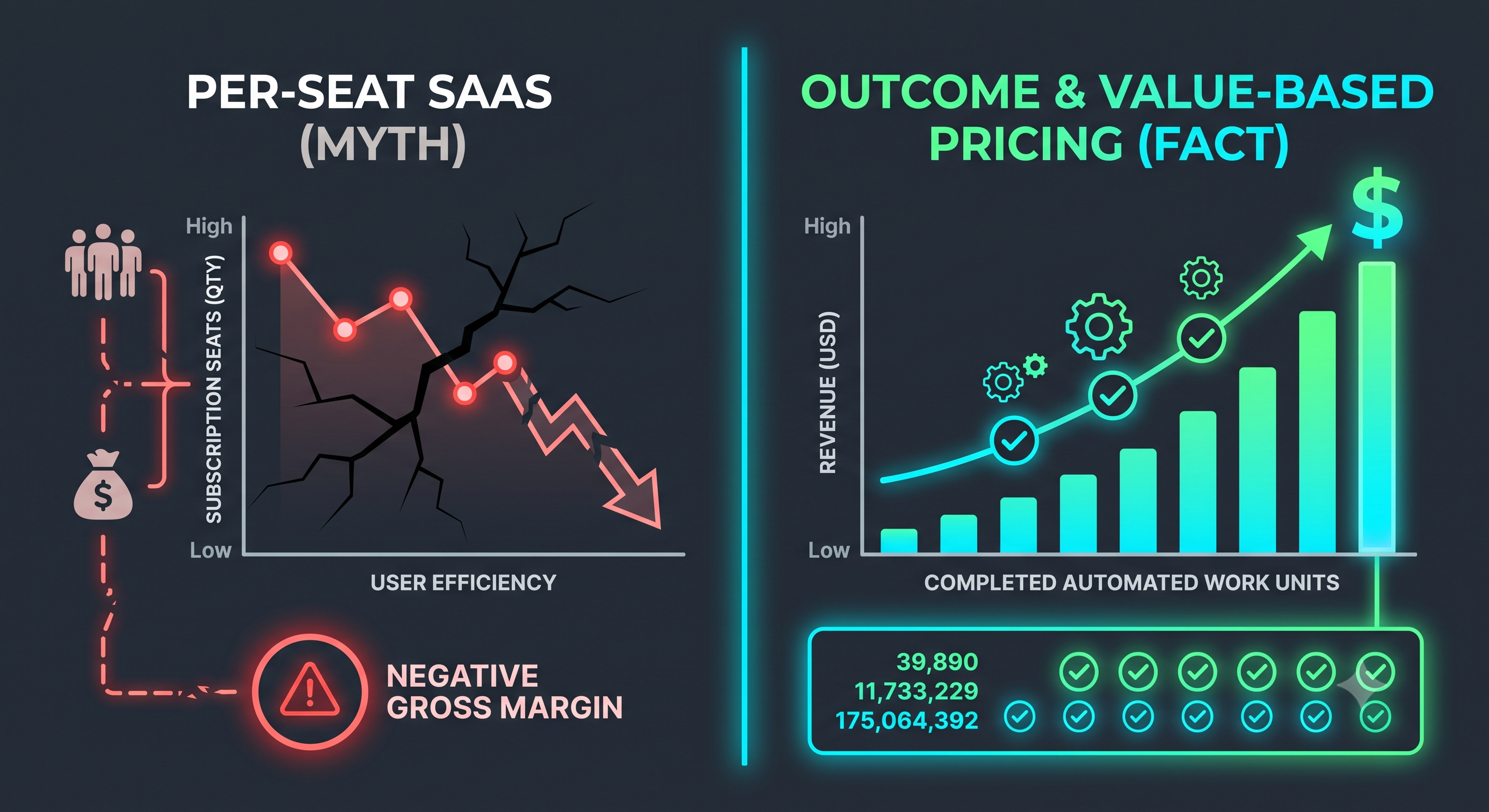
Myth: Charging per seat is the safest, most predictable pricing model for modern B2B tech startups.
Fact: Seat-based pricing penalizes software that automates labor. If your product successfully reduces the time a team spends on a task by 80%, the enterprise needs fewer headcount and fewer licenses—meaning higher product efficiency directly cannibalizes your expansion revenue.
Why this matters for your startup economics:
Traditional software had near-zero marginal cost of goods sold (COGS) per query. AI-native applications carry real variable compute costs (token inference, external tool calls, vector retrieval) alongside deterministic backend infrastructure.
If a power user consumes $200 worth of model compute in a month under a flat $40/user seat plan, you have negative gross margins disguised as product adoption.
How to architect sustainable, scalable pricing:
Anchor Pricing to Work Units, Not Logins
Price on work delivered: reconciled invoices, resolved support tickets, generated regulatory filings, or executed database migrations. Customers happily pay for completed outcomes that replace external service contracts or manual labor hours.
Implement a Platform Floor + Usage Burndown
Protect baseline unit economics. Charge a recurring base platform fee that covers baseline hosting and core infrastructure, bundled with a predetermined quota of outcome credits. Allow variable overages to burn against prepaid credit tiers.
Decouple Access from Billing
Encourage enterprise-wide team adoption by offering unlimited observer seats and collaboration access for free. The wider your software spreads across an organization, the more high-leverage workflows it triggers—scaling your outcome-based billable events without friction.
Sustainable startup growth isn't about selling software licenses to human operators. It is about capturing a percentage of the economic value your automation creates.
Discussion Question
If your product cut customer workflow time by 90% tomorrow, would your existing pricing model gain more revenue or lose customer seats?
CTA
Ready to build resilient business models and scale past early-stage traps? Join the Startup Founders & Entrepreneurs community to dissect unit economics, trade go-to-market strategies, and scale with fellow operators
For over a decade, early-stage founders inherited a default playbook: build a B2B SaaS product, charge $30/seat/month, and expand revenue by convincing enterprises to add more employees to the dashboard.
With AI-native automation and autonomous agent workflows, that pricing model is structurally broken.
Myth: Charging per seat is the safest, most predictable pricing model for modern B2B tech startups.
Fact: Seat-based pricing penalizes software that automates labor. If your product successfully reduces the time a team spends on a task by 80%, the enterprise needs fewer headcount and fewer licenses—meaning higher product efficiency directly cannibalizes your expansion revenue.
Why this matters for your startup economics:
Traditional software had near-zero marginal cost of goods sold (COGS) per query. AI-native applications carry real variable compute costs (token inference, external tool calls, vector retrieval) alongside deterministic backend infrastructure.
If a power user consumes $200 worth of model compute in a month under a flat $40/user seat plan, you have negative gross margins disguised as product adoption.
How to architect sustainable, scalable pricing:
Anchor Pricing to Work Units, Not Logins
Price on work delivered: reconciled invoices, resolved support tickets, generated regulatory filings, or executed database migrations. Customers happily pay for completed outcomes that replace external service contracts or manual labor hours.
Implement a Platform Floor + Usage Burndown
Protect baseline unit economics. Charge a recurring base platform fee that covers baseline hosting and core infrastructure, bundled with a predetermined quota of outcome credits. Allow variable overages to burn against prepaid credit tiers.
Decouple Access from Billing
Encourage enterprise-wide team adoption by offering unlimited observer seats and collaboration access for free. The wider your software spreads across an organization, the more high-leverage workflows it triggers—scaling your outcome-based billable events without friction.
Sustainable startup growth isn't about selling software licenses to human operators. It is about capturing a percentage of the economic value your automation creates.
Discussion Question
If your product cut customer workflow time by 90% tomorrow, would your existing pricing model gain more revenue or lose customer seats?
CTA
Ready to build resilient business models and scale past early-stage traps? Join the Startup Founders & Entrepreneurs community to dissect unit economics, trade go-to-market strategies, and scale with fellow operators
The Seat-Based SaaS Trap: Why Per-User Pricing Destroys AI Startup Margins
For over a decade, early-stage founders inherited a default playbook: build a B2B SaaS product, charge $30/seat/month, and expand revenue by convincing enterprises to add more employees to the dashboard.
With AI-native automation and autonomous agent workflows, that pricing model is structurally broken.
Myth: Charging per seat is the safest, most predictable pricing model for modern B2B tech startups.
Fact: Seat-based pricing penalizes software that automates labor. If your product successfully reduces the time a team spends on a task by 80%, the enterprise needs fewer headcount and fewer licenses—meaning higher product efficiency directly cannibalizes your expansion revenue.
Why this matters for your startup economics:
Traditional software had near-zero marginal cost of goods sold (COGS) per query. AI-native applications carry real variable compute costs (token inference, external tool calls, vector retrieval) alongside deterministic backend infrastructure.
If a power user consumes $200 worth of model compute in a month under a flat $40/user seat plan, you have negative gross margins disguised as product adoption.
How to architect sustainable, scalable pricing:
Anchor Pricing to Work Units, Not Logins
Price on work delivered: reconciled invoices, resolved support tickets, generated regulatory filings, or executed database migrations. Customers happily pay for completed outcomes that replace external service contracts or manual labor hours.
Implement a Platform Floor + Usage Burndown
Protect baseline unit economics. Charge a recurring base platform fee that covers baseline hosting and core infrastructure, bundled with a predetermined quota of outcome credits. Allow variable overages to burn against prepaid credit tiers.
Decouple Access from Billing
Encourage enterprise-wide team adoption by offering unlimited observer seats and collaboration access for free. The wider your software spreads across an organization, the more high-leverage workflows it triggers—scaling your outcome-based billable events without friction.
Sustainable startup growth isn't about selling software licenses to human operators. It is about capturing a percentage of the economic value your automation creates.
Discussion Question
If your product cut customer workflow time by 90% tomorrow, would your existing pricing model gain more revenue or lose customer seats?
CTA
Ready to build resilient business models and scale past early-stage traps? Join the Startup Founders & Entrepreneurs community to dissect unit economics, trade go-to-market strategies, and scale with fellow operators

 English
 Arabic
 French
 Spanish
 Portuguese
 Deutsch
 Turkish
 Dutch
Dutch
 Russian
 Romaian
 Portuguese (Brazil)
 Greek
Greek