


The AI Coding Assistant Trap: Why Autocomplete Is Not Making You a Better Software Engineer
Engineering students today have access to the most powerful code-generation tools in history. With autocomplete filling in entire functions in seconds, many learners assume that memorizing syntax, tracing memory layouts, and dissecting algorithms by hand are relics of the past.
The industry reality paints a very different picture.
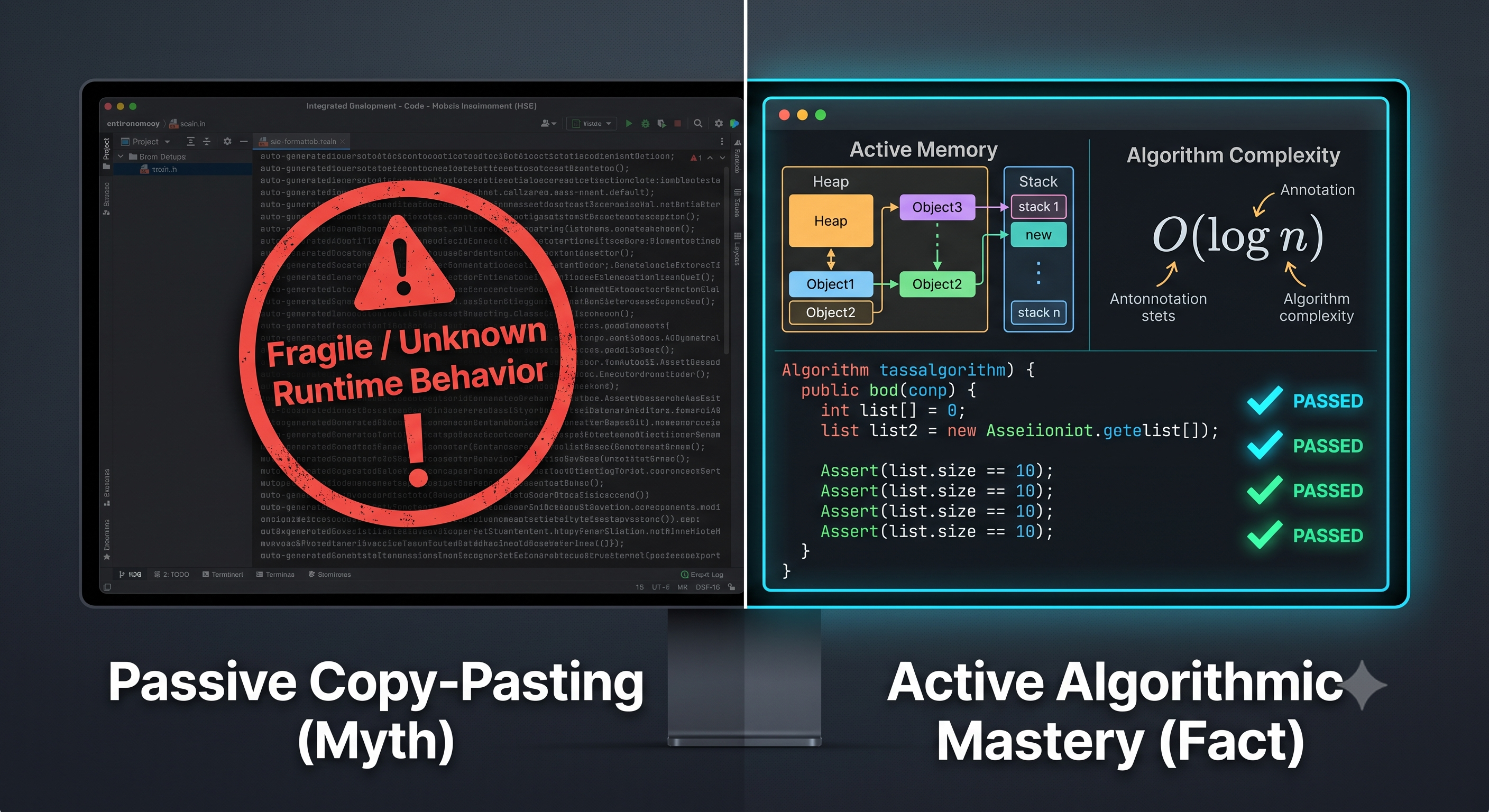
Myth: Using AI to write your college assignments accelerates your learning and prepares you for modern industry engineering roles.
Fact: AI code generation gives a deceptive illusion of competence. Generating syntax without understanding internal execution leaves you incapable of diagnosing runtime exceptions, memory leaks, concurrency locks, and architectural antipatterns when systems inevitably break.
Why this matters for your engineering career:
In professional environments, writing raw boilerplate is only a tiny fraction of the job. Senior engineers spend most of their time reading unfamiliar legacy systems, debugging erratic edge cases, reasoning about distributed state, and reviewing PRs for subtle security vulnerabilities.
If you use AI as a shortcut instead of a study partner, you miss the mental friction where actual algorithmic intuition forms. When an interviewer asks you to step through a pointer traversal or explain a cache eviction trade-off on a whiteboard, autocomplete won't be there to bail you out.
How to use AI tools like an elite engineering student:
Enforce the "Blank Editor" First Draft Rule
Never start an assignment by prompting an LLM. Design your data structures, draft pseudocode, and implement the initial baseline solution yourself. Once your implementation works (or fails deterministically), then consult AI tools to compare approaches.
Shift Prompts from Generation to Socratic Teardowns
Stop asking: "Write a binary search tree in C++."
Start asking: "Explain the cache locality trade-offs between an array-based binary heap and a pointer-based node tree," or "What are three edge cases where this specific sorting implementation will cause a stack overflow?"
Audit Generated Code Line-by-LineIf you use AI to explain or scaffold a routine, challenge yourself to explain every single variable, branch condition, and time/space complexity bound (O(n)) without looking back at the prompt. If you can't justify why a line is there, delete it.
AI doesn't replace the need to understand computer science fundamentals; it raises the bar on how deeply you must understand them to stay relevant.
Discussion Question
Do AI coding tools help you understand core computer science concepts faster, or do you find yourself relying on them to bypass difficult debugging sessions?
CTA
Ready to build deep technical foundations and bridge the gap from classroom theory to production systems? Join the Students in Tech community to break down engineering roadmaps, review open-source projects, and level up alongside peers worldwide
Engineering students today have access to the most powerful code-generation tools in history. With autocomplete filling in entire functions in seconds, many learners assume that memorizing syntax, tracing memory layouts, and dissecting algorithms by hand are relics of the past.
The industry reality paints a very different picture.
Myth: Using AI to write your college assignments accelerates your learning and prepares you for modern industry engineering roles.
Fact: AI code generation gives a deceptive illusion of competence. Generating syntax without understanding internal execution leaves you incapable of diagnosing runtime exceptions, memory leaks, concurrency locks, and architectural antipatterns when systems inevitably break.
Why this matters for your engineering career:
In professional environments, writing raw boilerplate is only a tiny fraction of the job. Senior engineers spend most of their time reading unfamiliar legacy systems, debugging erratic edge cases, reasoning about distributed state, and reviewing PRs for subtle security vulnerabilities.
If you use AI as a shortcut instead of a study partner, you miss the mental friction where actual algorithmic intuition forms. When an interviewer asks you to step through a pointer traversal or explain a cache eviction trade-off on a whiteboard, autocomplete won't be there to bail you out.
How to use AI tools like an elite engineering student:
Enforce the "Blank Editor" First Draft Rule
Never start an assignment by prompting an LLM. Design your data structures, draft pseudocode, and implement the initial baseline solution yourself. Once your implementation works (or fails deterministically), then consult AI tools to compare approaches.
Shift Prompts from Generation to Socratic Teardowns
Stop asking: "Write a binary search tree in C++."
Start asking: "Explain the cache locality trade-offs between an array-based binary heap and a pointer-based node tree," or "What are three edge cases where this specific sorting implementation will cause a stack overflow?"
Audit Generated Code Line-by-LineIf you use AI to explain or scaffold a routine, challenge yourself to explain every single variable, branch condition, and time/space complexity bound (O(n)) without looking back at the prompt. If you can't justify why a line is there, delete it.
AI doesn't replace the need to understand computer science fundamentals; it raises the bar on how deeply you must understand them to stay relevant.
Discussion Question
Do AI coding tools help you understand core computer science concepts faster, or do you find yourself relying on them to bypass difficult debugging sessions?
CTA
Ready to build deep technical foundations and bridge the gap from classroom theory to production systems? Join the Students in Tech community to break down engineering roadmaps, review open-source projects, and level up alongside peers worldwide
The AI Coding Assistant Trap: Why Autocomplete Is Not Making You a Better Software Engineer
Engineering students today have access to the most powerful code-generation tools in history. With autocomplete filling in entire functions in seconds, many learners assume that memorizing syntax, tracing memory layouts, and dissecting algorithms by hand are relics of the past.
The industry reality paints a very different picture.
Myth: Using AI to write your college assignments accelerates your learning and prepares you for modern industry engineering roles.
Fact: AI code generation gives a deceptive illusion of competence. Generating syntax without understanding internal execution leaves you incapable of diagnosing runtime exceptions, memory leaks, concurrency locks, and architectural antipatterns when systems inevitably break.
Why this matters for your engineering career:
In professional environments, writing raw boilerplate is only a tiny fraction of the job. Senior engineers spend most of their time reading unfamiliar legacy systems, debugging erratic edge cases, reasoning about distributed state, and reviewing PRs for subtle security vulnerabilities.
If you use AI as a shortcut instead of a study partner, you miss the mental friction where actual algorithmic intuition forms. When an interviewer asks you to step through a pointer traversal or explain a cache eviction trade-off on a whiteboard, autocomplete won't be there to bail you out.
How to use AI tools like an elite engineering student:
Enforce the "Blank Editor" First Draft Rule
Never start an assignment by prompting an LLM. Design your data structures, draft pseudocode, and implement the initial baseline solution yourself. Once your implementation works (or fails deterministically), then consult AI tools to compare approaches.
Shift Prompts from Generation to Socratic Teardowns
Stop asking: "Write a binary search tree in C++."
Start asking: "Explain the cache locality trade-offs between an array-based binary heap and a pointer-based node tree," or "What are three edge cases where this specific sorting implementation will cause a stack overflow?"
Audit Generated Code Line-by-LineIf you use AI to explain or scaffold a routine, challenge yourself to explain every single variable, branch condition, and time/space complexity bound (O(n)) without looking back at the prompt. If you can't justify why a line is there, delete it.
AI doesn't replace the need to understand computer science fundamentals; it raises the bar on how deeply you must understand them to stay relevant.
Discussion Question
Do AI coding tools help you understand core computer science concepts faster, or do you find yourself relying on them to bypass difficult debugging sessions?
CTA
Ready to build deep technical foundations and bridge the gap from classroom theory to production systems? Join the Students in Tech community to break down engineering roadmaps, review open-source projects, and level up alongside peers worldwide

 English
 Arabic
 French
 Spanish
 Portuguese
 Deutsch
 Turkish
 Dutch
Dutch
 Italiano
 Russian
 Romaian
 Portuguese (Brazil)