


The MFA Bulletproof Fallacy: Why Attackers Don't Crack Your Password, They Steal Your Session
As organizations enforce stricter MFA policies and adopt passwordless authentication, the traditional credential-stuffing playbook has changed. Modern adversaries rarely waste time attempting to guess passwords or trigger MFA push-fatigue storms.
Instead, they target the post-authentication state.
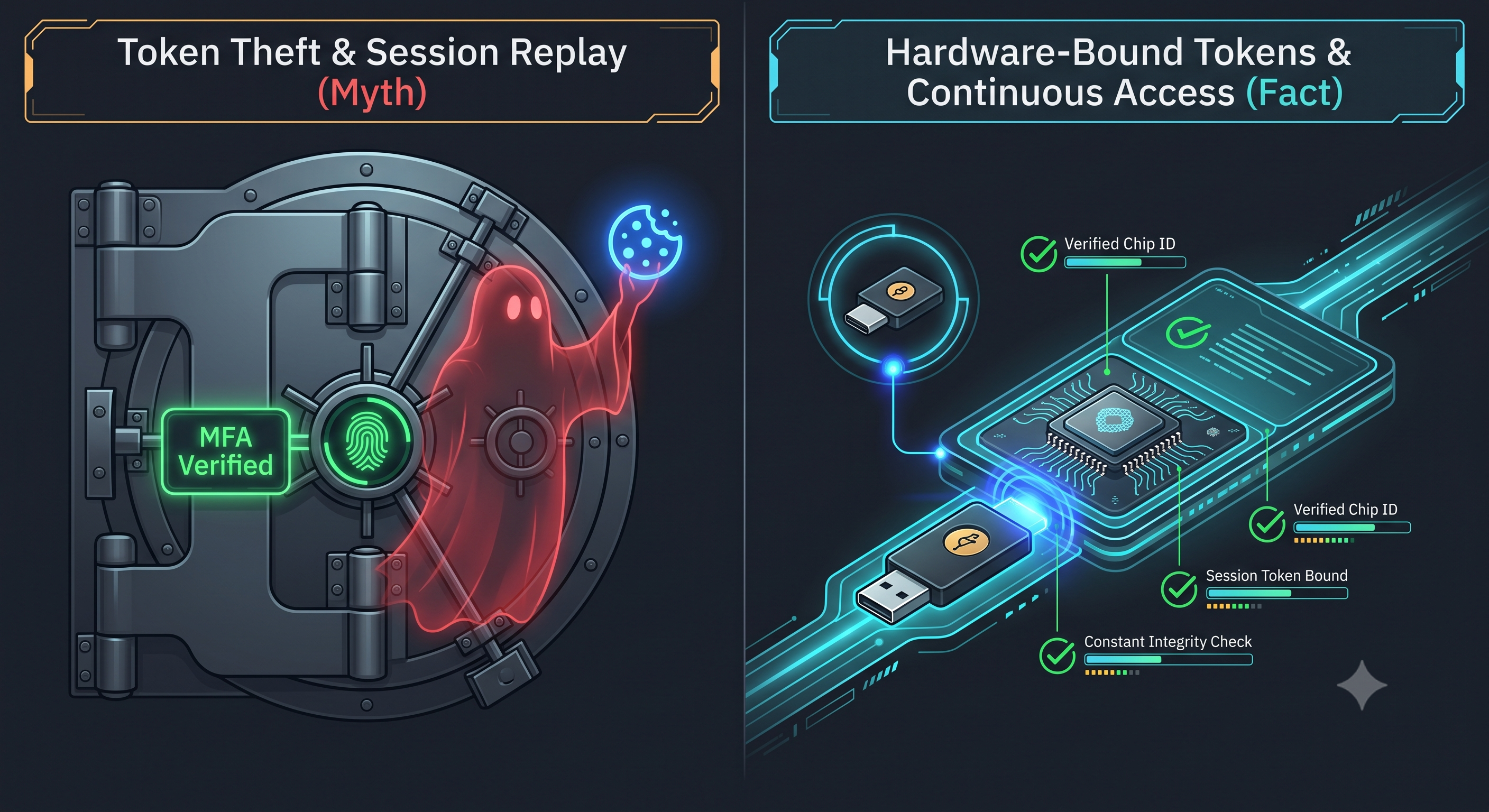
Myth: Multi-Factor Authentication (MFA) guarantees that an unauthorized user cannot access an authenticated cloud or enterprise account.
Fact: MFA only protects the initial point of authentication. Once a user successfully passes MFA, the application generates a bearer session token (or session cookie). If an attacker exfiltrates this token via infostealer malware or Adversary-in-the-Middle (AiTM) reverse proxies, they replay the session in their own browser—bypassing password prompts and MFA triggers entirely.
Why this matters for cybersecurity defenders:
In identity-first attacks, the adversary does not look like an intruder; they look like an authenticated, legitimate user. Automated security alerts for "impossible travel" or failed logins remain silent because the active session was already authenticated by the real employee.
How to defend the post-authentication boundary:
Implement Continuous Access Evaluation (CAE / CAEP)
Stop trusting static session tokens with 24-hour expiration windows. Deploy continuous evaluation protocols that revoke tokens in near-real-time if the user’s IP subnet, device compliance posture, or location changes abruptly mid-session.
Enforce Token and Session Binding
Transition to hardware-bound tokens using Demonstrating Proof-of-Possession (DPoP) or device-bound session credentials. If a stolen session cookie is replayed from a browser or machine without the corresponding private cryptographic key, the server rejects the request.
Transition to Phishing-Resistant MFA (FIDO2 / Passkeys)
SMS codes, one-time passwords (OTP), and push notifications are susceptible to AiTM proxy interception. FIDO2/WebAuthn hardware keys cryptographically bind authentication to the legitimate server domain, stopping proxy phishing before a token can be minted.
Modern identity defense isn't just about verifying who signs in. It is about continuously validating that the identity holding the active session is still the person you authenticated.
Discussion Question
Does your team currently monitor and restrict post-authentication token lifespans, or does your access policy rely entirely on point-in-time login challenges?
CTA
Ready to build resilient defensive architectures and stay ahead of modern adversary tradecraft? Join the Cybersecurity & Ethical Hacking community to break down real attack vectors, analyze threat intelligence, and level up with security practitioners worldwide.
As organizations enforce stricter MFA policies and adopt passwordless authentication, the traditional credential-stuffing playbook has changed. Modern adversaries rarely waste time attempting to guess passwords or trigger MFA push-fatigue storms.
Instead, they target the post-authentication state.
Myth: Multi-Factor Authentication (MFA) guarantees that an unauthorized user cannot access an authenticated cloud or enterprise account.
Fact: MFA only protects the initial point of authentication. Once a user successfully passes MFA, the application generates a bearer session token (or session cookie). If an attacker exfiltrates this token via infostealer malware or Adversary-in-the-Middle (AiTM) reverse proxies, they replay the session in their own browser—bypassing password prompts and MFA triggers entirely.
Why this matters for cybersecurity defenders:
In identity-first attacks, the adversary does not look like an intruder; they look like an authenticated, legitimate user. Automated security alerts for "impossible travel" or failed logins remain silent because the active session was already authenticated by the real employee.
How to defend the post-authentication boundary:
Implement Continuous Access Evaluation (CAE / CAEP)
Stop trusting static session tokens with 24-hour expiration windows. Deploy continuous evaluation protocols that revoke tokens in near-real-time if the user’s IP subnet, device compliance posture, or location changes abruptly mid-session.
Enforce Token and Session Binding
Transition to hardware-bound tokens using Demonstrating Proof-of-Possession (DPoP) or device-bound session credentials. If a stolen session cookie is replayed from a browser or machine without the corresponding private cryptographic key, the server rejects the request.
Transition to Phishing-Resistant MFA (FIDO2 / Passkeys)
SMS codes, one-time passwords (OTP), and push notifications are susceptible to AiTM proxy interception. FIDO2/WebAuthn hardware keys cryptographically bind authentication to the legitimate server domain, stopping proxy phishing before a token can be minted.
Modern identity defense isn't just about verifying who signs in. It is about continuously validating that the identity holding the active session is still the person you authenticated.
Discussion Question
Does your team currently monitor and restrict post-authentication token lifespans, or does your access policy rely entirely on point-in-time login challenges?
CTA
Ready to build resilient defensive architectures and stay ahead of modern adversary tradecraft? Join the Cybersecurity & Ethical Hacking community to break down real attack vectors, analyze threat intelligence, and level up with security practitioners worldwide.
The MFA Bulletproof Fallacy: Why Attackers Don't Crack Your Password, They Steal Your Session
As organizations enforce stricter MFA policies and adopt passwordless authentication, the traditional credential-stuffing playbook has changed. Modern adversaries rarely waste time attempting to guess passwords or trigger MFA push-fatigue storms.
Instead, they target the post-authentication state.
Myth: Multi-Factor Authentication (MFA) guarantees that an unauthorized user cannot access an authenticated cloud or enterprise account.
Fact: MFA only protects the initial point of authentication. Once a user successfully passes MFA, the application generates a bearer session token (or session cookie). If an attacker exfiltrates this token via infostealer malware or Adversary-in-the-Middle (AiTM) reverse proxies, they replay the session in their own browser—bypassing password prompts and MFA triggers entirely.
Why this matters for cybersecurity defenders:
In identity-first attacks, the adversary does not look like an intruder; they look like an authenticated, legitimate user. Automated security alerts for "impossible travel" or failed logins remain silent because the active session was already authenticated by the real employee.
How to defend the post-authentication boundary:
Implement Continuous Access Evaluation (CAE / CAEP)
Stop trusting static session tokens with 24-hour expiration windows. Deploy continuous evaluation protocols that revoke tokens in near-real-time if the user’s IP subnet, device compliance posture, or location changes abruptly mid-session.
Enforce Token and Session Binding
Transition to hardware-bound tokens using Demonstrating Proof-of-Possession (DPoP) or device-bound session credentials. If a stolen session cookie is replayed from a browser or machine without the corresponding private cryptographic key, the server rejects the request.
Transition to Phishing-Resistant MFA (FIDO2 / Passkeys)
SMS codes, one-time passwords (OTP), and push notifications are susceptible to AiTM proxy interception. FIDO2/WebAuthn hardware keys cryptographically bind authentication to the legitimate server domain, stopping proxy phishing before a token can be minted.
Modern identity defense isn't just about verifying who signs in. It is about continuously validating that the identity holding the active session is still the person you authenticated.
Discussion Question
Does your team currently monitor and restrict post-authentication token lifespans, or does your access policy rely entirely on point-in-time login challenges?
CTA
Ready to build resilient defensive architectures and stay ahead of modern adversary tradecraft? Join the Cybersecurity & Ethical Hacking community to break down real attack vectors, analyze threat intelligence, and level up with security practitioners worldwide.

 Arabic
 French
 Spanish
 Portuguese
 Deutsch
 Turkish
 Dutch
Dutch
 Italiano
 Russian
 Romaian
 Portuguese (Brazil)
 Greek
Greek