


The "No Framework" Weekend: How Building from Scratch Unlocks True Engineering Intuition
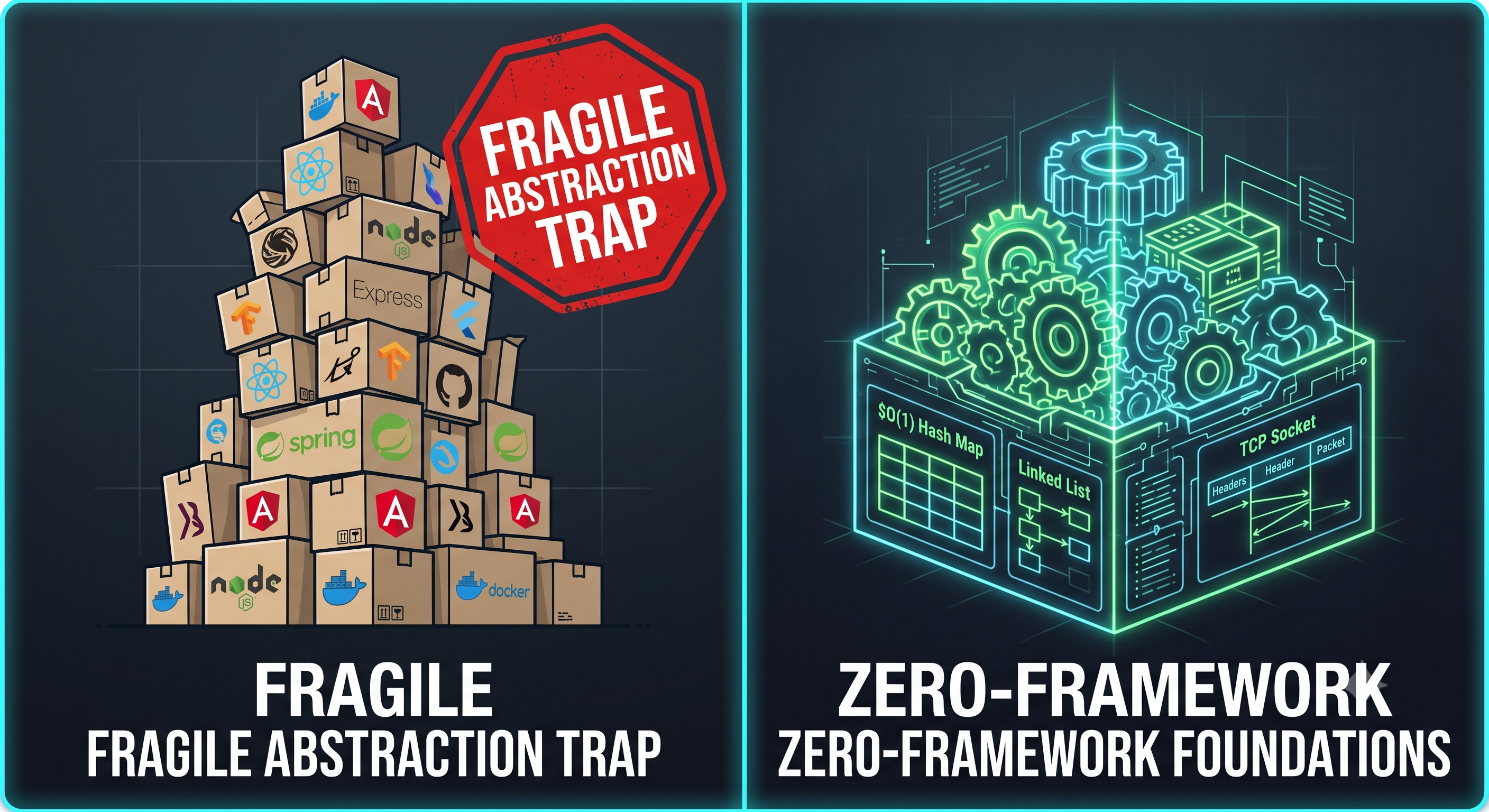
Modern developer tooling makes starting a project deceptively fast. With one terminal command, a beginner can scaffold a full-stack application loaded with state management libraries, ORMs, and pre-packaged authentication.
The problem? You learn how to consume APIs without ever understanding the computer science primitives underneath them.
When an interviewer asks how a relational join executes under the hood, how state changes trigger a Virtual DOM re-render, or why a cache eviction causes memory fragmentation, reciting library documentation won't save you.
If you want to build engineering intuition that actually lasts, step away from npm install and take the 48-Hour Zero-Framework Challenge:
Rebuild One Primitive by Hand
Pick a foundational tool you take for granted and implement a minimal, working version from scratch:
Option A: Build a toy HTTP router using raw TCP sockets that parses HTTP request headers and routes paths manually.
Option B: Implement a custom state container (like a miniature Redux/Zustand) using pure JavaScript closures and pub/sub observables.
Option C: Write an in-memory key-value database in Python or C++ featuring an LRU (Least Recently Used) cache backed by a hash map and a doubly linked list.
Ban External Dependencies
Set your dependency count to zero. Standard library only. No React, no Express, no ORMs. When you have to manually parse query strings or handle concurrent read/write locks, the design trade-offs behind modern frameworks suddenly become obvious.
Bench-Test and Break It
Write 20 automated integration tests designed to break your implementation. Feed it malformed headers, simulate simultaneous requests, or flood the cache. Diagnosing why your own raw code crashes teaches you more about distributed systems and systems performance in a single weekend than three months of tutorial videos.
Senior engineers aren't valued for their speed in configuring someone else's boilerplate. They are valued because they understand how the machine works when the abstractions leak.
Key Takeaways
High-level frameworks conceal core computer science trade-offs behind magical abstractions.
Implementing toy versions of everyday tools (routers, caches, event emitters) cements deep systems intuition.
Relying exclusively on standard libraries forces you to confront memory, state, and concurrency boundaries directly.
True technical seniority is built on understanding the fundamentals that frameworks are engineered to solve.
CTA
Ready to move past tutorial hell and master computer science fundamentals that actually scale your career? Join the Students in Tech community to dissect open-source internals, review build-from-scratch projects, and level up with peers worldwide.
Modern developer tooling makes starting a project deceptively fast. With one terminal command, a beginner can scaffold a full-stack application loaded with state management libraries, ORMs, and pre-packaged authentication.
The problem? You learn how to consume APIs without ever understanding the computer science primitives underneath them.
When an interviewer asks how a relational join executes under the hood, how state changes trigger a Virtual DOM re-render, or why a cache eviction causes memory fragmentation, reciting library documentation won't save you.
If you want to build engineering intuition that actually lasts, step away from npm install and take the 48-Hour Zero-Framework Challenge:
Rebuild One Primitive by Hand
Pick a foundational tool you take for granted and implement a minimal, working version from scratch:
Option A: Build a toy HTTP router using raw TCP sockets that parses HTTP request headers and routes paths manually.
Option B: Implement a custom state container (like a miniature Redux/Zustand) using pure JavaScript closures and pub/sub observables.
Option C: Write an in-memory key-value database in Python or C++ featuring an LRU (Least Recently Used) cache backed by a hash map and a doubly linked list.
Ban External Dependencies
Set your dependency count to zero. Standard library only. No React, no Express, no ORMs. When you have to manually parse query strings or handle concurrent read/write locks, the design trade-offs behind modern frameworks suddenly become obvious.
Bench-Test and Break It
Write 20 automated integration tests designed to break your implementation. Feed it malformed headers, simulate simultaneous requests, or flood the cache. Diagnosing why your own raw code crashes teaches you more about distributed systems and systems performance in a single weekend than three months of tutorial videos.
Senior engineers aren't valued for their speed in configuring someone else's boilerplate. They are valued because they understand how the machine works when the abstractions leak.
Key Takeaways
High-level frameworks conceal core computer science trade-offs behind magical abstractions.
Implementing toy versions of everyday tools (routers, caches, event emitters) cements deep systems intuition.
Relying exclusively on standard libraries forces you to confront memory, state, and concurrency boundaries directly.
True technical seniority is built on understanding the fundamentals that frameworks are engineered to solve.
CTA
Ready to move past tutorial hell and master computer science fundamentals that actually scale your career? Join the Students in Tech community to dissect open-source internals, review build-from-scratch projects, and level up with peers worldwide.
The "No Framework" Weekend: How Building from Scratch Unlocks True Engineering Intuition
Modern developer tooling makes starting a project deceptively fast. With one terminal command, a beginner can scaffold a full-stack application loaded with state management libraries, ORMs, and pre-packaged authentication.
The problem? You learn how to consume APIs without ever understanding the computer science primitives underneath them.
When an interviewer asks how a relational join executes under the hood, how state changes trigger a Virtual DOM re-render, or why a cache eviction causes memory fragmentation, reciting library documentation won't save you.
If you want to build engineering intuition that actually lasts, step away from npm install and take the 48-Hour Zero-Framework Challenge:
Rebuild One Primitive by Hand
Pick a foundational tool you take for granted and implement a minimal, working version from scratch:
Option A: Build a toy HTTP router using raw TCP sockets that parses HTTP request headers and routes paths manually.
Option B: Implement a custom state container (like a miniature Redux/Zustand) using pure JavaScript closures and pub/sub observables.
Option C: Write an in-memory key-value database in Python or C++ featuring an LRU (Least Recently Used) cache backed by a hash map and a doubly linked list.
Ban External Dependencies
Set your dependency count to zero. Standard library only. No React, no Express, no ORMs. When you have to manually parse query strings or handle concurrent read/write locks, the design trade-offs behind modern frameworks suddenly become obvious.
Bench-Test and Break It
Write 20 automated integration tests designed to break your implementation. Feed it malformed headers, simulate simultaneous requests, or flood the cache. Diagnosing why your own raw code crashes teaches you more about distributed systems and systems performance in a single weekend than three months of tutorial videos.
Senior engineers aren't valued for their speed in configuring someone else's boilerplate. They are valued because they understand how the machine works when the abstractions leak.
Key Takeaways
High-level frameworks conceal core computer science trade-offs behind magical abstractions.
Implementing toy versions of everyday tools (routers, caches, event emitters) cements deep systems intuition.
Relying exclusively on standard libraries forces you to confront memory, state, and concurrency boundaries directly.
True technical seniority is built on understanding the fundamentals that frameworks are engineered to solve.
CTA
Ready to move past tutorial hell and master computer science fundamentals that actually scale your career? Join the Students in Tech community to dissect open-source internals, review build-from-scratch projects, and level up with peers worldwide.

 English
 French
 Spanish
 Portuguese
 Deutsch
 Turkish
 Dutch
Dutch
 Italiano
 Russian
 Romaian
 Portuguese (Brazil)
 Greek
Greek