


The Zero-Trust Audit Challenge: Why Assuming Breach Will Transform Your Security Posture
Most teams treat security as a boundary problem: set up firewalls, enforce VPN access, and assume that every packet, device, and service operating inside the internal subnet is trustworthy.
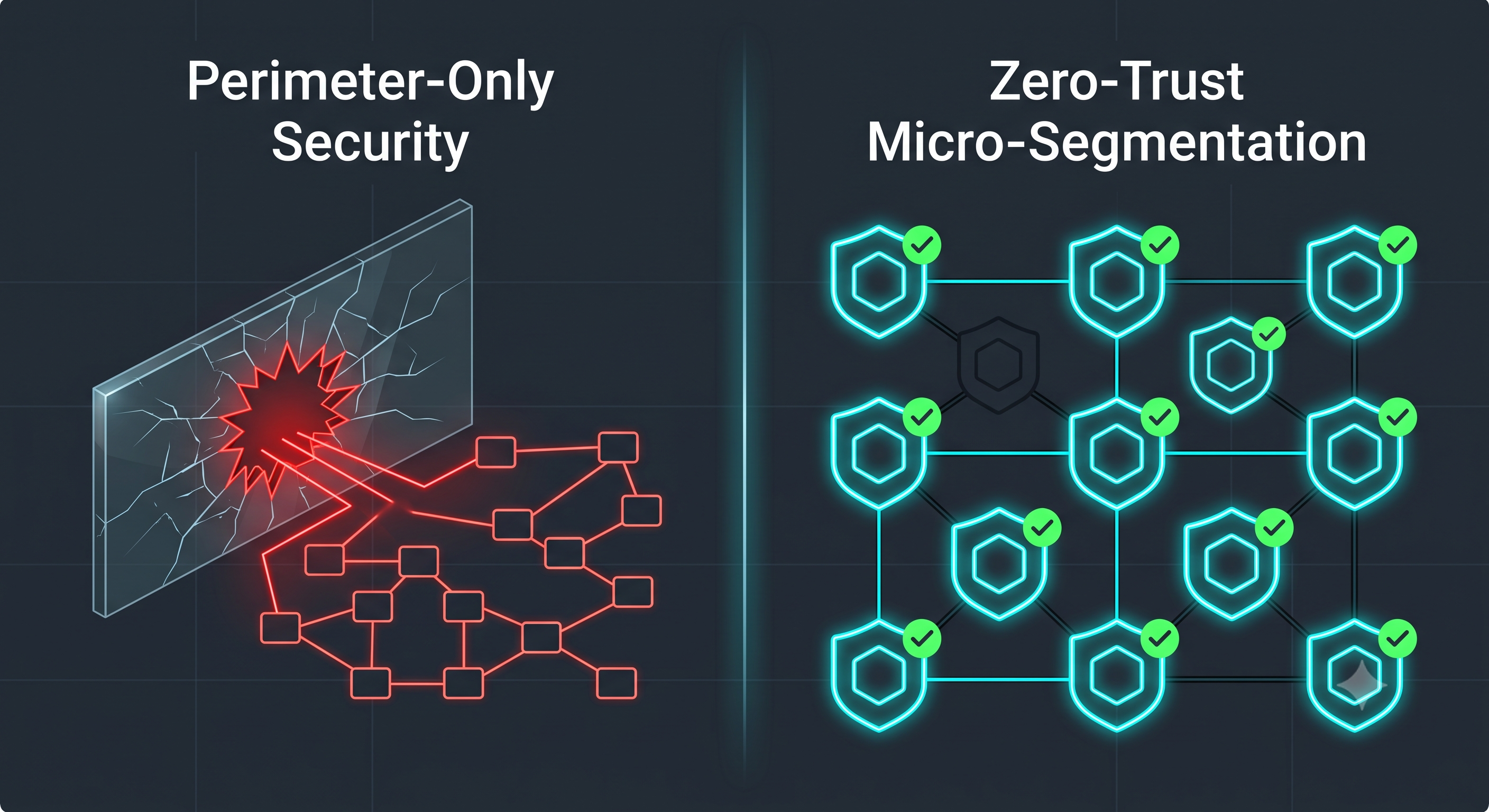
In real-world compromises, this implicit trust is exactly what turns a single compromised workstation into a full domain takeover. Once an adversary gains an initial foothold, flat networks allow them to scan internal subnets, dump memory credentials, and pivot across lateral routes completely unnoticed.
To build an architecture that survives a breach, stop assuming your internal network is safe and take the 72-Hour Zero-Trust Hardening Challenge:
Eliminate Implicit Lateral Trust
Segment your network down to the workload level. If an internal microservice or application tier doesn't need to communicate with another, explicitly deny traffic at the firewall or service mesh layer. Enforce mutual TLS (mTLS) for all internal service-to-service communications so every request is authenticated and encrypted, regardless of where it originates.
Conduct the "Assume Breach" Credential Sweep
Assume an attacker has local admin access to an average developer machine right now. Ask:
Are there static cloud keys or private SSH tokens saved in plaintext configs or bash histories?
Do standard user accounts have read access to internal network shares or unsegmented staging databases?
Scrub static secrets and replace them with short-lived, dynamically generated credentials delivered via a centralized secrets vault.
Enforce Micro-Perimeters and Least Privilege Access
Audit your Active Directory or IAM role hierarchies. Strip wildcard permissions (*) from service accounts and enforce time-bound, role-based access control (RBAC). Require re-authentication or step-up verification when accounts attempt high-risk actions, even from trusted corporate devices.
Defensive security isn't about hoping the perimeter never fails. It’s about building a system where a single compromised node gives the attacker nothing else to compromise.
Key Takeaways
Internal subnets should be treated with the same zero-trust posture as the public internet.
Flat networks enable effortless lateral movement; micro-segmentation contains the blast radius.
Replace long-lived static secrets with short-lived, rotated credentials to neutralize token exfiltration.
Enforce least privilege strictly across service accounts and human operators alike.
CTA
Ready to move past perimeter defense and master modern adversarial tradecraft? Join the Cybersecurity & Ethical Hacking community to dissect attack vectors, run architectural audits, and level up your defensive game with practitioners worldwide.
Most teams treat security as a boundary problem: set up firewalls, enforce VPN access, and assume that every packet, device, and service operating inside the internal subnet is trustworthy.
In real-world compromises, this implicit trust is exactly what turns a single compromised workstation into a full domain takeover. Once an adversary gains an initial foothold, flat networks allow them to scan internal subnets, dump memory credentials, and pivot across lateral routes completely unnoticed.
To build an architecture that survives a breach, stop assuming your internal network is safe and take the 72-Hour Zero-Trust Hardening Challenge:
Eliminate Implicit Lateral Trust
Segment your network down to the workload level. If an internal microservice or application tier doesn't need to communicate with another, explicitly deny traffic at the firewall or service mesh layer. Enforce mutual TLS (mTLS) for all internal service-to-service communications so every request is authenticated and encrypted, regardless of where it originates.
Conduct the "Assume Breach" Credential Sweep
Assume an attacker has local admin access to an average developer machine right now. Ask:
Are there static cloud keys or private SSH tokens saved in plaintext configs or bash histories?
Do standard user accounts have read access to internal network shares or unsegmented staging databases?
Scrub static secrets and replace them with short-lived, dynamically generated credentials delivered via a centralized secrets vault.
Enforce Micro-Perimeters and Least Privilege Access
Audit your Active Directory or IAM role hierarchies. Strip wildcard permissions (*) from service accounts and enforce time-bound, role-based access control (RBAC). Require re-authentication or step-up verification when accounts attempt high-risk actions, even from trusted corporate devices.
Defensive security isn't about hoping the perimeter never fails. It’s about building a system where a single compromised node gives the attacker nothing else to compromise.
Key Takeaways
Internal subnets should be treated with the same zero-trust posture as the public internet.
Flat networks enable effortless lateral movement; micro-segmentation contains the blast radius.
Replace long-lived static secrets with short-lived, rotated credentials to neutralize token exfiltration.
Enforce least privilege strictly across service accounts and human operators alike.
CTA
Ready to move past perimeter defense and master modern adversarial tradecraft? Join the Cybersecurity & Ethical Hacking community to dissect attack vectors, run architectural audits, and level up your defensive game with practitioners worldwide.
The Zero-Trust Audit Challenge: Why Assuming Breach Will Transform Your Security Posture
Most teams treat security as a boundary problem: set up firewalls, enforce VPN access, and assume that every packet, device, and service operating inside the internal subnet is trustworthy.
In real-world compromises, this implicit trust is exactly what turns a single compromised workstation into a full domain takeover. Once an adversary gains an initial foothold, flat networks allow them to scan internal subnets, dump memory credentials, and pivot across lateral routes completely unnoticed.
To build an architecture that survives a breach, stop assuming your internal network is safe and take the 72-Hour Zero-Trust Hardening Challenge:
Eliminate Implicit Lateral Trust
Segment your network down to the workload level. If an internal microservice or application tier doesn't need to communicate with another, explicitly deny traffic at the firewall or service mesh layer. Enforce mutual TLS (mTLS) for all internal service-to-service communications so every request is authenticated and encrypted, regardless of where it originates.
Conduct the "Assume Breach" Credential Sweep
Assume an attacker has local admin access to an average developer machine right now. Ask:
Are there static cloud keys or private SSH tokens saved in plaintext configs or bash histories?
Do standard user accounts have read access to internal network shares or unsegmented staging databases?
Scrub static secrets and replace them with short-lived, dynamically generated credentials delivered via a centralized secrets vault.
Enforce Micro-Perimeters and Least Privilege Access
Audit your Active Directory or IAM role hierarchies. Strip wildcard permissions (*) from service accounts and enforce time-bound, role-based access control (RBAC). Require re-authentication or step-up verification when accounts attempt high-risk actions, even from trusted corporate devices.
Defensive security isn't about hoping the perimeter never fails. It’s about building a system where a single compromised node gives the attacker nothing else to compromise.
Key Takeaways
Internal subnets should be treated with the same zero-trust posture as the public internet.
Flat networks enable effortless lateral movement; micro-segmentation contains the blast radius.
Replace long-lived static secrets with short-lived, rotated credentials to neutralize token exfiltration.
Enforce least privilege strictly across service accounts and human operators alike.
CTA
Ready to move past perimeter defense and master modern adversarial tradecraft? Join the Cybersecurity & Ethical Hacking community to dissect attack vectors, run architectural audits, and level up your defensive game with practitioners worldwide.

 English
 Arabic
 French
 Spanish
 Portuguese
 Deutsch
 Turkish
 Dutch
Dutch
 Russian
 Romaian
 Portuguese (Brazil)
 Greek
Greek