


Stop Trusting "It Works in Staging": The Zero-Click Cloud Drift Audit
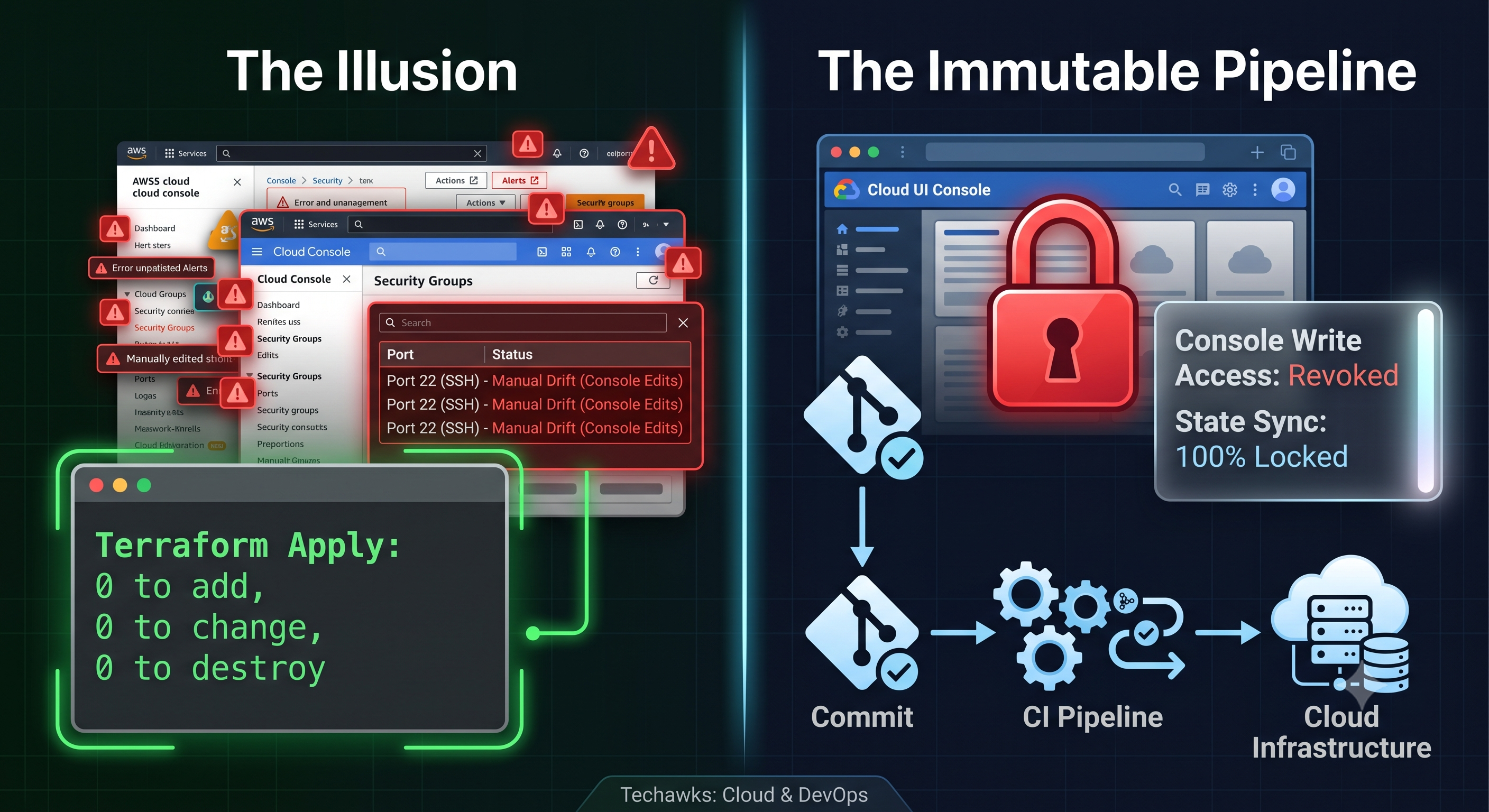
Configuration drift is the silent killer of cloud reliability. It rarely starts with malicious intent; it begins with an emergency 2:00 AM hotfix, a temporary security group rule opened for debugging, or an unrecorded manual instance resize.
When your real infrastructure diverges from your declarative code, you inherit major vulnerabilities:
The Phantom Rollback: The next automated CI/CD pipeline run will either silently overwrite the emergency hotfix (re-breaking production) or fail entirely due to state mismatch.
Security Blind Spots: Console-applied ingress rules bypass automated policy-as-code scanners (like tfsec or Checkov), leaving unauthorized ports open to the public internet.
Non-Reproducible Environments: Disaster recovery plans collapse because your code can only spin up a fraction of the actual operational architecture.
The 7-Day Zero-Click Infrastructure Challenge:
Select one non-critical production workload or tier-2 microservice and execute this audit:
Step 1: Run an Unscheduled Drift Detection. Trigger a clean terraform plan or equivalent state-refresh against live cloud state. Catalogue every single resource showing unexpected additions, modifications, or deletions outside of Git commits.
Step 2: Codify or Terminate. For every drifted attribute found: either formalize it into your version-controlled templates with a proper pull request, or destroy it immediately to align with the true state.
Step 3: Revoke Console Write Access. Strip interactive write/admin permissions for human operators in that target environment. Route all modifications—including environment variables and scaling policies—through peer-reviewed pull requests and automated pipelines.
Step 4: Implement Automated Drift Alarms. Set up a scheduled, read-only pipeline run (e.g., every 6 hours) that alerts directly to your on-call channel whenever real-world infrastructure deviates from state files.
Key Takeaways
Console fixes are technical debt: A manual change in a cloud dashboard solves a symptom today while guaranteeing a deployment failure tomorrow.
State files lie when humans have write access: Strict Least Privilege must apply to engineers, not just services; production changes belong exclusively in automated pipelines.
Drift detection is preventive maintenance: Catching infrastructure deltas continuously prevents catastrophic surprises during critical disaster-recovery events.
CTA
Ready to build resilient, immutable infrastructure that eliminates drift and operational overhead? Join the Cloud, DevOps & Open Source community to exchange proven IaC workflows, GitOps pipelines, and multi-cloud architectures.
Configuration drift is the silent killer of cloud reliability. It rarely starts with malicious intent; it begins with an emergency 2:00 AM hotfix, a temporary security group rule opened for debugging, or an unrecorded manual instance resize.
When your real infrastructure diverges from your declarative code, you inherit major vulnerabilities:
The Phantom Rollback: The next automated CI/CD pipeline run will either silently overwrite the emergency hotfix (re-breaking production) or fail entirely due to state mismatch.
Security Blind Spots: Console-applied ingress rules bypass automated policy-as-code scanners (like tfsec or Checkov), leaving unauthorized ports open to the public internet.
Non-Reproducible Environments: Disaster recovery plans collapse because your code can only spin up a fraction of the actual operational architecture.
The 7-Day Zero-Click Infrastructure Challenge:
Select one non-critical production workload or tier-2 microservice and execute this audit:
Step 1: Run an Unscheduled Drift Detection. Trigger a clean terraform plan or equivalent state-refresh against live cloud state. Catalogue every single resource showing unexpected additions, modifications, or deletions outside of Git commits.
Step 2: Codify or Terminate. For every drifted attribute found: either formalize it into your version-controlled templates with a proper pull request, or destroy it immediately to align with the true state.
Step 3: Revoke Console Write Access. Strip interactive write/admin permissions for human operators in that target environment. Route all modifications—including environment variables and scaling policies—through peer-reviewed pull requests and automated pipelines.
Step 4: Implement Automated Drift Alarms. Set up a scheduled, read-only pipeline run (e.g., every 6 hours) that alerts directly to your on-call channel whenever real-world infrastructure deviates from state files.
Key Takeaways
Console fixes are technical debt: A manual change in a cloud dashboard solves a symptom today while guaranteeing a deployment failure tomorrow.
State files lie when humans have write access: Strict Least Privilege must apply to engineers, not just services; production changes belong exclusively in automated pipelines.
Drift detection is preventive maintenance: Catching infrastructure deltas continuously prevents catastrophic surprises during critical disaster-recovery events.
CTA
Ready to build resilient, immutable infrastructure that eliminates drift and operational overhead? Join the Cloud, DevOps & Open Source community to exchange proven IaC workflows, GitOps pipelines, and multi-cloud architectures.
Stop Trusting "It Works in Staging": The Zero-Click Cloud Drift Audit
Configuration drift is the silent killer of cloud reliability. It rarely starts with malicious intent; it begins with an emergency 2:00 AM hotfix, a temporary security group rule opened for debugging, or an unrecorded manual instance resize.
When your real infrastructure diverges from your declarative code, you inherit major vulnerabilities:
The Phantom Rollback: The next automated CI/CD pipeline run will either silently overwrite the emergency hotfix (re-breaking production) or fail entirely due to state mismatch.
Security Blind Spots: Console-applied ingress rules bypass automated policy-as-code scanners (like tfsec or Checkov), leaving unauthorized ports open to the public internet.
Non-Reproducible Environments: Disaster recovery plans collapse because your code can only spin up a fraction of the actual operational architecture.
The 7-Day Zero-Click Infrastructure Challenge:
Select one non-critical production workload or tier-2 microservice and execute this audit:
Step 1: Run an Unscheduled Drift Detection. Trigger a clean terraform plan or equivalent state-refresh against live cloud state. Catalogue every single resource showing unexpected additions, modifications, or deletions outside of Git commits.
Step 2: Codify or Terminate. For every drifted attribute found: either formalize it into your version-controlled templates with a proper pull request, or destroy it immediately to align with the true state.
Step 3: Revoke Console Write Access. Strip interactive write/admin permissions for human operators in that target environment. Route all modifications—including environment variables and scaling policies—through peer-reviewed pull requests and automated pipelines.
Step 4: Implement Automated Drift Alarms. Set up a scheduled, read-only pipeline run (e.g., every 6 hours) that alerts directly to your on-call channel whenever real-world infrastructure deviates from state files.
Key Takeaways
Console fixes are technical debt: A manual change in a cloud dashboard solves a symptom today while guaranteeing a deployment failure tomorrow.
State files lie when humans have write access: Strict Least Privilege must apply to engineers, not just services; production changes belong exclusively in automated pipelines.
Drift detection is preventive maintenance: Catching infrastructure deltas continuously prevents catastrophic surprises during critical disaster-recovery events.
CTA
Ready to build resilient, immutable infrastructure that eliminates drift and operational overhead? Join the Cloud, DevOps & Open Source community to exchange proven IaC workflows, GitOps pipelines, and multi-cloud architectures.

 English
 Arabic
 French
 Spanish
 Deutsch
 Turkish
 Dutch
Dutch
 Italiano
 Russian
 Romaian
 Portuguese (Brazil)
 Greek
Greek