


Vector Search vs. Exact Match: The Enterprise RAG Reality Check
As enterprise teams race to integrate large reasoning models and contextual retrieval into structured reporting, vector databases have become the default answer for data discovery. But treating semantic similarity as a silver bullet reveals a fundamental misunderstanding of high-dimensional geometry and business data retrieval.
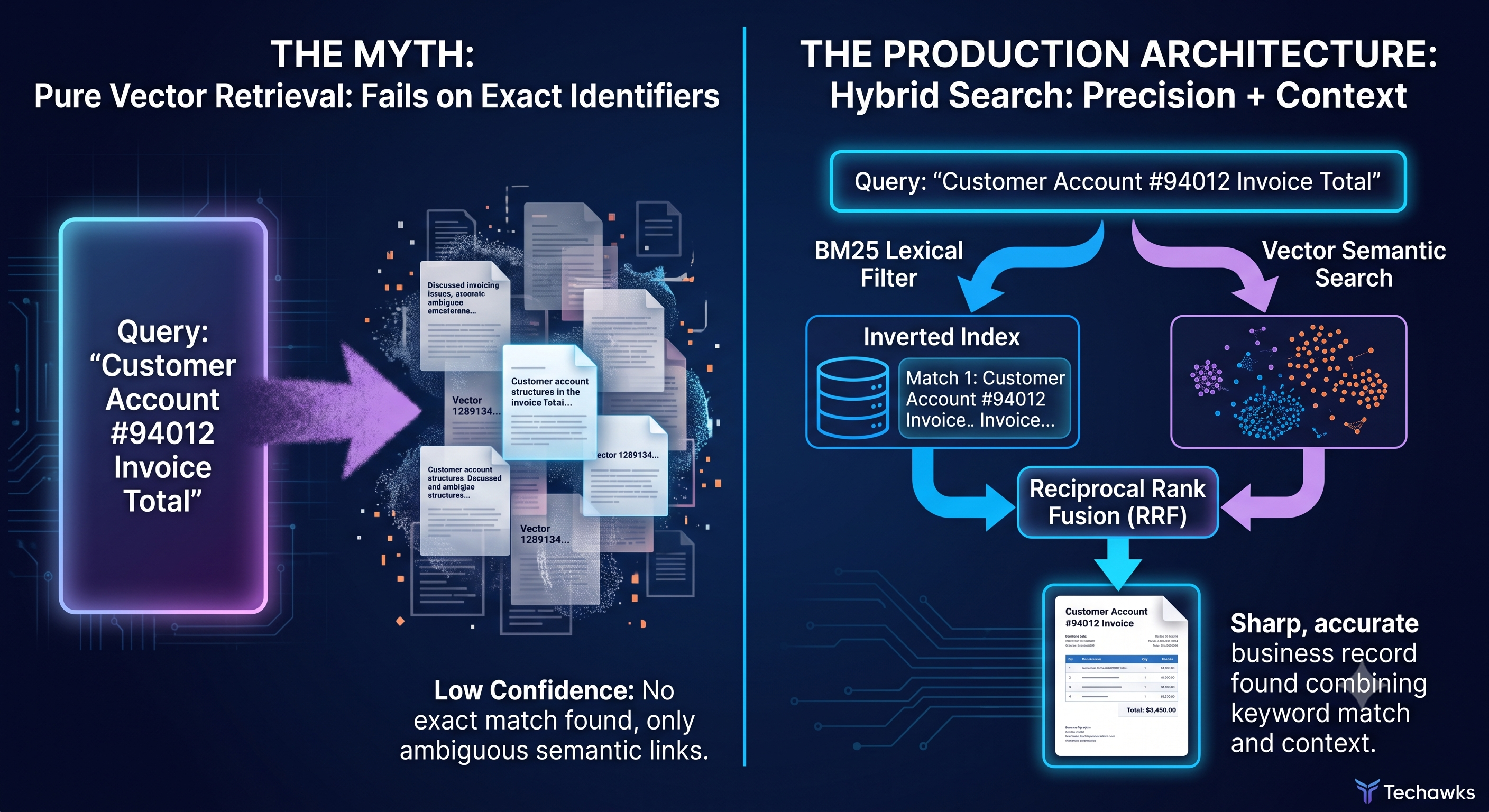
Myth: Vector search completely replaces lexical and structured querying because semantic embeddings capture "true context."
Fact: Vector search calculates mathematical distance, not logical conditions. It excels at conceptual similarity ("find customer complaints regarding shipping delays"), but it consistently fails at deterministic enterprise queries ("return customer ID 88412 where transaction amount > $500 in Q3").
Why relying purely on vector embeddings fails in production analytics:
The Exact-Token Blind Spot: Embeddings project words into probabilistic dense vectors. They often confuse critical enterprise identifiers like part numbers, error codes, SKUs, and regulatory compliance IDs because two completely different serial codes share nearly identical vector distances.
The Memory Tax of HNSW: Graph-based Approximate Nearest Neighbor (ANN) indexes (such as HNSW) must typically reside in memory (RAM) to maintain sub-50ms query latency, creating severe infrastructure cost spikes as dataset scale expands.
Embedding Drift: When your underlying domain corpus evolves or upstream embedding models are updated, vector representations shift. Unlike SQL queries that throw syntax or index errors when broken, vector drift silently degrades retrieval relevance without alerting the operations team.
How to Engineer Robust Retrieval Today:
Implement Hybrid Search (Dense + Sparse): Combine vector embeddings (dense) with BM25 or full-text inverted indexes (sparse) using Reciprocal Rank Fusion (RRF) to capture both high-level intent and exact nomenclature.
Pre-Filter with Metadata: Never let a vector index scan an entire database when structured filters (dates, tenant IDs, regions) can instantly reduce the search space using standard relational or columnar indexes.
Track Semantic Drift: Build automated relevance evaluations (e.g., Mean Reciprocal Rank on golden prompt sets) instead of monitoring only system uptime and latency.
Discussion Question
Where has pure semantic vector retrieval failed most noticeably in your internal pipelines: numerical precision, filtered aggregations, or specialized domain acronyms?
CTA
Ready to build reliable, high-performance data architectures that bridge modern AI with rigorous enterprise analytics? Join the Data Science & Analytics community to collaborate on hybrid retrieval pipelines, data engineering best practices, and production analytics frameworks.
As enterprise teams race to integrate large reasoning models and contextual retrieval into structured reporting, vector databases have become the default answer for data discovery. But treating semantic similarity as a silver bullet reveals a fundamental misunderstanding of high-dimensional geometry and business data retrieval.
Myth: Vector search completely replaces lexical and structured querying because semantic embeddings capture "true context."
Fact: Vector search calculates mathematical distance, not logical conditions. It excels at conceptual similarity ("find customer complaints regarding shipping delays"), but it consistently fails at deterministic enterprise queries ("return customer ID 88412 where transaction amount > $500 in Q3").
Why relying purely on vector embeddings fails in production analytics:
The Exact-Token Blind Spot: Embeddings project words into probabilistic dense vectors. They often confuse critical enterprise identifiers like part numbers, error codes, SKUs, and regulatory compliance IDs because two completely different serial codes share nearly identical vector distances.
The Memory Tax of HNSW: Graph-based Approximate Nearest Neighbor (ANN) indexes (such as HNSW) must typically reside in memory (RAM) to maintain sub-50ms query latency, creating severe infrastructure cost spikes as dataset scale expands.
Embedding Drift: When your underlying domain corpus evolves or upstream embedding models are updated, vector representations shift. Unlike SQL queries that throw syntax or index errors when broken, vector drift silently degrades retrieval relevance without alerting the operations team.
How to Engineer Robust Retrieval Today:
Implement Hybrid Search (Dense + Sparse): Combine vector embeddings (dense) with BM25 or full-text inverted indexes (sparse) using Reciprocal Rank Fusion (RRF) to capture both high-level intent and exact nomenclature.
Pre-Filter with Metadata: Never let a vector index scan an entire database when structured filters (dates, tenant IDs, regions) can instantly reduce the search space using standard relational or columnar indexes.
Track Semantic Drift: Build automated relevance evaluations (e.g., Mean Reciprocal Rank on golden prompt sets) instead of monitoring only system uptime and latency.
Discussion Question
Where has pure semantic vector retrieval failed most noticeably in your internal pipelines: numerical precision, filtered aggregations, or specialized domain acronyms?
CTA
Ready to build reliable, high-performance data architectures that bridge modern AI with rigorous enterprise analytics? Join the Data Science & Analytics community to collaborate on hybrid retrieval pipelines, data engineering best practices, and production analytics frameworks.
Vector Search vs. Exact Match: The Enterprise RAG Reality Check
As enterprise teams race to integrate large reasoning models and contextual retrieval into structured reporting, vector databases have become the default answer for data discovery. But treating semantic similarity as a silver bullet reveals a fundamental misunderstanding of high-dimensional geometry and business data retrieval.
Myth: Vector search completely replaces lexical and structured querying because semantic embeddings capture "true context."
Fact: Vector search calculates mathematical distance, not logical conditions. It excels at conceptual similarity ("find customer complaints regarding shipping delays"), but it consistently fails at deterministic enterprise queries ("return customer ID 88412 where transaction amount > $500 in Q3").
Why relying purely on vector embeddings fails in production analytics:
The Exact-Token Blind Spot: Embeddings project words into probabilistic dense vectors. They often confuse critical enterprise identifiers like part numbers, error codes, SKUs, and regulatory compliance IDs because two completely different serial codes share nearly identical vector distances.
The Memory Tax of HNSW: Graph-based Approximate Nearest Neighbor (ANN) indexes (such as HNSW) must typically reside in memory (RAM) to maintain sub-50ms query latency, creating severe infrastructure cost spikes as dataset scale expands.
Embedding Drift: When your underlying domain corpus evolves or upstream embedding models are updated, vector representations shift. Unlike SQL queries that throw syntax or index errors when broken, vector drift silently degrades retrieval relevance without alerting the operations team.
How to Engineer Robust Retrieval Today:
Implement Hybrid Search (Dense + Sparse): Combine vector embeddings (dense) with BM25 or full-text inverted indexes (sparse) using Reciprocal Rank Fusion (RRF) to capture both high-level intent and exact nomenclature.
Pre-Filter with Metadata: Never let a vector index scan an entire database when structured filters (dates, tenant IDs, regions) can instantly reduce the search space using standard relational or columnar indexes.
Track Semantic Drift: Build automated relevance evaluations (e.g., Mean Reciprocal Rank on golden prompt sets) instead of monitoring only system uptime and latency.
Discussion Question
Where has pure semantic vector retrieval failed most noticeably in your internal pipelines: numerical precision, filtered aggregations, or specialized domain acronyms?
CTA
Ready to build reliable, high-performance data architectures that bridge modern AI with rigorous enterprise analytics? Join the Data Science & Analytics community to collaborate on hybrid retrieval pipelines, data engineering best practices, and production analytics frameworks.

 English
 Arabic
 French
 Spanish
 Portuguese
 Deutsch
 Turkish
 Dutch
Dutch
 Italiano
 Russian
 Romaian
 Portuguese (Brazil)