


The Sidecar Tax: Why Ambient Mesh and eBPF Are Ending the Proxy-per-Pod Era
For years, the standard pattern for securing microservices in Kubernetes was uniform: inject a dedicated user-space proxy container into every application pod to handle mTLS, observability, and traffic routing.
While battle-tested, the sidecar pattern introduces severe operational drag at scale.
Myth: Running a sidecar proxy in every pod is the only way to achieve strict Zero-Trust mTLS and granular traffic governance in Kubernetes.
Fact: Sidecars waste massive memory reserves, inflate application deployment latency, and bind Layer 4 identity to heavy Layer 7 compute overhead.
Why the traditional sidecar model is hitting an architectural wall:
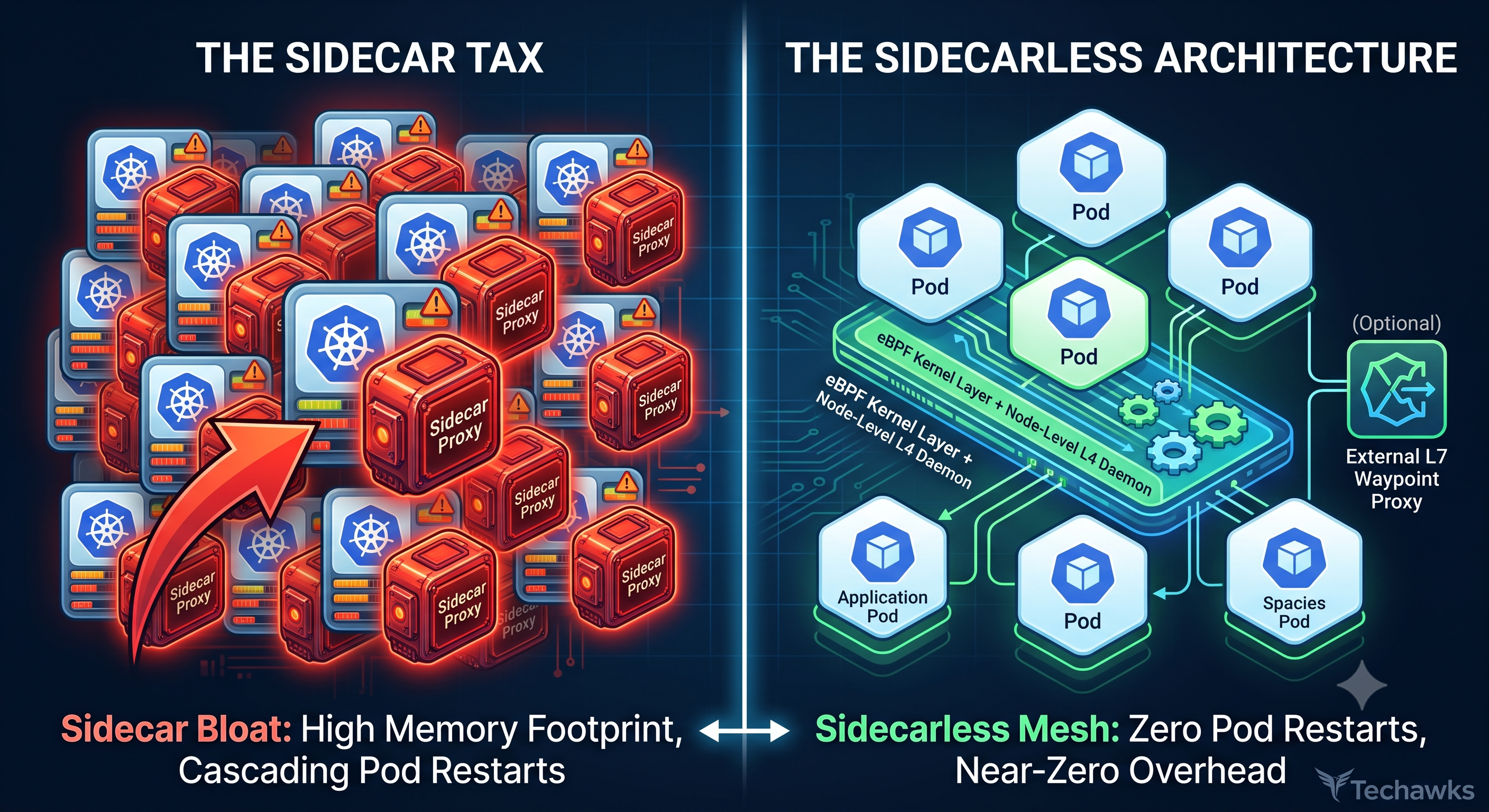
The Resource Penalty: Injecting an Envoy container consuming 50–70 MB of RAM across 1,500 pods means dedicating up to 100 GB of cluster memory solely to duplicate proxy binaries—starving actual business compute.
Lifecycle Coupling: When an Envoy proxy needs a security patch, every application pod across the cluster requires a rolling restart. If a sidecar fails to initialize before the main container, startup crashes and race conditions occur.
The Multi-Hop Latency Spike: Every request traversing microservice boundaries suffers two user-space context switches on both the source and destination pods, adding 2–6 ms of avoidable latency.
How Modern Platform Engineering Replaces Sidecars:
Decouple L4 Encryption from L7 Governance: Adopt sidecarless architectures (such as Istio Ambient Mode). Route Layer 4 mutual TLS through a shared, lightweight node-level daemon (ztunnel), and only deploy Layer 7 waypoint proxies for services that explicitly need advanced routing or header transformation.
Push L4 Policy into the Kernel with eBPF: Leverage eBPF-based datapaths (such as Cilium) to handle socket-level routing, network policy enforcement, and observability directly in kernel space without redirecting packets into user-space proxies.
Eliminate Pod Restart Dependencies: Decoupled networking stacks allow platform teams to upgrade network proxies, security certificates, and CNI layers without restarting production application containers or breaking existing connections.
Discussion Question
Is your platform team still deploying per-pod sidecars for basic mTLS, or have you begun migrating to sidecarless/eBPF-driven networking to cut resource bloat?
CTA
Ready to optimize your Kubernetes infrastructure, eliminate operational overhead, and master cloud-native networking? Join the Cloud, DevOps & Open Source community to share production benchmarks, GitOps patterns, and resilient architectural designs.
For years, the standard pattern for securing microservices in Kubernetes was uniform: inject a dedicated user-space proxy container into every application pod to handle mTLS, observability, and traffic routing.
While battle-tested, the sidecar pattern introduces severe operational drag at scale.
Myth: Running a sidecar proxy in every pod is the only way to achieve strict Zero-Trust mTLS and granular traffic governance in Kubernetes.
Fact: Sidecars waste massive memory reserves, inflate application deployment latency, and bind Layer 4 identity to heavy Layer 7 compute overhead.
Why the traditional sidecar model is hitting an architectural wall:
The Resource Penalty: Injecting an Envoy container consuming 50–70 MB of RAM across 1,500 pods means dedicating up to 100 GB of cluster memory solely to duplicate proxy binaries—starving actual business compute.
Lifecycle Coupling: When an Envoy proxy needs a security patch, every application pod across the cluster requires a rolling restart. If a sidecar fails to initialize before the main container, startup crashes and race conditions occur.
The Multi-Hop Latency Spike: Every request traversing microservice boundaries suffers two user-space context switches on both the source and destination pods, adding 2–6 ms of avoidable latency.
How Modern Platform Engineering Replaces Sidecars:
Decouple L4 Encryption from L7 Governance: Adopt sidecarless architectures (such as Istio Ambient Mode). Route Layer 4 mutual TLS through a shared, lightweight node-level daemon (ztunnel), and only deploy Layer 7 waypoint proxies for services that explicitly need advanced routing or header transformation.
Push L4 Policy into the Kernel with eBPF: Leverage eBPF-based datapaths (such as Cilium) to handle socket-level routing, network policy enforcement, and observability directly in kernel space without redirecting packets into user-space proxies.
Eliminate Pod Restart Dependencies: Decoupled networking stacks allow platform teams to upgrade network proxies, security certificates, and CNI layers without restarting production application containers or breaking existing connections.
Discussion Question
Is your platform team still deploying per-pod sidecars for basic mTLS, or have you begun migrating to sidecarless/eBPF-driven networking to cut resource bloat?
CTA
Ready to optimize your Kubernetes infrastructure, eliminate operational overhead, and master cloud-native networking? Join the Cloud, DevOps & Open Source community to share production benchmarks, GitOps patterns, and resilient architectural designs.
The Sidecar Tax: Why Ambient Mesh and eBPF Are Ending the Proxy-per-Pod Era
For years, the standard pattern for securing microservices in Kubernetes was uniform: inject a dedicated user-space proxy container into every application pod to handle mTLS, observability, and traffic routing.
While battle-tested, the sidecar pattern introduces severe operational drag at scale.
Myth: Running a sidecar proxy in every pod is the only way to achieve strict Zero-Trust mTLS and granular traffic governance in Kubernetes.
Fact: Sidecars waste massive memory reserves, inflate application deployment latency, and bind Layer 4 identity to heavy Layer 7 compute overhead.
Why the traditional sidecar model is hitting an architectural wall:
The Resource Penalty: Injecting an Envoy container consuming 50–70 MB of RAM across 1,500 pods means dedicating up to 100 GB of cluster memory solely to duplicate proxy binaries—starving actual business compute.
Lifecycle Coupling: When an Envoy proxy needs a security patch, every application pod across the cluster requires a rolling restart. If a sidecar fails to initialize before the main container, startup crashes and race conditions occur.
The Multi-Hop Latency Spike: Every request traversing microservice boundaries suffers two user-space context switches on both the source and destination pods, adding 2–6 ms of avoidable latency.
How Modern Platform Engineering Replaces Sidecars:
Decouple L4 Encryption from L7 Governance: Adopt sidecarless architectures (such as Istio Ambient Mode). Route Layer 4 mutual TLS through a shared, lightweight node-level daemon (ztunnel), and only deploy Layer 7 waypoint proxies for services that explicitly need advanced routing or header transformation.
Push L4 Policy into the Kernel with eBPF: Leverage eBPF-based datapaths (such as Cilium) to handle socket-level routing, network policy enforcement, and observability directly in kernel space without redirecting packets into user-space proxies.
Eliminate Pod Restart Dependencies: Decoupled networking stacks allow platform teams to upgrade network proxies, security certificates, and CNI layers without restarting production application containers or breaking existing connections.
Discussion Question
Is your platform team still deploying per-pod sidecars for basic mTLS, or have you begun migrating to sidecarless/eBPF-driven networking to cut resource bloat?
CTA
Ready to optimize your Kubernetes infrastructure, eliminate operational overhead, and master cloud-native networking? Join the Cloud, DevOps & Open Source community to share production benchmarks, GitOps patterns, and resilient architectural designs.

 English
 Arabic
 French
 Spanish
 Portuguese
 Deutsch
 Turkish
 Dutch
Dutch
 Russian
 Romaian
 Portuguese (Brazil)
 Greek
Greek