


Stop Treating Terminal Agents Like Autocomplete: The Real Power of Claude Code
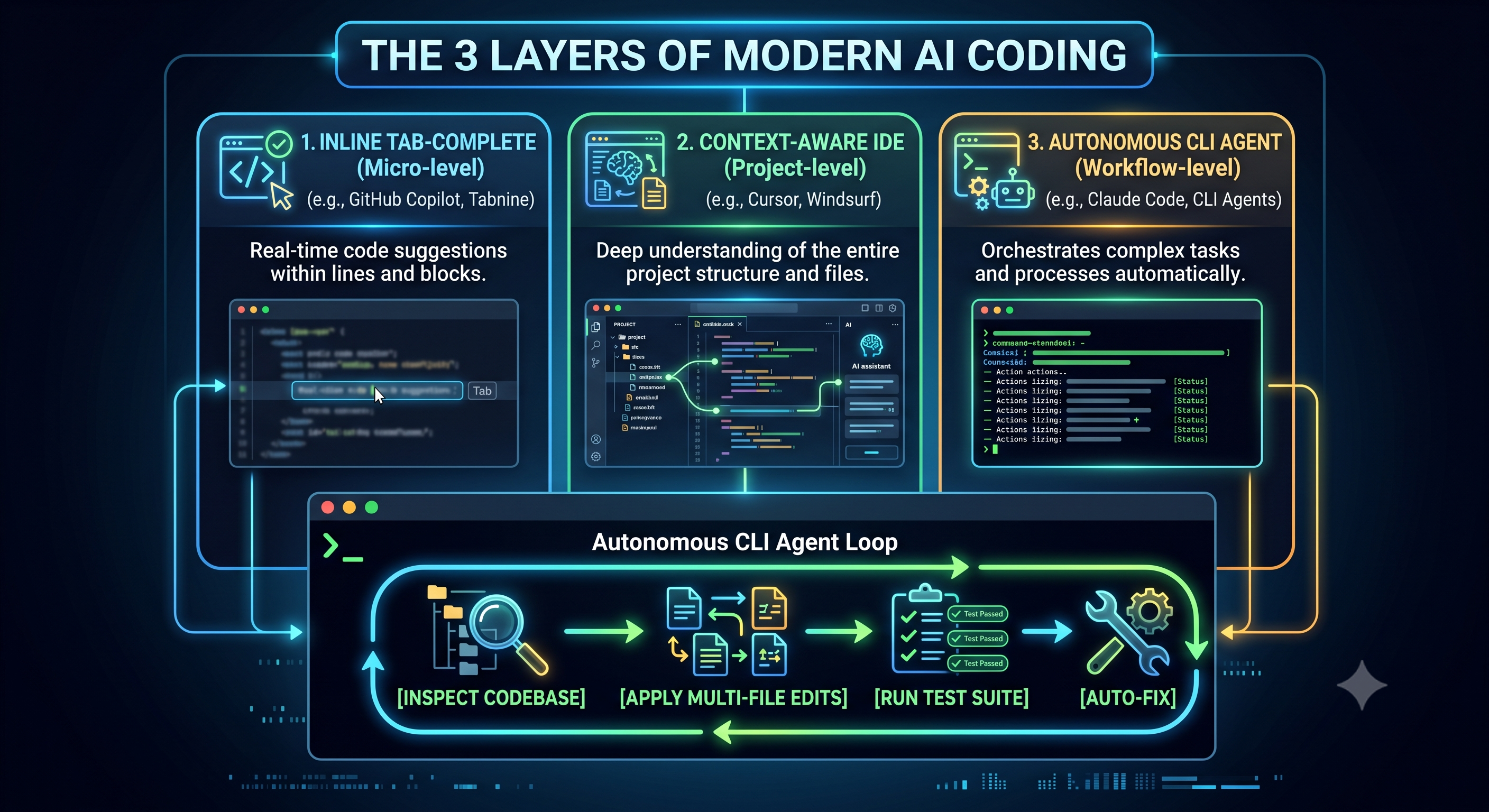
The developer tooling landscape has fractured into three distinct paradigms:
Editor Plugins (Copilot) optimized for localized, line-by-line inline completions.
AI-Native IDE Forks (Cursor, Windsurf) built for cross-file navigation and refactoring.
Autonomous CLI Agents (Claude Code, OpenAI Codex CLI) designed for headless execution and orchestration.
Most engineers test CLI agents once, watch them struggle with ambiguous natural language, and revert to their IDE chat panel. But that misses the architectural design: Terminal agents are not pair programmers; they are junior execution engines.
Why It Matters
A CLI agent has access to your shell, test runners, git history, and build toolchain. When hooked into your terminal, it doesn’t just predict text—it observes build errors, iterates on unit tests, and validates its own diffs before staging a commit.
The Playbook: How to Get Maximum Yield
To move beyond basic prompt-and-pray coding, adopt the Recon → Constrain → Verify pattern:
Step 1: Scoped Architectural Context (Recon)
Never ask a terminal agent to "fix the payment flow." Point it to boundaries:
claude "Inspect /services/billing and /tests/billing. Identify why Stripe webhook retries cause idempotency collisions on duplicate payloads."
Step 2: Constraint-Driven Delegation (Constrain)
Enforce explicit operational rules directly in the prompt or project config:
claude "Refactor the session middleware to use Redis TTLs. Do NOT touch database schema migrations or add third-party dependencies."
Step 3: Autonomous Feedback Loop (Verify)
Leverage shell execution to create self-healing cycles:
claude "Implement the changes, run 'npm test -- --grep billing', and iterate until all tests pass without manual intervention."
The value of an agentic CLI is not speed of typing; it is decoupling yourself from repetitive triage and letting the model close the loop against deterministic tests.
Discussion Question
Are you leaning more toward embedded IDEs (like Cursor) for tight interactive control, or CLI agents (like Claude Code) for end-to-end task delegation? Where has your workflow hit a wall?
CTA
Join Techawks General Community: Connect with software architects, engineers, and tech leaders debating the future of developer tooling
The developer tooling landscape has fractured into three distinct paradigms:
Editor Plugins (Copilot) optimized for localized, line-by-line inline completions.
AI-Native IDE Forks (Cursor, Windsurf) built for cross-file navigation and refactoring.
Autonomous CLI Agents (Claude Code, OpenAI Codex CLI) designed for headless execution and orchestration.
Most engineers test CLI agents once, watch them struggle with ambiguous natural language, and revert to their IDE chat panel. But that misses the architectural design: Terminal agents are not pair programmers; they are junior execution engines.
Why It Matters
A CLI agent has access to your shell, test runners, git history, and build toolchain. When hooked into your terminal, it doesn’t just predict text—it observes build errors, iterates on unit tests, and validates its own diffs before staging a commit.
The Playbook: How to Get Maximum Yield
To move beyond basic prompt-and-pray coding, adopt the Recon → Constrain → Verify pattern:
Step 1: Scoped Architectural Context (Recon)
Never ask a terminal agent to "fix the payment flow." Point it to boundaries:
claude "Inspect /services/billing and /tests/billing. Identify why Stripe webhook retries cause idempotency collisions on duplicate payloads."
Step 2: Constraint-Driven Delegation (Constrain)
Enforce explicit operational rules directly in the prompt or project config:
claude "Refactor the session middleware to use Redis TTLs. Do NOT touch database schema migrations or add third-party dependencies."
Step 3: Autonomous Feedback Loop (Verify)
Leverage shell execution to create self-healing cycles:
claude "Implement the changes, run 'npm test -- --grep billing', and iterate until all tests pass without manual intervention."
The value of an agentic CLI is not speed of typing; it is decoupling yourself from repetitive triage and letting the model close the loop against deterministic tests.
Discussion Question
Are you leaning more toward embedded IDEs (like Cursor) for tight interactive control, or CLI agents (like Claude Code) for end-to-end task delegation? Where has your workflow hit a wall?
CTA
Join Techawks General Community: Connect with software architects, engineers, and tech leaders debating the future of developer tooling
Stop Treating Terminal Agents Like Autocomplete: The Real Power of Claude Code
The developer tooling landscape has fractured into three distinct paradigms:
Editor Plugins (Copilot) optimized for localized, line-by-line inline completions.
AI-Native IDE Forks (Cursor, Windsurf) built for cross-file navigation and refactoring.
Autonomous CLI Agents (Claude Code, OpenAI Codex CLI) designed for headless execution and orchestration.
Most engineers test CLI agents once, watch them struggle with ambiguous natural language, and revert to their IDE chat panel. But that misses the architectural design: Terminal agents are not pair programmers; they are junior execution engines.
Why It Matters
A CLI agent has access to your shell, test runners, git history, and build toolchain. When hooked into your terminal, it doesn’t just predict text—it observes build errors, iterates on unit tests, and validates its own diffs before staging a commit.
The Playbook: How to Get Maximum Yield
To move beyond basic prompt-and-pray coding, adopt the Recon → Constrain → Verify pattern:
Step 1: Scoped Architectural Context (Recon)
Never ask a terminal agent to "fix the payment flow." Point it to boundaries:
claude "Inspect /services/billing and /tests/billing. Identify why Stripe webhook retries cause idempotency collisions on duplicate payloads."
Step 2: Constraint-Driven Delegation (Constrain)
Enforce explicit operational rules directly in the prompt or project config:
claude "Refactor the session middleware to use Redis TTLs. Do NOT touch database schema migrations or add third-party dependencies."
Step 3: Autonomous Feedback Loop (Verify)
Leverage shell execution to create self-healing cycles:
claude "Implement the changes, run 'npm test -- --grep billing', and iterate until all tests pass without manual intervention."
The value of an agentic CLI is not speed of typing; it is decoupling yourself from repetitive triage and letting the model close the loop against deterministic tests.
Discussion Question
Are you leaning more toward embedded IDEs (like Cursor) for tight interactive control, or CLI agents (like Claude Code) for end-to-end task delegation? Where has your workflow hit a wall?
CTA
Join Techawks General Community: Connect with software architects, engineers, and tech leaders debating the future of developer tooling

 Arabic
 French
 Spanish
 Portuguese
 Deutsch
 Turkish
 Dutch
Dutch
 Italiano
 Russian
 Romaian
 Portuguese (Brazil)
 Greek
Greek