


Stop Writing Ad-Hoc SQL for Dashboards: The Skill That Protects Data Careers in the Agentic AI Era
With AI agents and text-to-SQL copilots advancing into production environments, business leaders can increasingly generate standard aggregations and charts on demand.
Yet, enterprise rollouts face a consistent roadblock: hallucinated business logic and metric drift.
When an LLM queries raw tables directly, it often guesses the correct table grain, picks the wrong join path, or computes "Revenue" using five conflicting definitions.
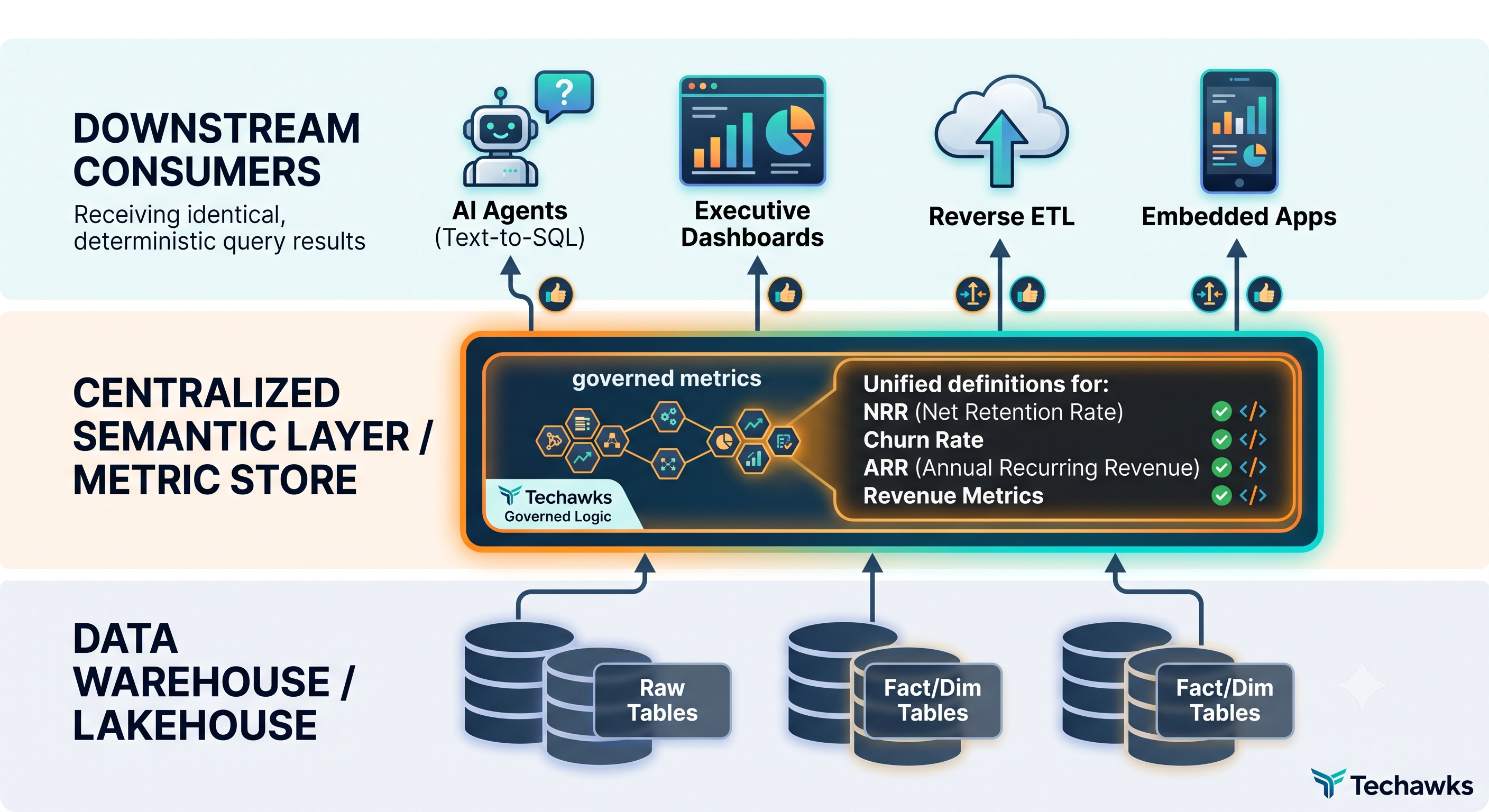
The industry solved this with an abstraction layer: The Modern Semantic Layer (via frameworks like dbt Semantic Layer, Cube, or metric-tree architectures).
Why This Shift Matters for Your Career:
Writing ad-hoc queries makes you a human API router. Modeling governed semantics transforms you into a systems architect.
AI tools cannot independently resolve domain ambiguity without strict constraints. High-earning data practitioners spend less time resolving ad-hoc Slack tickets and more time codifying deterministic business logic.
The Lesson: Build a Governed Semantic Metric
Instead of scattering metric logic across disparate dashboard calculated fields, define metrics centrally using a standard metric specification pattern (such as MetricFlow or YAML-based semantic declarations):
# Example: Defining deterministic logic so both AI & humans compute the identical KPI
metrics:
- name: net_retained_revenue
label: "Net Retained Revenue (NRR)"
description: "Expansion revenue minus churn, divided by starting base."
type: ratio
type_params:
numerator: ending_mrr_retained
denominator: starting_mrr_base
filter: |
customer_tier != 'internal_test'
How to Pivot Your Day-to-Day:
Audit your calculation debt: Identify KPIs currently computed in three separate BI tools with conflicting totals.
Abstract before you visualize: Stop building one-off CTEs. Consolidate your core business entities (Dimensions) and aggregations (Measures) into code-reviewed, version-controlled repository models.
Become the validator of truth: Position yourself as the interface owner who evaluates, tests, and ensures agentic analytics remain reliable and grounded.
Discussion Question
Is your team already centralizing metrics into a standalone semantic layer, or are your critical business definitions still living inside scattered BI dashboards and manual SQL scripts? Let’s talk architecture in the comments.
CTA
Ready to level up from query-runner to data architect? Join Data Science & Analytics at Techawks for hands-on labs, architectural teardowns, and modern data career roadmaps.
With AI agents and text-to-SQL copilots advancing into production environments, business leaders can increasingly generate standard aggregations and charts on demand.
Yet, enterprise rollouts face a consistent roadblock: hallucinated business logic and metric drift.
When an LLM queries raw tables directly, it often guesses the correct table grain, picks the wrong join path, or computes "Revenue" using five conflicting definitions.
The industry solved this with an abstraction layer: The Modern Semantic Layer (via frameworks like dbt Semantic Layer, Cube, or metric-tree architectures).
Why This Shift Matters for Your Career:
Writing ad-hoc queries makes you a human API router. Modeling governed semantics transforms you into a systems architect.
AI tools cannot independently resolve domain ambiguity without strict constraints. High-earning data practitioners spend less time resolving ad-hoc Slack tickets and more time codifying deterministic business logic.
The Lesson: Build a Governed Semantic Metric
Instead of scattering metric logic across disparate dashboard calculated fields, define metrics centrally using a standard metric specification pattern (such as MetricFlow or YAML-based semantic declarations):
# Example: Defining deterministic logic so both AI & humans compute the identical KPI
metrics:
- name: net_retained_revenue
label: "Net Retained Revenue (NRR)"
description: "Expansion revenue minus churn, divided by starting base."
type: ratio
type_params:
numerator: ending_mrr_retained
denominator: starting_mrr_base
filter: |
customer_tier != 'internal_test'
How to Pivot Your Day-to-Day:
Audit your calculation debt: Identify KPIs currently computed in three separate BI tools with conflicting totals.
Abstract before you visualize: Stop building one-off CTEs. Consolidate your core business entities (Dimensions) and aggregations (Measures) into code-reviewed, version-controlled repository models.
Become the validator of truth: Position yourself as the interface owner who evaluates, tests, and ensures agentic analytics remain reliable and grounded.
Discussion Question
Is your team already centralizing metrics into a standalone semantic layer, or are your critical business definitions still living inside scattered BI dashboards and manual SQL scripts? Let’s talk architecture in the comments.
CTA
Ready to level up from query-runner to data architect? Join Data Science & Analytics at Techawks for hands-on labs, architectural teardowns, and modern data career roadmaps.
Stop Writing Ad-Hoc SQL for Dashboards: The Skill That Protects Data Careers in the Agentic AI Era
With AI agents and text-to-SQL copilots advancing into production environments, business leaders can increasingly generate standard aggregations and charts on demand.
Yet, enterprise rollouts face a consistent roadblock: hallucinated business logic and metric drift.
When an LLM queries raw tables directly, it often guesses the correct table grain, picks the wrong join path, or computes "Revenue" using five conflicting definitions.
The industry solved this with an abstraction layer: The Modern Semantic Layer (via frameworks like dbt Semantic Layer, Cube, or metric-tree architectures).
Why This Shift Matters for Your Career:
Writing ad-hoc queries makes you a human API router. Modeling governed semantics transforms you into a systems architect.
AI tools cannot independently resolve domain ambiguity without strict constraints. High-earning data practitioners spend less time resolving ad-hoc Slack tickets and more time codifying deterministic business logic.
The Lesson: Build a Governed Semantic Metric
Instead of scattering metric logic across disparate dashboard calculated fields, define metrics centrally using a standard metric specification pattern (such as MetricFlow or YAML-based semantic declarations):
# Example: Defining deterministic logic so both AI & humans compute the identical KPI
metrics:
- name: net_retained_revenue
label: "Net Retained Revenue (NRR)"
description: "Expansion revenue minus churn, divided by starting base."
type: ratio
type_params:
numerator: ending_mrr_retained
denominator: starting_mrr_base
filter: |
customer_tier != 'internal_test'
How to Pivot Your Day-to-Day:
Audit your calculation debt: Identify KPIs currently computed in three separate BI tools with conflicting totals.
Abstract before you visualize: Stop building one-off CTEs. Consolidate your core business entities (Dimensions) and aggregations (Measures) into code-reviewed, version-controlled repository models.
Become the validator of truth: Position yourself as the interface owner who evaluates, tests, and ensures agentic analytics remain reliable and grounded.
Discussion Question
Is your team already centralizing metrics into a standalone semantic layer, or are your critical business definitions still living inside scattered BI dashboards and manual SQL scripts? Let’s talk architecture in the comments.
CTA
Ready to level up from query-runner to data architect? Join Data Science & Analytics at Techawks for hands-on labs, architectural teardowns, and modern data career roadmaps.

 English
 Arabic
 French
 Spanish
 Portuguese
 Turkish
 Dutch
Dutch
 Italiano
 Russian
 Romaian
 Portuguese (Brazil)
 Greek
Greek