


Why "Ticket-Ops" Is Killing Your Cloud Career (And How Platform Thinking Saves It)
Gartner projected that 80% of large engineering organizations would establish dedicated platform teams by 2026—and looking across modern infrastructure stacks today, that reality is already here.
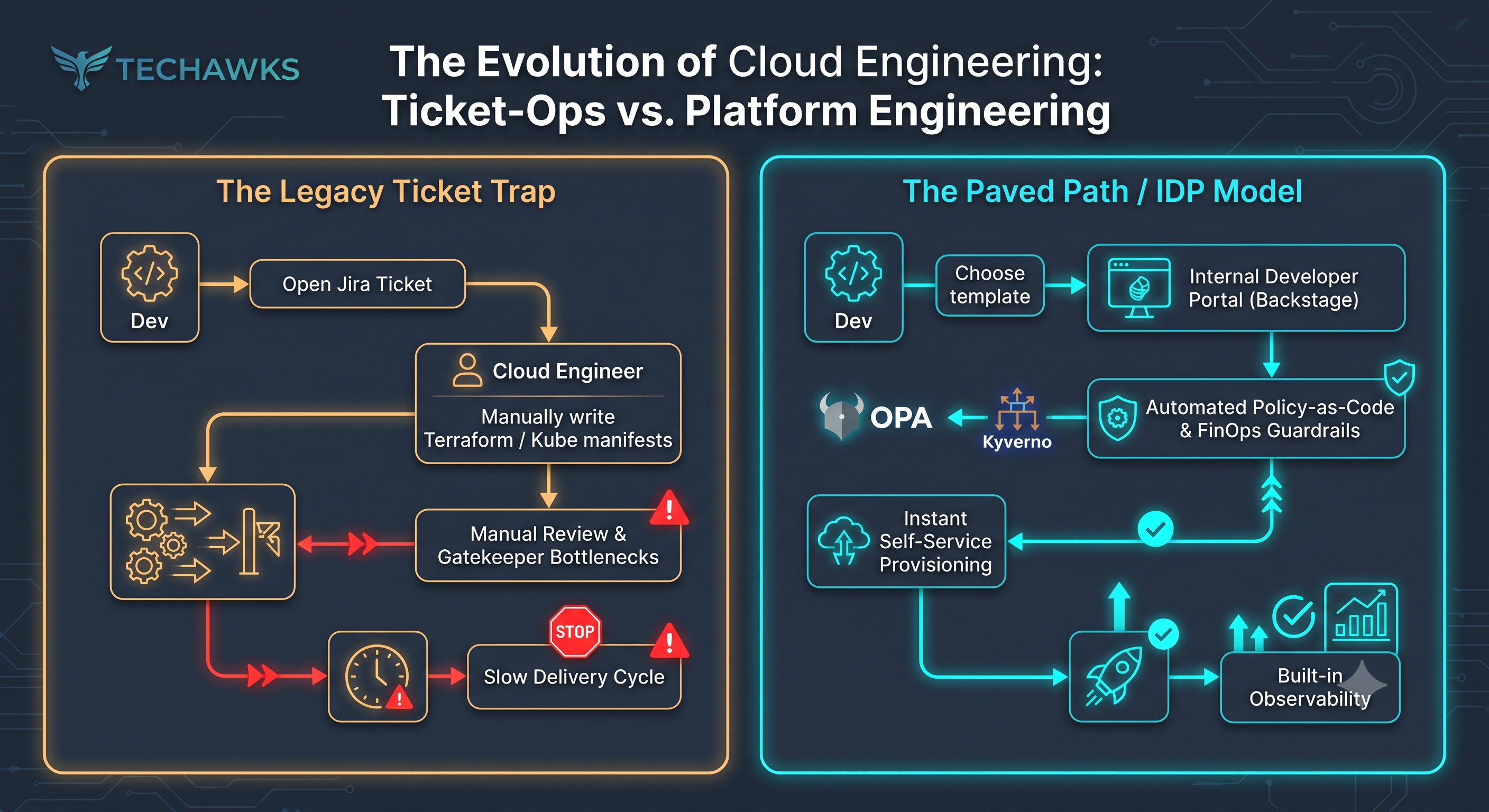
Yet, far too many cloud engineers remain stuck in the "DevOps reactive trap":
A developer needs an RDS cluster or S3 bucket -> They open a Jira ticket.
You manually write HCL, run plan, get sign-off, and apply.
A deployment breaks -> You get paged at 2 AM because nobody else understands the manifest.
This is not DevOps; it is glorified operations disguised as automation.
When AI coding assistants and automation tooling can generate boilerplate Terraform and Kubernetes manifests in seconds, the cloud engineers commanding top-tier career leverage aren’t the ones typing YAML—they are Platform Engineers treating infrastructure as an internal product.
Here is how you shift your career from Reactive Operator to Platform Architect:
1. Stop Provisioning Resources; Start Building "Golden Paths"
Don’t hand developers raw cloud primitives where they can misconfigure security groups or incur run-away costs. Package your architecture into opinionated, self-service templates (via tools like Backstage or custom CLI workflows).
Old way: Manually spinning up an EKS namespace and ingress on request.
New way: Codifying a "Node.js service standard" where a developer runs one command to get repo scaffolding, automated CI/CD, RBAC, and telemetry out of the box.
2. Trade "Manual Gates" for Policy-as-Code & FinOps Guardrails
If you are the human bottleneck reviewing every pull request for IAM least-privilege or cost overruns, you don't scale.
Enforce pre-commit and admission controls (using Kyverno, Open Policy Agent, or Infracost).
Let code linters and CI policies block unencrypted storage or missing resource limits before you ever see a PR.
3. Measure Value by "Developer Cognitive Load," Not Uptime
Uptime is table stakes. High-leverage platform teams measure:
Time to First Deploy: How fast can a new hire ship their first microservice to staging?
Self-Service Adoption: Are engineers choosing your paved path over custom hacky pipelines?
Career Takeaway: Your engineering value is no longer measured by how many cloud resources you personally manage. It’s measured by how many developers can safely deploy to production without ever having to speak with you.
Discussion Question
What is the single biggest bottleneck in your current deployment workflow: slow approval gates, cognitive overload on complex Helm charts, or ticket-driven infrastructure requests?
CTA
Ready to move past reactive DevOps and build scalable internal platforms?
👉 Join Cloud, DevOps & Open Source on Techawks for production architectures, platform engineering blueprints, and open-source tooling breakdowns.
Gartner projected that 80% of large engineering organizations would establish dedicated platform teams by 2026—and looking across modern infrastructure stacks today, that reality is already here.
Yet, far too many cloud engineers remain stuck in the "DevOps reactive trap":
A developer needs an RDS cluster or S3 bucket -> They open a Jira ticket.
You manually write HCL, run plan, get sign-off, and apply.
A deployment breaks -> You get paged at 2 AM because nobody else understands the manifest.
This is not DevOps; it is glorified operations disguised as automation.
When AI coding assistants and automation tooling can generate boilerplate Terraform and Kubernetes manifests in seconds, the cloud engineers commanding top-tier career leverage aren’t the ones typing YAML—they are Platform Engineers treating infrastructure as an internal product.
Here is how you shift your career from Reactive Operator to Platform Architect:
1. Stop Provisioning Resources; Start Building "Golden Paths"
Don’t hand developers raw cloud primitives where they can misconfigure security groups or incur run-away costs. Package your architecture into opinionated, self-service templates (via tools like Backstage or custom CLI workflows).
Old way: Manually spinning up an EKS namespace and ingress on request.
New way: Codifying a "Node.js service standard" where a developer runs one command to get repo scaffolding, automated CI/CD, RBAC, and telemetry out of the box.
2. Trade "Manual Gates" for Policy-as-Code & FinOps Guardrails
If you are the human bottleneck reviewing every pull request for IAM least-privilege or cost overruns, you don't scale.
Enforce pre-commit and admission controls (using Kyverno, Open Policy Agent, or Infracost).
Let code linters and CI policies block unencrypted storage or missing resource limits before you ever see a PR.
3. Measure Value by "Developer Cognitive Load," Not Uptime
Uptime is table stakes. High-leverage platform teams measure:
Time to First Deploy: How fast can a new hire ship their first microservice to staging?
Self-Service Adoption: Are engineers choosing your paved path over custom hacky pipelines?
Career Takeaway: Your engineering value is no longer measured by how many cloud resources you personally manage. It’s measured by how many developers can safely deploy to production without ever having to speak with you.
Discussion Question
What is the single biggest bottleneck in your current deployment workflow: slow approval gates, cognitive overload on complex Helm charts, or ticket-driven infrastructure requests?
CTA
Ready to move past reactive DevOps and build scalable internal platforms?
👉 Join Cloud, DevOps & Open Source on Techawks for production architectures, platform engineering blueprints, and open-source tooling breakdowns.
Why "Ticket-Ops" Is Killing Your Cloud Career (And How Platform Thinking Saves It)
Gartner projected that 80% of large engineering organizations would establish dedicated platform teams by 2026—and looking across modern infrastructure stacks today, that reality is already here.
Yet, far too many cloud engineers remain stuck in the "DevOps reactive trap":
A developer needs an RDS cluster or S3 bucket -> They open a Jira ticket.
You manually write HCL, run plan, get sign-off, and apply.
A deployment breaks -> You get paged at 2 AM because nobody else understands the manifest.
This is not DevOps; it is glorified operations disguised as automation.
When AI coding assistants and automation tooling can generate boilerplate Terraform and Kubernetes manifests in seconds, the cloud engineers commanding top-tier career leverage aren’t the ones typing YAML—they are Platform Engineers treating infrastructure as an internal product.
Here is how you shift your career from Reactive Operator to Platform Architect:
1. Stop Provisioning Resources; Start Building "Golden Paths"
Don’t hand developers raw cloud primitives where they can misconfigure security groups or incur run-away costs. Package your architecture into opinionated, self-service templates (via tools like Backstage or custom CLI workflows).
Old way: Manually spinning up an EKS namespace and ingress on request.
New way: Codifying a "Node.js service standard" where a developer runs one command to get repo scaffolding, automated CI/CD, RBAC, and telemetry out of the box.
2. Trade "Manual Gates" for Policy-as-Code & FinOps Guardrails
If you are the human bottleneck reviewing every pull request for IAM least-privilege or cost overruns, you don't scale.
Enforce pre-commit and admission controls (using Kyverno, Open Policy Agent, or Infracost).
Let code linters and CI policies block unencrypted storage or missing resource limits before you ever see a PR.
3. Measure Value by "Developer Cognitive Load," Not Uptime
Uptime is table stakes. High-leverage platform teams measure:
Time to First Deploy: How fast can a new hire ship their first microservice to staging?
Self-Service Adoption: Are engineers choosing your paved path over custom hacky pipelines?
Career Takeaway: Your engineering value is no longer measured by how many cloud resources you personally manage. It’s measured by how many developers can safely deploy to production without ever having to speak with you.
Discussion Question
What is the single biggest bottleneck in your current deployment workflow: slow approval gates, cognitive overload on complex Helm charts, or ticket-driven infrastructure requests?
CTA
Ready to move past reactive DevOps and build scalable internal platforms?
👉 Join Cloud, DevOps & Open Source on Techawks for production architectures, platform engineering blueprints, and open-source tooling breakdowns.

 English
 Arabic
 French
 Spanish
 Portuguese
 Deutsch
 Turkish
 Dutch
Dutch
 Italiano
 Romaian
 Portuguese (Brazil)
 Greek
Greek