


The 48-Hour Problem Validation Challenge: Test Demand Before You Build
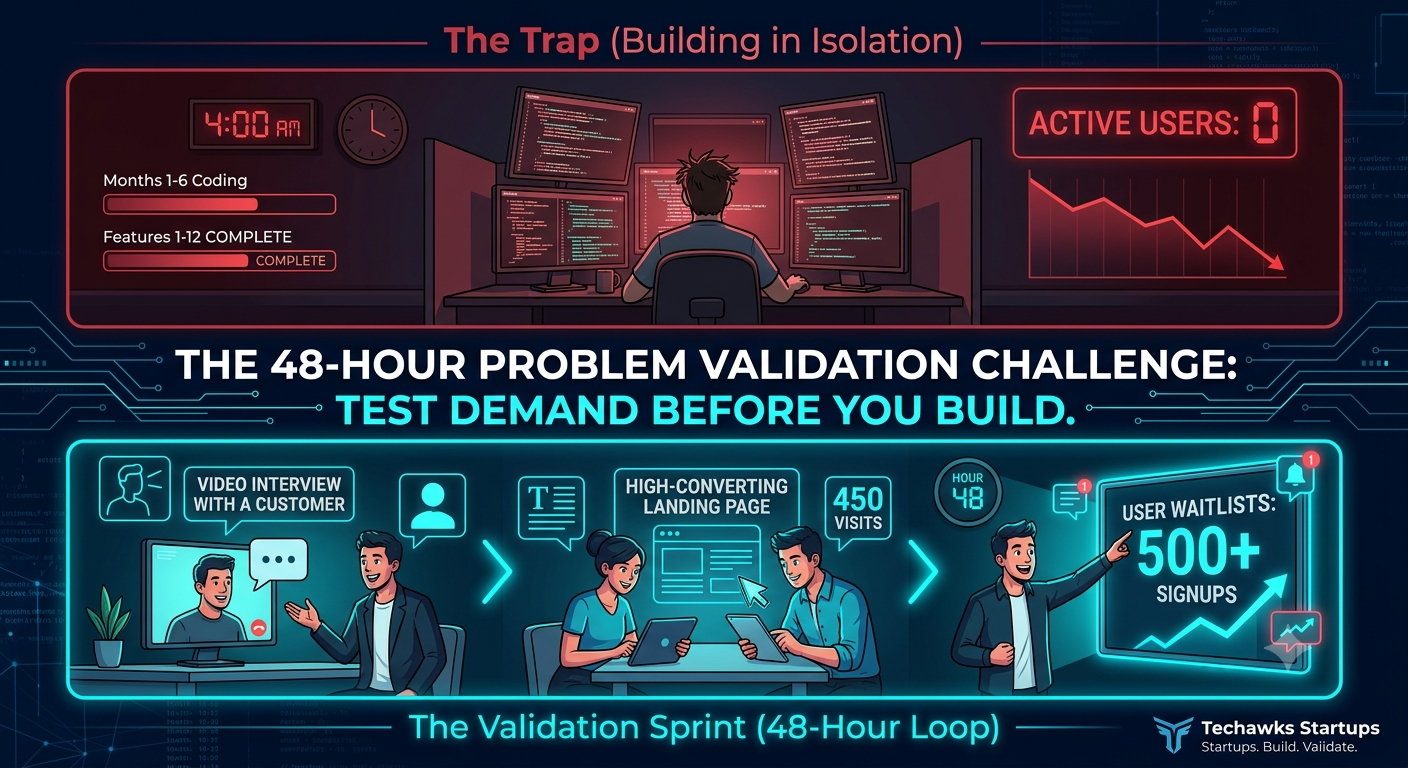
Founders often waste months—and tens of thousands of dollars—building polished Minimum Viable Products (MVPs) only to launch to total silence. True validation doesn't come from positive feedback from friends; it comes from proving that prospective customers feel enough pain to give you their time, data, or money right now.
Here is your 2-day actionable protocol to validate problem-solution fit:
Day 1: Conduct 5 "Mom Test" Customer Interviews
The Challenge: Speak to 5 ideal target users without pitching your product concept once.
The Rules: Talk about their past behaviors and existing workflows, not hypothetical future promises ("Would you use a tool that...?").
Ask: "How do you currently solve [Problem]?" and "How much time or money did that cost you last month?"
The Benchmark: If none of your interviewees have actively spent money or effort trying to fix the problem in the last 90 days, it is a nice-to-have, not a hair-on-fire priority.
Day 2: Launch a Low-Fidelity Smoke Test
The Challenge: Build a simple, single-page landing page explaining your value proposition with a clear call-to-action (CTA).
The Mechanics: Use a no-code builder to launch the page in under 3 hours.
Define a high-intent conversion goal: a paid pre-order, a deposit, or a detailed onboarding questionnaire (not just an email newsletter signup).
Drive 100–200 targeted visitors via direct outreach, niche community posts, or small test ad budgets.
The Benchmark: Aim for a minimum 5% to 10% high-intent conversion rate. If users won't trade contact information or join a waitlist for your core promise, refactoring your messaging or target customer profile is necessary before building.
Key Takeaways
Validate pain, not opinions: Focus on how customers currently solve their problems today rather than asking for opinions on your future product.
Require high-intent skin in the game: Look for validation signals like deposit payments, detailed onboarding forms, or letter-of-intent (LOI) signups.
Speed to insight over perfection: You can validate core demand in 48 hours with low-code tools faster than building a multi-month prototype.
CTA (Join Startup Founders & Entrepreneurs)
Navigating early-stage validation, go-to-market strategies, or fundraising setup? [Join Startup Founders & Entrepreneurs] to swap teardowns, refine pitch decks, and build alongside fellow founders!
Founders often waste months—and tens of thousands of dollars—building polished Minimum Viable Products (MVPs) only to launch to total silence. True validation doesn't come from positive feedback from friends; it comes from proving that prospective customers feel enough pain to give you their time, data, or money right now.
Here is your 2-day actionable protocol to validate problem-solution fit:
Day 1: Conduct 5 "Mom Test" Customer Interviews
The Challenge: Speak to 5 ideal target users without pitching your product concept once.
The Rules: Talk about their past behaviors and existing workflows, not hypothetical future promises ("Would you use a tool that...?").
Ask: "How do you currently solve [Problem]?" and "How much time or money did that cost you last month?"
The Benchmark: If none of your interviewees have actively spent money or effort trying to fix the problem in the last 90 days, it is a nice-to-have, not a hair-on-fire priority.
Day 2: Launch a Low-Fidelity Smoke Test
The Challenge: Build a simple, single-page landing page explaining your value proposition with a clear call-to-action (CTA).
The Mechanics: Use a no-code builder to launch the page in under 3 hours.
Define a high-intent conversion goal: a paid pre-order, a deposit, or a detailed onboarding questionnaire (not just an email newsletter signup).
Drive 100–200 targeted visitors via direct outreach, niche community posts, or small test ad budgets.
The Benchmark: Aim for a minimum 5% to 10% high-intent conversion rate. If users won't trade contact information or join a waitlist for your core promise, refactoring your messaging or target customer profile is necessary before building.
Key Takeaways
Validate pain, not opinions: Focus on how customers currently solve their problems today rather than asking for opinions on your future product.
Require high-intent skin in the game: Look for validation signals like deposit payments, detailed onboarding forms, or letter-of-intent (LOI) signups.
Speed to insight over perfection: You can validate core demand in 48 hours with low-code tools faster than building a multi-month prototype.
CTA (Join Startup Founders & Entrepreneurs)
Navigating early-stage validation, go-to-market strategies, or fundraising setup? [Join Startup Founders & Entrepreneurs] to swap teardowns, refine pitch decks, and build alongside fellow founders!
The 48-Hour Problem Validation Challenge: Test Demand Before You Build
Founders often waste months—and tens of thousands of dollars—building polished Minimum Viable Products (MVPs) only to launch to total silence. True validation doesn't come from positive feedback from friends; it comes from proving that prospective customers feel enough pain to give you their time, data, or money right now.
Here is your 2-day actionable protocol to validate problem-solution fit:
Day 1: Conduct 5 "Mom Test" Customer Interviews
The Challenge: Speak to 5 ideal target users without pitching your product concept once.
The Rules: Talk about their past behaviors and existing workflows, not hypothetical future promises ("Would you use a tool that...?").
Ask: "How do you currently solve [Problem]?" and "How much time or money did that cost you last month?"
The Benchmark: If none of your interviewees have actively spent money or effort trying to fix the problem in the last 90 days, it is a nice-to-have, not a hair-on-fire priority.
Day 2: Launch a Low-Fidelity Smoke Test
The Challenge: Build a simple, single-page landing page explaining your value proposition with a clear call-to-action (CTA).
The Mechanics: Use a no-code builder to launch the page in under 3 hours.
Define a high-intent conversion goal: a paid pre-order, a deposit, or a detailed onboarding questionnaire (not just an email newsletter signup).
Drive 100–200 targeted visitors via direct outreach, niche community posts, or small test ad budgets.
The Benchmark: Aim for a minimum 5% to 10% high-intent conversion rate. If users won't trade contact information or join a waitlist for your core promise, refactoring your messaging or target customer profile is necessary before building.
Key Takeaways
Validate pain, not opinions: Focus on how customers currently solve their problems today rather than asking for opinions on your future product.
Require high-intent skin in the game: Look for validation signals like deposit payments, detailed onboarding forms, or letter-of-intent (LOI) signups.
Speed to insight over perfection: You can validate core demand in 48 hours with low-code tools faster than building a multi-month prototype.
CTA (Join Startup Founders & Entrepreneurs)
Navigating early-stage validation, go-to-market strategies, or fundraising setup? [Join Startup Founders & Entrepreneurs] to swap teardowns, refine pitch decks, and build alongside fellow founders!

 English
 Arabic
 French
 Spanish
 Deutsch
 Turkish
 Dutch
Dutch
 Italiano
 Russian
 Romaian
 Portuguese (Brazil)
 Greek
Greek