


The Death of the Sidecar: Why eBPF is Replacing Heavy Cloud-Native Proxies
For years, implementing a service mesh or deep runtime observability in Kubernetes meant accepting a painful tax: the Sidecar Pattern.
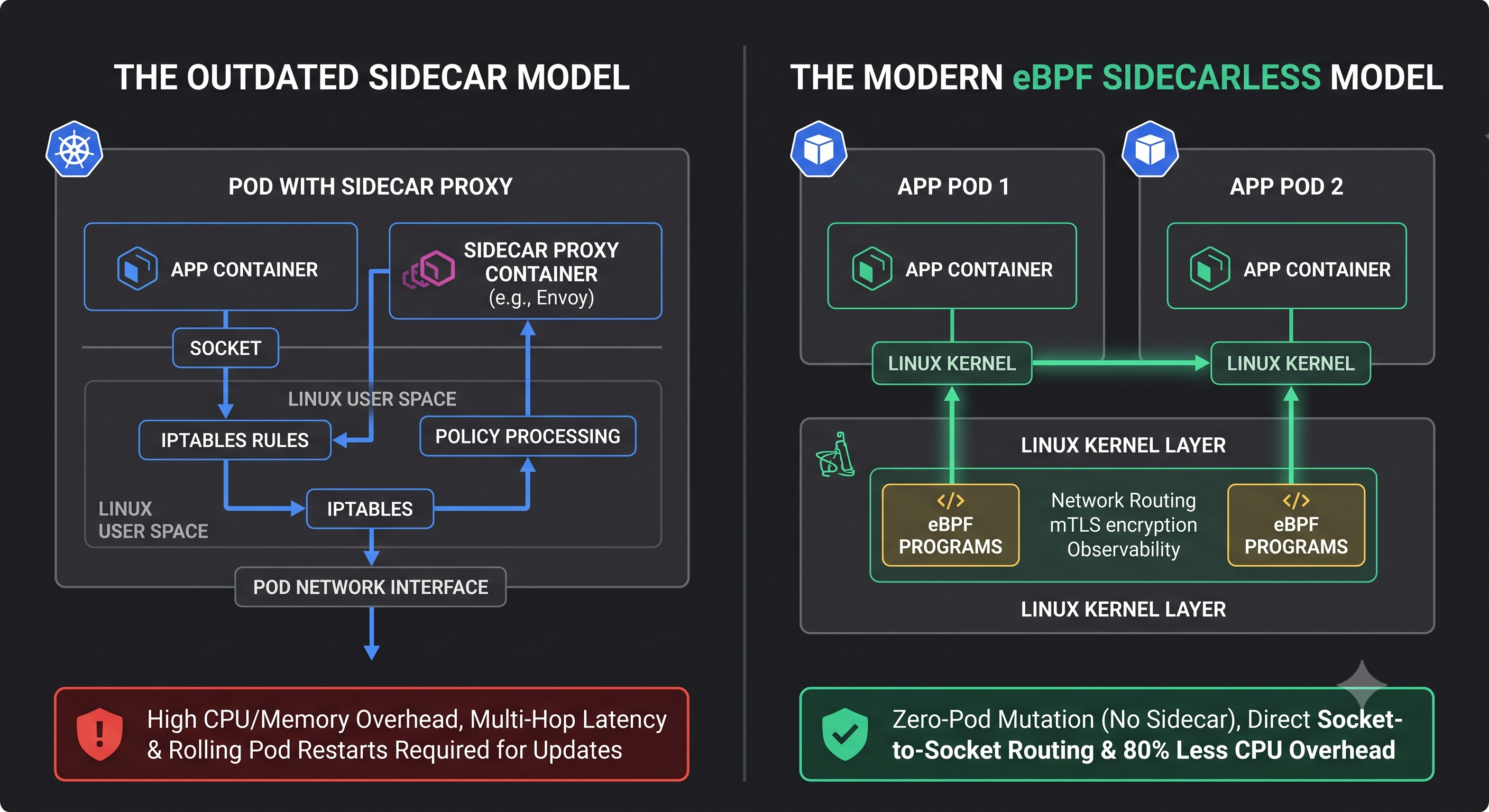
Every application pod ran an accompanying container (like Envoy or a local daemon) intercepting local traffic. At scale, this introduced severe operational drag:
Resource Fragmentation: Thousands of sidecars consume CPU and memory reserves that could run core workloads.
Network Latency: Packets hop through multiple TCP/IP user-space buffers and virtual network interfaces just to move across services.
Lifecycle Headaches: Upgrading sidecar images across hundreds of microservices requires rolling restarts and complex admission controller webhooks.
Modern cloud infrastructure is standardizing around an alternative: Sidecarless Architectures powered by eBPF (Extended Berkeley Packet Filter).
By compiling sandboxed programs directly into the Linux kernel, tools like Cilium handle packet routing, L7 traffic management, and cryptographic microsegmentation at the socket layer.
Here is how modern platform teams transition from proxy overhead to kernel-level performance:
Bypass iptables & Virtual Interfaces: Traditional kube-proxy relies on massive iptables rule-chains that slow down as cluster services grow. eBPF routes packets directly from socket to socket via BPF sockops programs, bypassing network stack bottlenecks.
Sidecarless L7 Governance: Instead of deploying a proxy container alongside every microservice, run a shared node-level proxy managed dynamically by eBPF. The kernel forwards traffic to the local proxy only when deep L7 inspection (HTTP headers, gRPC parsing) is explicitly declared.
Zero-Instrumentation Telemetry: eBPF hooks into kernel system calls (sys_enter, tcp_connect) directly. Observability and security telemetry are gathered across the entire node without touching application code, modifying Dockerfiles, or maintaining daemon sidecars.
Infrastructure efficiency isn’t just about autoscaling compute down; it’s about removing the architectural overhead you never should have deployed in the first place.
Discussion Question
POLL: How is your team currently handling Kubernetes service-to-service networking and observability?
Traditional Sidecar Service Mesh (Istio / Linkerd with injected proxies)
Kernel-level eBPF / Sidecarless mesh (Cilium / Ambient mesh)
Basic Kubernetes CNI + Ingress controllers (no mesh layer)
Managed cloud service provider fabrics (AWS App Mesh / GCP Service Connect)
Cast your vote below and share your latency/cost tradeoffs in the comments!
CTA
Looking to master cloud-native architecture, eBPF internals, and production Kubernetes engineering?
👉 Join Cloud, DevOps & Open Source [link in bio/comments] to trade real cluster post-mortems, GitOps pipelines, and infrastructure playbooks.
For years, implementing a service mesh or deep runtime observability in Kubernetes meant accepting a painful tax: the Sidecar Pattern.
Every application pod ran an accompanying container (like Envoy or a local daemon) intercepting local traffic. At scale, this introduced severe operational drag:
Resource Fragmentation: Thousands of sidecars consume CPU and memory reserves that could run core workloads.
Network Latency: Packets hop through multiple TCP/IP user-space buffers and virtual network interfaces just to move across services.
Lifecycle Headaches: Upgrading sidecar images across hundreds of microservices requires rolling restarts and complex admission controller webhooks.
Modern cloud infrastructure is standardizing around an alternative: Sidecarless Architectures powered by eBPF (Extended Berkeley Packet Filter).
By compiling sandboxed programs directly into the Linux kernel, tools like Cilium handle packet routing, L7 traffic management, and cryptographic microsegmentation at the socket layer.
Here is how modern platform teams transition from proxy overhead to kernel-level performance:
Bypass iptables & Virtual Interfaces: Traditional kube-proxy relies on massive iptables rule-chains that slow down as cluster services grow. eBPF routes packets directly from socket to socket via BPF sockops programs, bypassing network stack bottlenecks.
Sidecarless L7 Governance: Instead of deploying a proxy container alongside every microservice, run a shared node-level proxy managed dynamically by eBPF. The kernel forwards traffic to the local proxy only when deep L7 inspection (HTTP headers, gRPC parsing) is explicitly declared.
Zero-Instrumentation Telemetry: eBPF hooks into kernel system calls (sys_enter, tcp_connect) directly. Observability and security telemetry are gathered across the entire node without touching application code, modifying Dockerfiles, or maintaining daemon sidecars.
Infrastructure efficiency isn’t just about autoscaling compute down; it’s about removing the architectural overhead you never should have deployed in the first place.
Discussion Question
POLL: How is your team currently handling Kubernetes service-to-service networking and observability?
Traditional Sidecar Service Mesh (Istio / Linkerd with injected proxies)
Kernel-level eBPF / Sidecarless mesh (Cilium / Ambient mesh)
Basic Kubernetes CNI + Ingress controllers (no mesh layer)
Managed cloud service provider fabrics (AWS App Mesh / GCP Service Connect)
Cast your vote below and share your latency/cost tradeoffs in the comments!
CTA
Looking to master cloud-native architecture, eBPF internals, and production Kubernetes engineering?
👉 Join Cloud, DevOps & Open Source [link in bio/comments] to trade real cluster post-mortems, GitOps pipelines, and infrastructure playbooks.
The Death of the Sidecar: Why eBPF is Replacing Heavy Cloud-Native Proxies
For years, implementing a service mesh or deep runtime observability in Kubernetes meant accepting a painful tax: the Sidecar Pattern.
Every application pod ran an accompanying container (like Envoy or a local daemon) intercepting local traffic. At scale, this introduced severe operational drag:
Resource Fragmentation: Thousands of sidecars consume CPU and memory reserves that could run core workloads.
Network Latency: Packets hop through multiple TCP/IP user-space buffers and virtual network interfaces just to move across services.
Lifecycle Headaches: Upgrading sidecar images across hundreds of microservices requires rolling restarts and complex admission controller webhooks.
Modern cloud infrastructure is standardizing around an alternative: Sidecarless Architectures powered by eBPF (Extended Berkeley Packet Filter).
By compiling sandboxed programs directly into the Linux kernel, tools like Cilium handle packet routing, L7 traffic management, and cryptographic microsegmentation at the socket layer.
Here is how modern platform teams transition from proxy overhead to kernel-level performance:
Bypass iptables & Virtual Interfaces: Traditional kube-proxy relies on massive iptables rule-chains that slow down as cluster services grow. eBPF routes packets directly from socket to socket via BPF sockops programs, bypassing network stack bottlenecks.
Sidecarless L7 Governance: Instead of deploying a proxy container alongside every microservice, run a shared node-level proxy managed dynamically by eBPF. The kernel forwards traffic to the local proxy only when deep L7 inspection (HTTP headers, gRPC parsing) is explicitly declared.
Zero-Instrumentation Telemetry: eBPF hooks into kernel system calls (sys_enter, tcp_connect) directly. Observability and security telemetry are gathered across the entire node without touching application code, modifying Dockerfiles, or maintaining daemon sidecars.
Infrastructure efficiency isn’t just about autoscaling compute down; it’s about removing the architectural overhead you never should have deployed in the first place.
Discussion Question
POLL: How is your team currently handling Kubernetes service-to-service networking and observability?
Traditional Sidecar Service Mesh (Istio / Linkerd with injected proxies)
Kernel-level eBPF / Sidecarless mesh (Cilium / Ambient mesh)
Basic Kubernetes CNI + Ingress controllers (no mesh layer)
Managed cloud service provider fabrics (AWS App Mesh / GCP Service Connect)
Cast your vote below and share your latency/cost tradeoffs in the comments!
CTA
Looking to master cloud-native architecture, eBPF internals, and production Kubernetes engineering?
👉 Join Cloud, DevOps & Open Source [link in bio/comments] to trade real cluster post-mortems, GitOps pipelines, and infrastructure playbooks.

 English
 Arabic
 French
 Portuguese
 Deutsch
 Turkish
 Dutch
Dutch
 Italiano
 Russian
 Romaian
 Portuguese (Brazil)
 Greek
Greek