


Myth vs. Fact: Does Raising Venture Capital Mean Your Startup Is Successful
In the startup ecosystem, funding announcements are often celebrated like final victories. Founders are showered with congratulations when they secure a seed or Series A round, creating a false impression that capital injection equals validation.
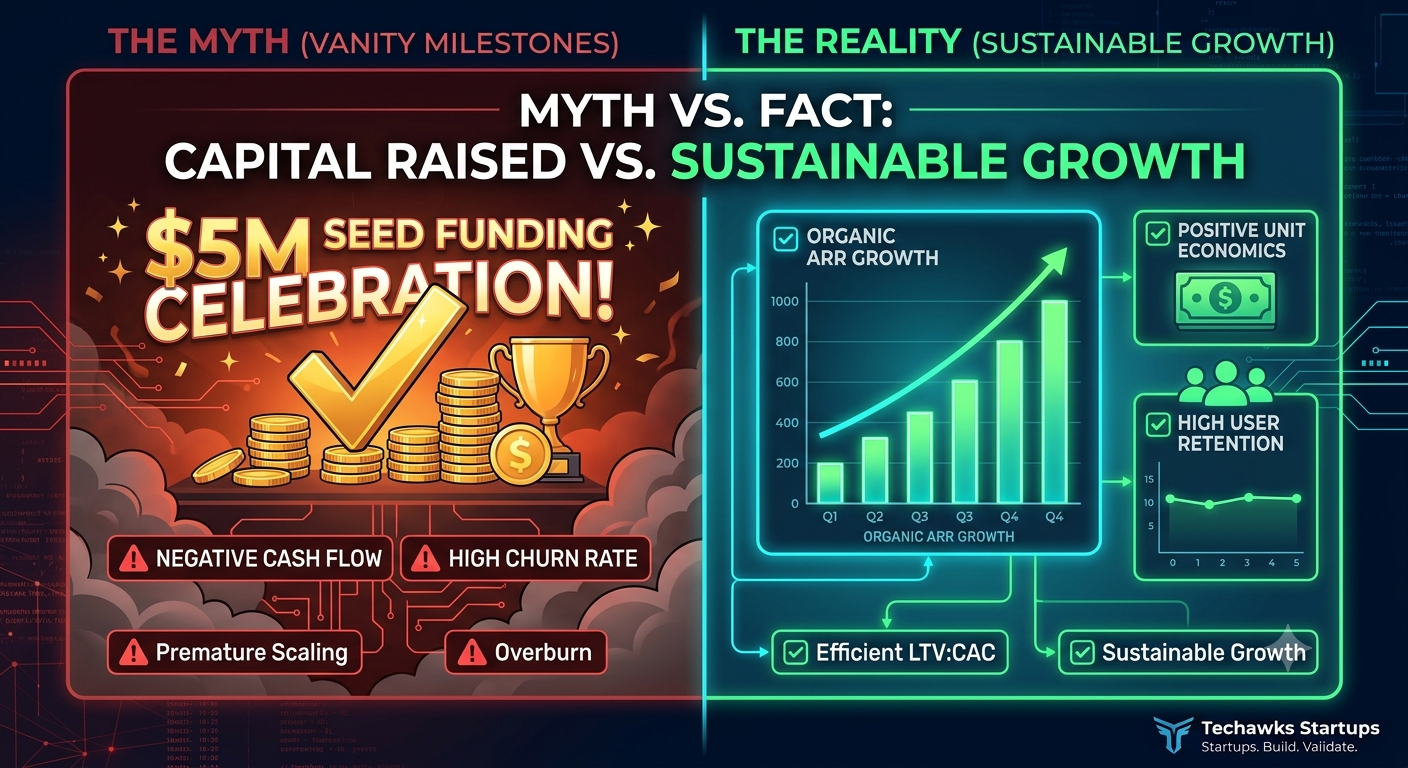
However, venture capital is simply fuel—it accelerates your trajectory in whichever direction you are already heading. Here is the reality behind venture funding vs. building a sustainable business:
Myth #1:
Raising VC funding is the ultimate validation of product-market fit.
Fact: VC funding validates investor appetite for your story, not customer demand for your product.
Why? Venture capitalists invest in potential scale and market size based on early signals. They are not buying or using your product. True product-market fit is proven by strong customer retention, low churn, and organic referral growth.
The Action: Before pitching investors, focus on achieving strong unit economics and high customer retention ($NLR / ARR$ growth). Capital should be used to scale an already proven revenue engine, not to search for one.
Myth #2:
More capital always gives your startup a better chance of survival.
Fact: Overfunding early leads to premature scaling, inflated burn rates, and loss of agility.
Why? Having a large cash cushion often encourages founders to solve structural problems by throwing money at them—hiring too fast or ramping up ad spend before fixing leaky conversion funnels.
The Action: Maintain a lean burn rate even after a successful raise. Set strict metric milestones (e.g., reaching $X$ in ARR at $Y\%$ gross margin) before scaling team headcount or marketing budgets.
Myth #3:
Every high-growth startup should pursue venture capital.
Fact: VC is a specific asset class designed for hyper-growth; many profitable, highly valuable businesses are better suited for bootstrapping or non-dilutive funding.
Why? Taking venture money locks you onto a specific trajectory requiring 10x–100x returns and a liquidity event (IPO or acquisition). If your market size doesn't support that scale, VC alignment breaks down.
The Action: Evaluate your business model objectively. If you can achieve profitability early with high margins, consider bootstrapping, revenue-based financing, or customer-funded growth to retain maximum ownership and control.
Key Takeaways
Funding is a tool, not a milestone: Treat a funding round as a responsibility to deliver returns, not proof of product success.
Prioritize unit economics: Focus on customer retention, lifetime value (LTV), and customer acquisition cost (CAC) over total capital raised.
Choose the right capital structure: Only take VC funding if your business model demands hyper-scale and operates in a massive addressable market.
CTA (Join Startup Founders & Entrepreneurs)
Want to refine your business model, master unit economics, and navigate fundraising with total clarity? [Join Startup Founders & Entrepreneurs] to swap playbooks, join teardown sessions, and build alongside fellow founders!
In the startup ecosystem, funding announcements are often celebrated like final victories. Founders are showered with congratulations when they secure a seed or Series A round, creating a false impression that capital injection equals validation.
However, venture capital is simply fuel—it accelerates your trajectory in whichever direction you are already heading. Here is the reality behind venture funding vs. building a sustainable business:
Myth #1:
Raising VC funding is the ultimate validation of product-market fit.
Fact: VC funding validates investor appetite for your story, not customer demand for your product.
Why? Venture capitalists invest in potential scale and market size based on early signals. They are not buying or using your product. True product-market fit is proven by strong customer retention, low churn, and organic referral growth.
The Action: Before pitching investors, focus on achieving strong unit economics and high customer retention ($NLR / ARR$ growth). Capital should be used to scale an already proven revenue engine, not to search for one.
Myth #2:
More capital always gives your startup a better chance of survival.
Fact: Overfunding early leads to premature scaling, inflated burn rates, and loss of agility.
Why? Having a large cash cushion often encourages founders to solve structural problems by throwing money at them—hiring too fast or ramping up ad spend before fixing leaky conversion funnels.
The Action: Maintain a lean burn rate even after a successful raise. Set strict metric milestones (e.g., reaching $X$ in ARR at $Y\%$ gross margin) before scaling team headcount or marketing budgets.
Myth #3:
Every high-growth startup should pursue venture capital.
Fact: VC is a specific asset class designed for hyper-growth; many profitable, highly valuable businesses are better suited for bootstrapping or non-dilutive funding.
Why? Taking venture money locks you onto a specific trajectory requiring 10x–100x returns and a liquidity event (IPO or acquisition). If your market size doesn't support that scale, VC alignment breaks down.
The Action: Evaluate your business model objectively. If you can achieve profitability early with high margins, consider bootstrapping, revenue-based financing, or customer-funded growth to retain maximum ownership and control.
Key Takeaways
Funding is a tool, not a milestone: Treat a funding round as a responsibility to deliver returns, not proof of product success.
Prioritize unit economics: Focus on customer retention, lifetime value (LTV), and customer acquisition cost (CAC) over total capital raised.
Choose the right capital structure: Only take VC funding if your business model demands hyper-scale and operates in a massive addressable market.
CTA (Join Startup Founders & Entrepreneurs)
Want to refine your business model, master unit economics, and navigate fundraising with total clarity? [Join Startup Founders & Entrepreneurs] to swap playbooks, join teardown sessions, and build alongside fellow founders!
Myth vs. Fact: Does Raising Venture Capital Mean Your Startup Is Successful
In the startup ecosystem, funding announcements are often celebrated like final victories. Founders are showered with congratulations when they secure a seed or Series A round, creating a false impression that capital injection equals validation.
However, venture capital is simply fuel—it accelerates your trajectory in whichever direction you are already heading. Here is the reality behind venture funding vs. building a sustainable business:
Myth #1:
Raising VC funding is the ultimate validation of product-market fit.
Fact: VC funding validates investor appetite for your story, not customer demand for your product.
Why? Venture capitalists invest in potential scale and market size based on early signals. They are not buying or using your product. True product-market fit is proven by strong customer retention, low churn, and organic referral growth.
The Action: Before pitching investors, focus on achieving strong unit economics and high customer retention ($NLR / ARR$ growth). Capital should be used to scale an already proven revenue engine, not to search for one.
Myth #2:
More capital always gives your startup a better chance of survival.
Fact: Overfunding early leads to premature scaling, inflated burn rates, and loss of agility.
Why? Having a large cash cushion often encourages founders to solve structural problems by throwing money at them—hiring too fast or ramping up ad spend before fixing leaky conversion funnels.
The Action: Maintain a lean burn rate even after a successful raise. Set strict metric milestones (e.g., reaching $X$ in ARR at $Y\%$ gross margin) before scaling team headcount or marketing budgets.
Myth #3:
Every high-growth startup should pursue venture capital.
Fact: VC is a specific asset class designed for hyper-growth; many profitable, highly valuable businesses are better suited for bootstrapping or non-dilutive funding.
Why? Taking venture money locks you onto a specific trajectory requiring 10x–100x returns and a liquidity event (IPO or acquisition). If your market size doesn't support that scale, VC alignment breaks down.
The Action: Evaluate your business model objectively. If you can achieve profitability early with high margins, consider bootstrapping, revenue-based financing, or customer-funded growth to retain maximum ownership and control.
Key Takeaways
Funding is a tool, not a milestone: Treat a funding round as a responsibility to deliver returns, not proof of product success.
Prioritize unit economics: Focus on customer retention, lifetime value (LTV), and customer acquisition cost (CAC) over total capital raised.
Choose the right capital structure: Only take VC funding if your business model demands hyper-scale and operates in a massive addressable market.
CTA (Join Startup Founders & Entrepreneurs)
Want to refine your business model, master unit economics, and navigate fundraising with total clarity? [Join Startup Founders & Entrepreneurs] to swap playbooks, join teardown sessions, and build alongside fellow founders!

 English
 Arabic
 French
 Spanish
 Portuguese
 Deutsch
 Turkish
 Italiano
 Russian
 Romaian
 Portuguese (Brazil)
 Greek
Greek