


The Death of the "Mega-Prompt": Why 2026 Belongs to Agent Control Planes & Stateful Orchestration
The enterprise AI shift this week is undeniable: the industry is moving away from monolithic LLM wrappers and toward decoupled Agent Control Planes and multi-agent coordination.
Recent enterprise studies show that while foundation models are more capable than ever, less than a quarter of companies have successfully scaled autonomous AI beyond pilot phases. The bottleneck is rarely the raw model; it is state, orchestration, and governance.
Here is why it matters and how you should redesign your architecture today:
1. The Context Dilution Trap
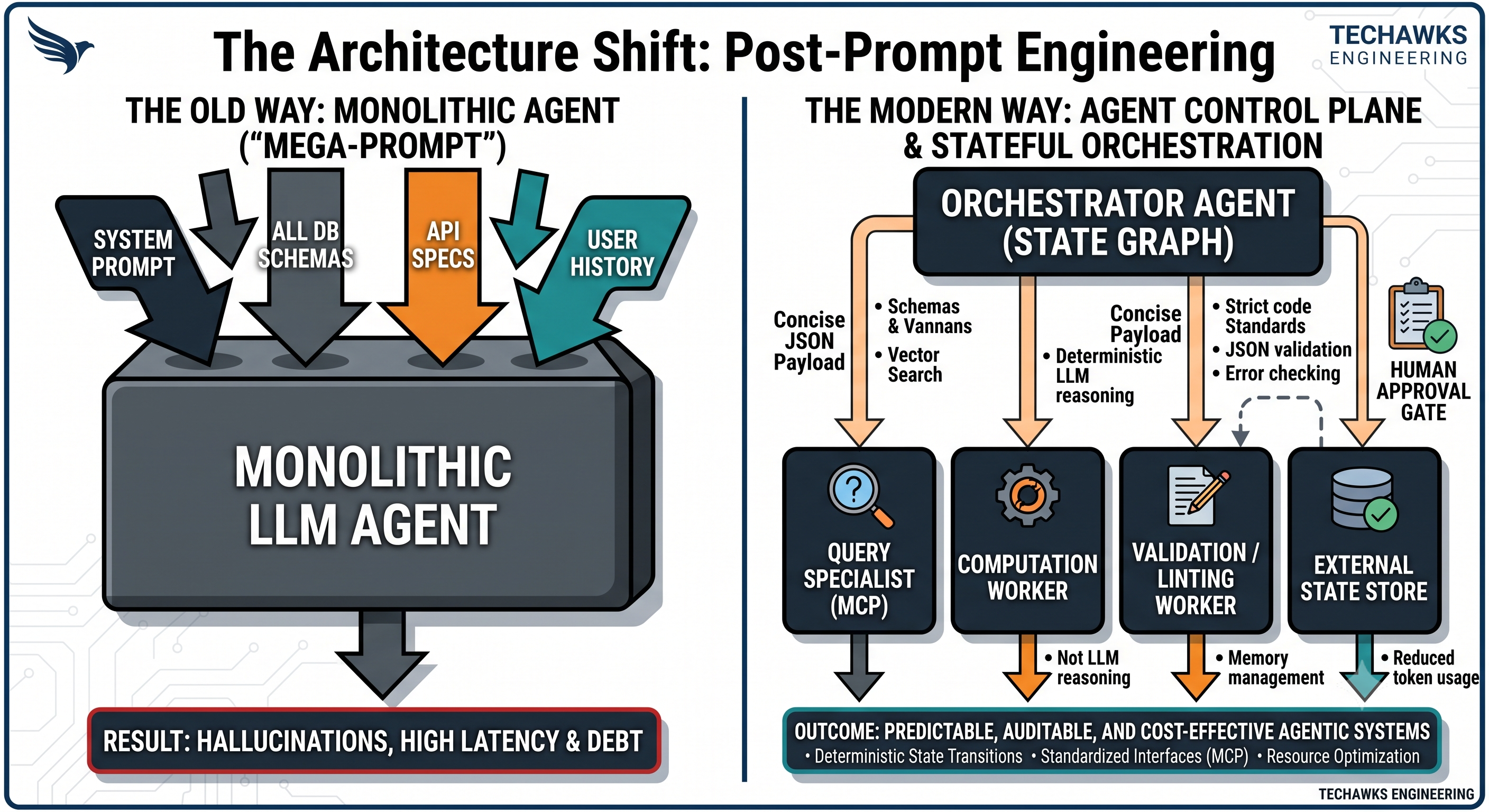
When you force one agent to act as planner, researcher, coder, and auditor within a single session, token noise increases exponentially. Long-context windows may fit the text, but retrieval accuracy and instruction adherence decay ("needle-in-a-haystack" degradation).
2. The Solution: Orchestrator–Worker Architecture
High-performing systems decouple responsibilities into distinct execution contexts:
The Orchestrator: Handles goal decomposition, route selection, and state transitions (e.g., deterministic state graphs like LangGraph or AutoGen). It does not solve problems directly; it routes them.
Specialized Sub-Agents: Single-purpose workers equipped strictly with the tools (via standards like Model Context Protocol / MCP) and context needed for their subtask.
Shared State Memory: A central memory layer (Redis, vector stores, or key-value caches) that persists intermediate outputs without inflating LLM context windows.
3. Practical Architecture Blueprint to Implement Today
Define Deterministic Guardrails First: Don't let agents guess next steps probabilistically. Use finite-state machines (FSM) where critical transitions require hard validations or human-in-the-loop approvals.
Standardize Tool Interfaces: Decouple tools from the model provider. Implement MCP or OpenAPI specs so any model switch requires zero rewrite of your underlying tool integrations.
Add Telemetry & Cost Routers: Put an AI Gateway between your workers and model APIs to dynamically fall back to lightweight models (e.g., small, fast inference models) for deterministic tasks and reserve frontier models only for multi-step reasoning.
The competitive advantage in modern software engineering is no longer who accesses the best weights—it is who designs the cleanest orchestration layer.
Discussion Question
Is your team still relying on monolithic prompt pipelines, or have you migrated to multi-agent state machines? What has been your biggest challenge with agent state drift in production?
CTA
Level up your engineering stack with Techawks.
Join the Techawks General Community on Discord & LinkedIn to access open architecture blueprints, production case studies, and live technical teardowns with fellow software architects and AI engineers
The enterprise AI shift this week is undeniable: the industry is moving away from monolithic LLM wrappers and toward decoupled Agent Control Planes and multi-agent coordination.
Recent enterprise studies show that while foundation models are more capable than ever, less than a quarter of companies have successfully scaled autonomous AI beyond pilot phases. The bottleneck is rarely the raw model; it is state, orchestration, and governance.
Here is why it matters and how you should redesign your architecture today:
1. The Context Dilution Trap
When you force one agent to act as planner, researcher, coder, and auditor within a single session, token noise increases exponentially. Long-context windows may fit the text, but retrieval accuracy and instruction adherence decay ("needle-in-a-haystack" degradation).
2. The Solution: Orchestrator–Worker Architecture
High-performing systems decouple responsibilities into distinct execution contexts:
The Orchestrator: Handles goal decomposition, route selection, and state transitions (e.g., deterministic state graphs like LangGraph or AutoGen). It does not solve problems directly; it routes them.
Specialized Sub-Agents: Single-purpose workers equipped strictly with the tools (via standards like Model Context Protocol / MCP) and context needed for their subtask.
Shared State Memory: A central memory layer (Redis, vector stores, or key-value caches) that persists intermediate outputs without inflating LLM context windows.
3. Practical Architecture Blueprint to Implement Today
Define Deterministic Guardrails First: Don't let agents guess next steps probabilistically. Use finite-state machines (FSM) where critical transitions require hard validations or human-in-the-loop approvals.
Standardize Tool Interfaces: Decouple tools from the model provider. Implement MCP or OpenAPI specs so any model switch requires zero rewrite of your underlying tool integrations.
Add Telemetry & Cost Routers: Put an AI Gateway between your workers and model APIs to dynamically fall back to lightweight models (e.g., small, fast inference models) for deterministic tasks and reserve frontier models only for multi-step reasoning.
The competitive advantage in modern software engineering is no longer who accesses the best weights—it is who designs the cleanest orchestration layer.
Discussion Question
Is your team still relying on monolithic prompt pipelines, or have you migrated to multi-agent state machines? What has been your biggest challenge with agent state drift in production?
CTA
Level up your engineering stack with Techawks.
Join the Techawks General Community on Discord & LinkedIn to access open architecture blueprints, production case studies, and live technical teardowns with fellow software architects and AI engineers
The Death of the "Mega-Prompt": Why 2026 Belongs to Agent Control Planes & Stateful Orchestration
The enterprise AI shift this week is undeniable: the industry is moving away from monolithic LLM wrappers and toward decoupled Agent Control Planes and multi-agent coordination.
Recent enterprise studies show that while foundation models are more capable than ever, less than a quarter of companies have successfully scaled autonomous AI beyond pilot phases. The bottleneck is rarely the raw model; it is state, orchestration, and governance.
Here is why it matters and how you should redesign your architecture today:
1. The Context Dilution Trap
When you force one agent to act as planner, researcher, coder, and auditor within a single session, token noise increases exponentially. Long-context windows may fit the text, but retrieval accuracy and instruction adherence decay ("needle-in-a-haystack" degradation).
2. The Solution: Orchestrator–Worker Architecture
High-performing systems decouple responsibilities into distinct execution contexts:
The Orchestrator: Handles goal decomposition, route selection, and state transitions (e.g., deterministic state graphs like LangGraph or AutoGen). It does not solve problems directly; it routes them.
Specialized Sub-Agents: Single-purpose workers equipped strictly with the tools (via standards like Model Context Protocol / MCP) and context needed for their subtask.
Shared State Memory: A central memory layer (Redis, vector stores, or key-value caches) that persists intermediate outputs without inflating LLM context windows.
3. Practical Architecture Blueprint to Implement Today
Define Deterministic Guardrails First: Don't let agents guess next steps probabilistically. Use finite-state machines (FSM) where critical transitions require hard validations or human-in-the-loop approvals.
Standardize Tool Interfaces: Decouple tools from the model provider. Implement MCP or OpenAPI specs so any model switch requires zero rewrite of your underlying tool integrations.
Add Telemetry & Cost Routers: Put an AI Gateway between your workers and model APIs to dynamically fall back to lightweight models (e.g., small, fast inference models) for deterministic tasks and reserve frontier models only for multi-step reasoning.
The competitive advantage in modern software engineering is no longer who accesses the best weights—it is who designs the cleanest orchestration layer.
Discussion Question
Is your team still relying on monolithic prompt pipelines, or have you migrated to multi-agent state machines? What has been your biggest challenge with agent state drift in production?
CTA
Level up your engineering stack with Techawks.
Join the Techawks General Community on Discord & LinkedIn to access open architecture blueprints, production case studies, and live technical teardowns with fellow software architects and AI engineers

 English
 Arabic
 French
 Spanish
 Portuguese
 Deutsch
 Turkish
 Dutch
Dutch
 Italiano
 Romaian
 Portuguese (Brazil)
 Greek
Greek