


Tool Review: Analytics vs. Attribution Tools — Choosing the Right Stack for Early-Stage Startups
In the early days of a startup, founders often assume a single tool can track everything from top-of-funnel ad clicks down to feature engagement. In reality, modern startup growth relies on two distinct classes of software that answer entirely different business questions.
Deploying the wrong tool at the wrong stage can lead to bloat, security risks, and decision paralysis. Here is how to evaluate and choose between them:
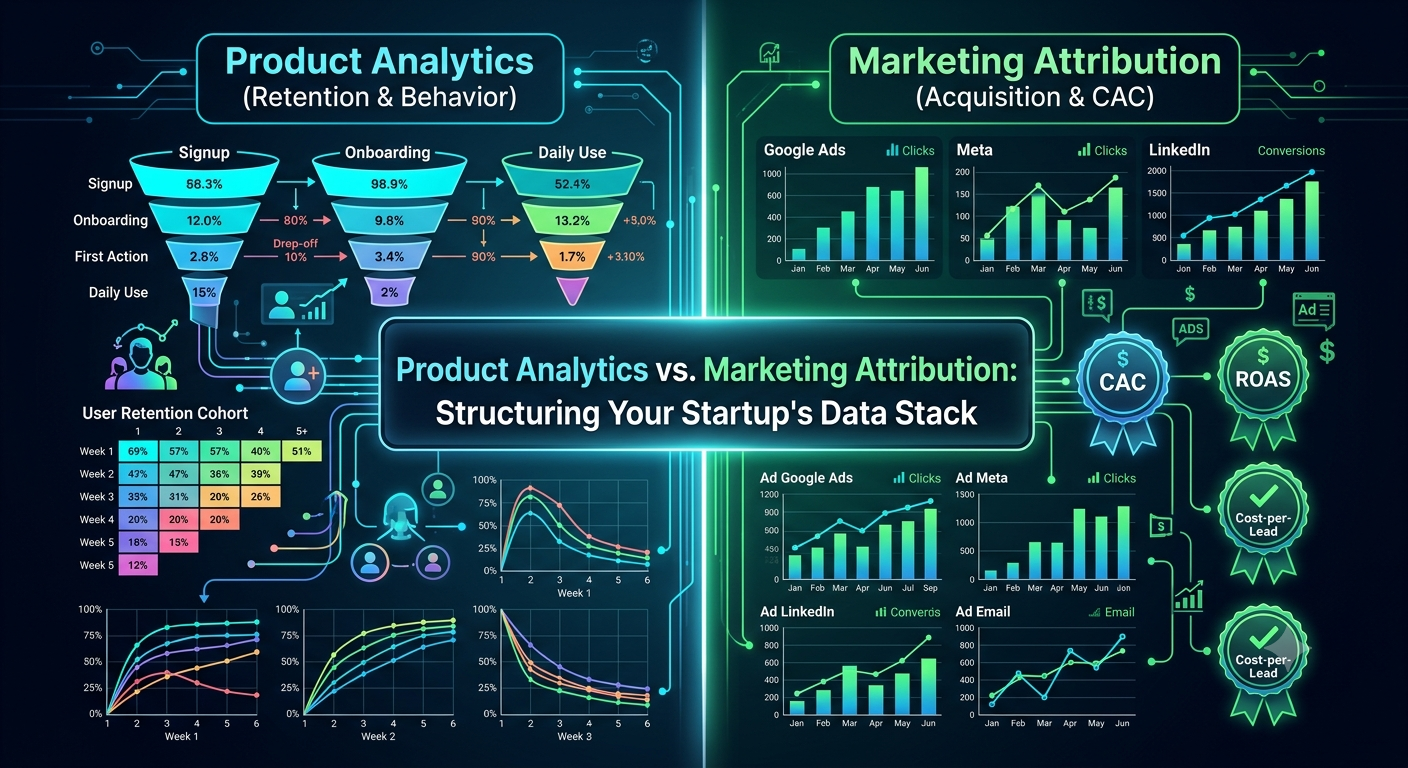
1. Product Analytics Tools (e.g., Mixpanel, PostHog, Amplitude)
Primary Focus: In-product user behavior, funnel drop-offs, and feature retention.
Key Metrics Tracked: Daily/Monthly Active Users (DAU/MAU), conversion funnels, retention cohorts, feature usage rates.
When to Deploy: Day 1 of Product Launch. You need visibility into where users drop off during onboarding and which features drive recurring usage.
Strengths: Event-based tracking built specifically for web and mobile apps.
Deep cohort retention analysis to prove true Product-Market Fit (PMF).
Limitations: Weak at tracking off-platform touchpoints, ad network campaigns, and multi-channel marketing attribution.
Actionable Advice: Start with a privacy-friendly or open-source tool like PostHog or Mixpanel’s free tier. Focus on tracking no more than 5 core event actions (e.g., user_signed_up, first_project_created) before building out complex taxonomy.
2. Marketing Attribution Platforms (e.g., Google Analytics 4, HockeyStack, Hyros)
Primary Focus: Acquisition channels, campaign performance, and top-of-funnel conversion rates.
Key Metrics Tracked: Customer Acquisition Cost (CAC), Return on Ad Spend (ROAS), channel traffic sources, multi-touch attribution.
When to Deploy: When Scaling Paid Growth. Only invest heavily here once you have validated retention and are actively spending on paid acquisition across multiple channels.
Strengths: Connects ad spending across networks (Meta, Google, LinkedIn) to landing page conversions.
Helps optimize marketing budgets and campaign targeting.
Limitations: Provides zero insight into what users do inside your application after they create an account.
Actionable Advice: Avoid buying enterprise-grade attribution software too early. Standard UTM parameter discipline combined with clean GA4 tracking is sufficient until your paid marketing budget exceeds $5,000/month.
Key Takeaways
Product Analytics comes first: Prove that users keep coming back to your product before spending money on tools to scale marketing acquisition.
Keep event tracking lean: Map out a clean, minimal schema of core user actions rather than auto-capturing hundreds of unused events.
Match tools to growth stages: Stick to simple UTM tracking and free tiers until paid acquisition scales enough to justify specialized attribution tools.
CTA (Join Startup Founders & Entrepreneurs)
Looking to optimize your startup’s tech stack, refine your growth metrics, and avoid costly early-stage mistakes? [Join Startup Founders & Entrepreneurs] to swap software playbooks, participate in stack reviews, and scale alongside fellow founders!
In the early days of a startup, founders often assume a single tool can track everything from top-of-funnel ad clicks down to feature engagement. In reality, modern startup growth relies on two distinct classes of software that answer entirely different business questions.
Deploying the wrong tool at the wrong stage can lead to bloat, security risks, and decision paralysis. Here is how to evaluate and choose between them:
1. Product Analytics Tools (e.g., Mixpanel, PostHog, Amplitude)
Primary Focus: In-product user behavior, funnel drop-offs, and feature retention.
Key Metrics Tracked: Daily/Monthly Active Users (DAU/MAU), conversion funnels, retention cohorts, feature usage rates.
When to Deploy: Day 1 of Product Launch. You need visibility into where users drop off during onboarding and which features drive recurring usage.
Strengths: Event-based tracking built specifically for web and mobile apps.
Deep cohort retention analysis to prove true Product-Market Fit (PMF).
Limitations: Weak at tracking off-platform touchpoints, ad network campaigns, and multi-channel marketing attribution.
Actionable Advice: Start with a privacy-friendly or open-source tool like PostHog or Mixpanel’s free tier. Focus on tracking no more than 5 core event actions (e.g., user_signed_up, first_project_created) before building out complex taxonomy.
2. Marketing Attribution Platforms (e.g., Google Analytics 4, HockeyStack, Hyros)
Primary Focus: Acquisition channels, campaign performance, and top-of-funnel conversion rates.
Key Metrics Tracked: Customer Acquisition Cost (CAC), Return on Ad Spend (ROAS), channel traffic sources, multi-touch attribution.
When to Deploy: When Scaling Paid Growth. Only invest heavily here once you have validated retention and are actively spending on paid acquisition across multiple channels.
Strengths: Connects ad spending across networks (Meta, Google, LinkedIn) to landing page conversions.
Helps optimize marketing budgets and campaign targeting.
Limitations: Provides zero insight into what users do inside your application after they create an account.
Actionable Advice: Avoid buying enterprise-grade attribution software too early. Standard UTM parameter discipline combined with clean GA4 tracking is sufficient until your paid marketing budget exceeds $5,000/month.
Key Takeaways
Product Analytics comes first: Prove that users keep coming back to your product before spending money on tools to scale marketing acquisition.
Keep event tracking lean: Map out a clean, minimal schema of core user actions rather than auto-capturing hundreds of unused events.
Match tools to growth stages: Stick to simple UTM tracking and free tiers until paid acquisition scales enough to justify specialized attribution tools.
CTA (Join Startup Founders & Entrepreneurs)
Looking to optimize your startup’s tech stack, refine your growth metrics, and avoid costly early-stage mistakes? [Join Startup Founders & Entrepreneurs] to swap software playbooks, participate in stack reviews, and scale alongside fellow founders!
Tool Review: Analytics vs. Attribution Tools — Choosing the Right Stack for Early-Stage Startups
In the early days of a startup, founders often assume a single tool can track everything from top-of-funnel ad clicks down to feature engagement. In reality, modern startup growth relies on two distinct classes of software that answer entirely different business questions.
Deploying the wrong tool at the wrong stage can lead to bloat, security risks, and decision paralysis. Here is how to evaluate and choose between them:
1. Product Analytics Tools (e.g., Mixpanel, PostHog, Amplitude)
Primary Focus: In-product user behavior, funnel drop-offs, and feature retention.
Key Metrics Tracked: Daily/Monthly Active Users (DAU/MAU), conversion funnels, retention cohorts, feature usage rates.
When to Deploy: Day 1 of Product Launch. You need visibility into where users drop off during onboarding and which features drive recurring usage.
Strengths: Event-based tracking built specifically for web and mobile apps.
Deep cohort retention analysis to prove true Product-Market Fit (PMF).
Limitations: Weak at tracking off-platform touchpoints, ad network campaigns, and multi-channel marketing attribution.
Actionable Advice: Start with a privacy-friendly or open-source tool like PostHog or Mixpanel’s free tier. Focus on tracking no more than 5 core event actions (e.g., user_signed_up, first_project_created) before building out complex taxonomy.
2. Marketing Attribution Platforms (e.g., Google Analytics 4, HockeyStack, Hyros)
Primary Focus: Acquisition channels, campaign performance, and top-of-funnel conversion rates.
Key Metrics Tracked: Customer Acquisition Cost (CAC), Return on Ad Spend (ROAS), channel traffic sources, multi-touch attribution.
When to Deploy: When Scaling Paid Growth. Only invest heavily here once you have validated retention and are actively spending on paid acquisition across multiple channels.
Strengths: Connects ad spending across networks (Meta, Google, LinkedIn) to landing page conversions.
Helps optimize marketing budgets and campaign targeting.
Limitations: Provides zero insight into what users do inside your application after they create an account.
Actionable Advice: Avoid buying enterprise-grade attribution software too early. Standard UTM parameter discipline combined with clean GA4 tracking is sufficient until your paid marketing budget exceeds $5,000/month.
Key Takeaways
Product Analytics comes first: Prove that users keep coming back to your product before spending money on tools to scale marketing acquisition.
Keep event tracking lean: Map out a clean, minimal schema of core user actions rather than auto-capturing hundreds of unused events.
Match tools to growth stages: Stick to simple UTM tracking and free tiers until paid acquisition scales enough to justify specialized attribution tools.
CTA (Join Startup Founders & Entrepreneurs)
Looking to optimize your startup’s tech stack, refine your growth metrics, and avoid costly early-stage mistakes? [Join Startup Founders & Entrepreneurs] to swap software playbooks, participate in stack reviews, and scale alongside fellow founders!

 English
 Arabic
 French
 Spanish
 Deutsch
 Turkish
 Dutch
Dutch
 Italiano
 Russian
 Romaian
 Portuguese (Brazil)
 Greek
Greek