


The Seat-Based Cannibalization Paradox: Why Your AI Agent Is Killing Your ARR
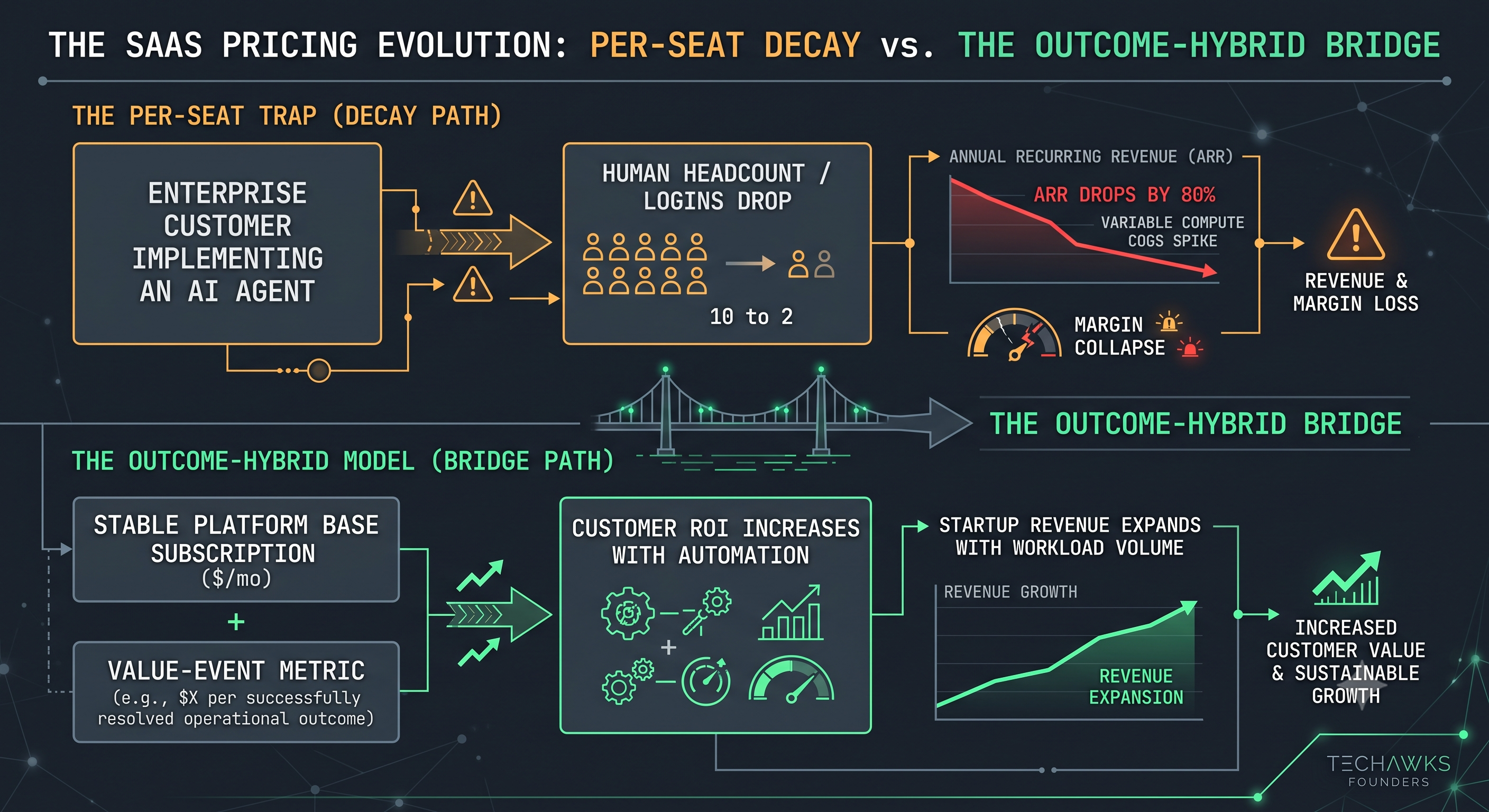
For two decades, the B2B SaaS playbook was straightforward: hire more employees $\to$ buy more licenses $\to$ expand Annual Recurring Revenue (ARR).AI agents destroy this correlation. When your product successfully completes the work of three human operators, your customer doesn’t add three seats next quarter—they downgrade their tier or consolidate logins.
At the same time, your marginal COGS explode. A human user clicking through a dashboard costs pennies in database queries; an agent running multi-step reasoning, vector retrieval, and third-party API tool calls introduces real variable compute costs. If seat counts shrink while inference consumption surges, gross margins collapse.
The Fix: Architecting the Outcome-Hybrid Pricing Model Startups surviving this shift are moving away from pure per-seat licensing to hybrid, outcome-aligned monetization:
Anchor with a Platform Base Fee: Maintain baseline ARR predictability with a recurring subscription fee for access, security, compliance, and core workflow persistence.
Price the "Value Event," Not the API Token: Charging customers per raw input/output token or compute-minute transfers technical volatility to the buyer and creates friction. Instead, charge for verified unit work (e.g., qualified leads routed, support tickets resolved without human escalation, pull requests merged, or invoices reconciled).Instrument Attribution Telemetry First:
You cannot bill for outcomes you cannot deterministically prove. Build an immutable telemetry log into your execution engine that captures the baseline state, the agent's action, and verifiable completion criteria before billing against it.
Implement Customer-Side Margin Guardrails: Enterprise procurement teams panic at uncapped usage. Protect both sides by offering tiered credit commitments, overage bands, and auto-pause spending caps.Discussion QuestionFor founders and operators: What value metric are you tying your pricing to right now? Have you already begun transitioning away from per-seat subscriptions to hybrid or outcome-based billing, or are enterprise buyers still demanding fixed seat predictability?
CTA
Drop your real-world monetization lessons in the comments! Whether you've successfully rolled out consumption credits or faced enterprise pushback on outcome billing, share what worked and what broke for your startup.
For two decades, the B2B SaaS playbook was straightforward: hire more employees $\to$ buy more licenses $\to$ expand Annual Recurring Revenue (ARR).AI agents destroy this correlation. When your product successfully completes the work of three human operators, your customer doesn’t add three seats next quarter—they downgrade their tier or consolidate logins.
At the same time, your marginal COGS explode. A human user clicking through a dashboard costs pennies in database queries; an agent running multi-step reasoning, vector retrieval, and third-party API tool calls introduces real variable compute costs. If seat counts shrink while inference consumption surges, gross margins collapse.
The Fix: Architecting the Outcome-Hybrid Pricing Model Startups surviving this shift are moving away from pure per-seat licensing to hybrid, outcome-aligned monetization:
Anchor with a Platform Base Fee: Maintain baseline ARR predictability with a recurring subscription fee for access, security, compliance, and core workflow persistence.
Price the "Value Event," Not the API Token: Charging customers per raw input/output token or compute-minute transfers technical volatility to the buyer and creates friction. Instead, charge for verified unit work (e.g., qualified leads routed, support tickets resolved without human escalation, pull requests merged, or invoices reconciled).Instrument Attribution Telemetry First:
You cannot bill for outcomes you cannot deterministically prove. Build an immutable telemetry log into your execution engine that captures the baseline state, the agent's action, and verifiable completion criteria before billing against it.
Implement Customer-Side Margin Guardrails: Enterprise procurement teams panic at uncapped usage. Protect both sides by offering tiered credit commitments, overage bands, and auto-pause spending caps.Discussion QuestionFor founders and operators: What value metric are you tying your pricing to right now? Have you already begun transitioning away from per-seat subscriptions to hybrid or outcome-based billing, or are enterprise buyers still demanding fixed seat predictability?
CTA
Drop your real-world monetization lessons in the comments! Whether you've successfully rolled out consumption credits or faced enterprise pushback on outcome billing, share what worked and what broke for your startup.
The Seat-Based Cannibalization Paradox: Why Your AI Agent Is Killing Your ARR
For two decades, the B2B SaaS playbook was straightforward: hire more employees $\to$ buy more licenses $\to$ expand Annual Recurring Revenue (ARR).AI agents destroy this correlation. When your product successfully completes the work of three human operators, your customer doesn’t add three seats next quarter—they downgrade their tier or consolidate logins.
At the same time, your marginal COGS explode. A human user clicking through a dashboard costs pennies in database queries; an agent running multi-step reasoning, vector retrieval, and third-party API tool calls introduces real variable compute costs. If seat counts shrink while inference consumption surges, gross margins collapse.
The Fix: Architecting the Outcome-Hybrid Pricing Model Startups surviving this shift are moving away from pure per-seat licensing to hybrid, outcome-aligned monetization:
Anchor with a Platform Base Fee: Maintain baseline ARR predictability with a recurring subscription fee for access, security, compliance, and core workflow persistence.
Price the "Value Event," Not the API Token: Charging customers per raw input/output token or compute-minute transfers technical volatility to the buyer and creates friction. Instead, charge for verified unit work (e.g., qualified leads routed, support tickets resolved without human escalation, pull requests merged, or invoices reconciled).Instrument Attribution Telemetry First:
You cannot bill for outcomes you cannot deterministically prove. Build an immutable telemetry log into your execution engine that captures the baseline state, the agent's action, and verifiable completion criteria before billing against it.
Implement Customer-Side Margin Guardrails: Enterprise procurement teams panic at uncapped usage. Protect both sides by offering tiered credit commitments, overage bands, and auto-pause spending caps.Discussion QuestionFor founders and operators: What value metric are you tying your pricing to right now? Have you already begun transitioning away from per-seat subscriptions to hybrid or outcome-based billing, or are enterprise buyers still demanding fixed seat predictability?
CTA
Drop your real-world monetization lessons in the comments! Whether you've successfully rolled out consumption credits or faced enterprise pushback on outcome billing, share what worked and what broke for your startup.

 Arabic
 French
 Spanish
 Portuguese
 Deutsch
 Turkish
 Dutch
Dutch
 Italiano
 Russian
 Romaian
 Portuguese (Brazil)
 Greek
Greek