


Why 80% of Enterprise "AI Agent" Pilots Fail Before Production (And the 3-Layer Fix)
We are witnessing a massive transition in B2B software: the shift from generative copilot sidebars to autonomous workflow execution.
Industry research projects that by year-end, over 40% of enterprise business suites will incorporate autonomous workflow agents. Yet, founders consistently run into the same wall when closing mid-market and enterprise deals: Decision Paralysis & Trust Deficits.
Why? Because when a chatbot hallucinates, a user chuckles. When an autonomous agent hallucinates a database write, an API trigger, or a customer discount, someone gets fired.If you want enterprise buyers to sign five- and six-figure contracts for agentic systems, you must design for verifiability and governance from day zero.
The 3-Layer Architecture Enterprise Buyers Actually Sign Off On
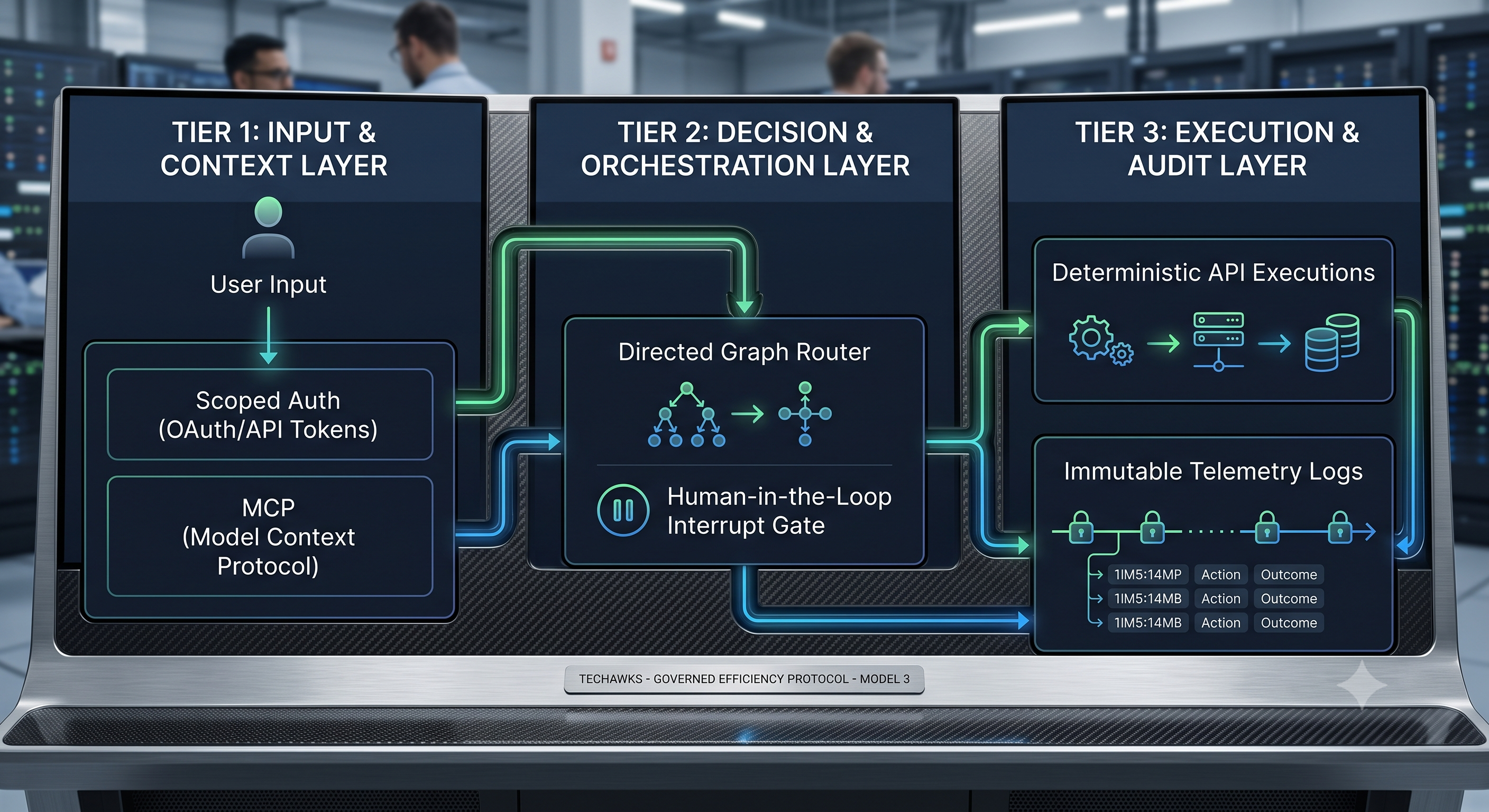
1. Explicit Autonomy Boundaries (Deterministic Routing)
Never let an agent guess what it is allowed to execute. Split your actions into two distinct categories:
Safe Actions (Autonomous): Read-only queries, internal drafting, log filtering, data indexing.
Impact Actions (Gated): External emails, customer-facing refunds, schema mutations, payments.
Every impact action must hit a deterministic state machine with a human-in-the-loop (HITL) interrupt before execution.
2. Scoped Delegation over Omnipresent Access
Enterprise CISOs reject agents that request broad API tokens. Build your product around protocols like MCP (Model Context Protocol) or per-tenant OAuth token scoping. If an agent only needs to draft an update in a CRM, it must never carry write permissions to the billing module.
3. Immutable Telemetry & Replayability
You cannot sell an enterprise "black box". Your system needs:
Full trace logs of every reasoning step and tool call.
State checkpointing that allows engineering teams to pause, inspect, and replay any failed run without re-running entire workflows.
The Founder Takeaway:
Stop pitching "unlimited autonomous intelligence." Pitch governed efficiency with zero unmonitored blast radius. That is what gets procurement signatures.
Discussion Question
For technical founders: Are you building human-in-the-loop approval gates directly inside your core product workflows, or treating observability as a post-launch add-on?
CTA
Join Startup Founders & EntrepreneursConnect with hundreds of early-stage operators, access actionable playbooks, and master enterprise-ready product architecture. Join the Techawks Startups community today
We are witnessing a massive transition in B2B software: the shift from generative copilot sidebars to autonomous workflow execution.
Industry research projects that by year-end, over 40% of enterprise business suites will incorporate autonomous workflow agents. Yet, founders consistently run into the same wall when closing mid-market and enterprise deals: Decision Paralysis & Trust Deficits.
Why? Because when a chatbot hallucinates, a user chuckles. When an autonomous agent hallucinates a database write, an API trigger, or a customer discount, someone gets fired.If you want enterprise buyers to sign five- and six-figure contracts for agentic systems, you must design for verifiability and governance from day zero.
The 3-Layer Architecture Enterprise Buyers Actually Sign Off On
1. Explicit Autonomy Boundaries (Deterministic Routing)
Never let an agent guess what it is allowed to execute. Split your actions into two distinct categories:
Safe Actions (Autonomous): Read-only queries, internal drafting, log filtering, data indexing.
Impact Actions (Gated): External emails, customer-facing refunds, schema mutations, payments.
Every impact action must hit a deterministic state machine with a human-in-the-loop (HITL) interrupt before execution.
2. Scoped Delegation over Omnipresent Access
Enterprise CISOs reject agents that request broad API tokens. Build your product around protocols like MCP (Model Context Protocol) or per-tenant OAuth token scoping. If an agent only needs to draft an update in a CRM, it must never carry write permissions to the billing module.
3. Immutable Telemetry & Replayability
You cannot sell an enterprise "black box". Your system needs:
Full trace logs of every reasoning step and tool call.
State checkpointing that allows engineering teams to pause, inspect, and replay any failed run without re-running entire workflows.
The Founder Takeaway:
Stop pitching "unlimited autonomous intelligence." Pitch governed efficiency with zero unmonitored blast radius. That is what gets procurement signatures.
Discussion Question
For technical founders: Are you building human-in-the-loop approval gates directly inside your core product workflows, or treating observability as a post-launch add-on?
CTA
Join Startup Founders & EntrepreneursConnect with hundreds of early-stage operators, access actionable playbooks, and master enterprise-ready product architecture. Join the Techawks Startups community today
Why 80% of Enterprise "AI Agent" Pilots Fail Before Production (And the 3-Layer Fix)
We are witnessing a massive transition in B2B software: the shift from generative copilot sidebars to autonomous workflow execution.
Industry research projects that by year-end, over 40% of enterprise business suites will incorporate autonomous workflow agents. Yet, founders consistently run into the same wall when closing mid-market and enterprise deals: Decision Paralysis & Trust Deficits.
Why? Because when a chatbot hallucinates, a user chuckles. When an autonomous agent hallucinates a database write, an API trigger, or a customer discount, someone gets fired.If you want enterprise buyers to sign five- and six-figure contracts for agentic systems, you must design for verifiability and governance from day zero.
The 3-Layer Architecture Enterprise Buyers Actually Sign Off On
1. Explicit Autonomy Boundaries (Deterministic Routing)
Never let an agent guess what it is allowed to execute. Split your actions into two distinct categories:
Safe Actions (Autonomous): Read-only queries, internal drafting, log filtering, data indexing.
Impact Actions (Gated): External emails, customer-facing refunds, schema mutations, payments.
Every impact action must hit a deterministic state machine with a human-in-the-loop (HITL) interrupt before execution.
2. Scoped Delegation over Omnipresent Access
Enterprise CISOs reject agents that request broad API tokens. Build your product around protocols like MCP (Model Context Protocol) or per-tenant OAuth token scoping. If an agent only needs to draft an update in a CRM, it must never carry write permissions to the billing module.
3. Immutable Telemetry & Replayability
You cannot sell an enterprise "black box". Your system needs:
Full trace logs of every reasoning step and tool call.
State checkpointing that allows engineering teams to pause, inspect, and replay any failed run without re-running entire workflows.
The Founder Takeaway:
Stop pitching "unlimited autonomous intelligence." Pitch governed efficiency with zero unmonitored blast radius. That is what gets procurement signatures.
Discussion Question
For technical founders: Are you building human-in-the-loop approval gates directly inside your core product workflows, or treating observability as a post-launch add-on?
CTA
Join Startup Founders & EntrepreneursConnect with hundreds of early-stage operators, access actionable playbooks, and master enterprise-ready product architecture. Join the Techawks Startups community today

 Arabic
 French
 Spanish
 Portuguese
 Deutsch
 Turkish
 Dutch
Dutch
 Italiano
 Russian
 Romaian
 Portuguese (Brazil)
 Greek
Greek